Topics
Commercial Mathematics
Compound Interest
- Compound Interest as a Repeated Simple Interest Computation with a Growing Principal
- Use of Compound Interest in Computing Amount Over a Period of 2 Or 3-years
- Use of Formula
- Finding CI from the Relation CI = A – P
Goods and Services Tax (G.S.T.)
- Tax and Its Computation
- Mathematical Study of GST (Goods and Services Tax)
- Types of GST in Mathematics
- Computational Mechanisms under GST
- GST in Trading Chain
- E-way Bill in GST Sums
- Examples based on GST Calculations
Algebra
Banking
Geometry
Shares and Dividends
Linear Inequations
Mensuration
Quadratic Equations
Trigonometry
Ratio and Proportion
Statistics
Probability
Factorisation of Polynomials
- Function and Polynomial
- Division Algorithm for Polynomials
- Remainder Theorem
- Factor Theorem
- Applications of Factor Theorem
Matrices
Arithmetic and Geometric Progression
Co-ordinate Geometry
- Foundation of Coordinate Geometry
- Advanced Concept of Reflection in Mathematics
- Invariant Points
- Combination of Reflections
- Using Graph Paper for Reflection
Similarity
Symmetry
Loci
- Locus
- Points Equidistant from Two Given Points
- Points Equidistant from Two Intersecting Lines
- Summary of Important Results on Locus
- Important Points on Concurrency in a Triangle
Circles
Tangent and Secant Properties
Constructions
Area and Volume of Solids (Cylinder, Cone and Sphere)
- Mensuration of Cylinder
- Hollow Cylinder
- Mensuration of Cones
- Mensuration of a Sphere
- Hemisphere
- Conversion of Solids
- Solid Figures
- Problems on Mensuration
Trigonometrical Identities
Heights and Distances
- Angles of Elevation and Depression
- Problems based on Elevation and Depression
Statistics : basic concepts, Mean, Median, Mode. Histograms and Ogive
Probability
- Definition: Cylinder
- Properties of a Cylinder
- Activity 1
- Activity 2
Definition: Cylinder
A cylinder is a three-dimensional solid figure that has two identical circular bases joined by a curved surface at a particular distance from its centre, which is its height.
Parts of Cylinder
- Faces: A cylinder has 3 faces in total (2 flat circular faces + 1 curved face)
- Edges: A cylinder has 2 edges (one at the top and one at the bottom)
- Vertices: A cylinder has 0 vertices (as the two edges of the cylinder never meet anywhere)

Formula: Cylinder
Curved surface area of a cylinder = circumference of base × height
= 2πrh
Total surface area = Curved surface area + 2 (Area of cross-section)
= 2πrh + 2πr2
= 2πr(r + h)
Volume = Area of cross-section × height (or, length)
= πr2h
Properties of a Cylinder
- A cylinder has one curved surface and two flat faces, which are identical.
- The two circular bases are congruent with each other.
- Its size depends on the radius of the base and the height of the curved surface.
- Unlike a cone, cube, or cuboid, a cylinder does not have any vertices. This means that a cylinder has no corners.
- The base and the top of the cylinder are identical, i.e., it has the same base — either circular or elliptical.
Activity 1
Making a Hollow Cylinder
Steps:
- Take a rectangular sheet of paper.
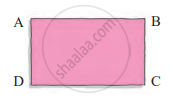
- Bring together its opposite sides (join side AB to DC).
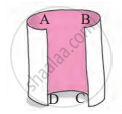
- Tape or glue the sides together.
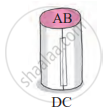
Observation:
- The paper takes the shape of a hollow cylinder (open at both ends).
Conclusion:
- A hollow cylinder can be formed by rolling a rectangular sheet and joining its opposite edges.
Activity 2
Steps:
- Take a cylindrical tin and a rectangular sheet (one side equal to the height of the tin).
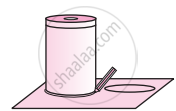
- Wrap the sheet around the tin to cover it completely.
- Mark and cut off extra paper, then unfold the sheet and lay it flat — this is the side of the cylinder.
- Take another sheet and trace two circles using the base of the tin.
- Cut out the two circles.
- Place the two circular cut-outs beside the rectangle.
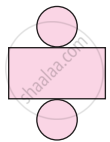
Observation:
- You get one rectangle (side face) and two circles (top and bottom faces).
- This set forms the net of a closed cylinder.
Conclusion:
- A closed cylinder is made of one rectangle (curved surface) and two circles (flat circular faces).
- By joining these shapes together, we can form a 3D closed cylinder.
Example
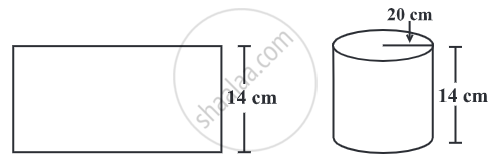
A rectangular paper of width 14 cm is rolled along its width and a cylinder of radius 20 cm is formed. Find the volume of the cylinder. (Take `22/7` for π)
Example
Example
In a building, there are 24 cylindrical pillars. For each pillar, the radius is 28 m, and the height is 4 m. Find the total cost of painting the curved surface area of the pillars at the rate of ₹ 8 per m2.
