Topics
Set Language
- Concept of Sets
- Representation of a Set
- Types of Sets
- Properties of Set Operations
- De Morgan’s Laws
- Cardinality of a Set
Real Numbers
- Rational Numbers
- Denseness Property of Rational Numbers
- Irrational Numbers and Proof of Irrationality
- Representation of Irrational Numbers on the Number Line
- Decimal Representation of Rational Numbers
- Period of Decimal
- Conversion of Terminating Decimals into Rational Numbers
- Conversion of Non-terminating and Recurring Decimals into Rational Numbers
- Decimal Representation to Identify Irrational Numbers
- Concept of Real Numbers
- Representing Real Numbers on the Number Line
- Radical Notation
- Fractional Index
- Surds
- Order of a Surd
- Laws of Radicals
- Operations on Surds
- Rationalisation of Surds
- Scientific Notation
- Converting Scientific Notation to Decimal Form
- Arithmetic of Numbers in Scientific Notation
Algebra
- Algebraic Expressions
- Basic Concept of Polynomial and its Degree
- Standard Form of a Polynomial
- Degree of Polynomial
- Types of Polynomials
- Arithmetic of Polynomials
- Addition of Polynomials
- Subtraction of Polynomials
- Multiplication of Two Polynomials
- Zeroes of a Polynomial
- Zeroes of a Polynomial
- Remainder Theorem
- Factor Theorem
- Concept of Identity
- Expansion of (a + b)2 = a2 + 2ab + b2
- Expansion of (a - b)2 = a2 - 2ab + b2
- Expansion of (a + b)(a - b) = a2-b2
- Expansion of (x + a)(x + b)
- Expansion of (a + b + c)2
- Expansion of (x + a)(x + b)(x + c)
- Expansion of (a + b)3
- Expansion of (a - b)3
- Factorisation Using Identities
- Factorisation Using Identity a2 + 2ab + b2 = (a + b)2
- Factorisation Using Identity a2 - 2ab + b2 = (a - b)2
- Factorisation Using Identity a2 - b2 = (a + b)(a - b)
- Factorisation using Identity a2 + b2 + c2 + 2ab + 2bc + 2ac = (a + b + c)2
- Factorisation using Identity a3 + b3 = (a + b)(a2 - ab + b2)
- Factorisation using Identity a3 - b3 = (a - b)(a2 + ab + b2)
- Factorisation using Identity a3 + b3 + c3 - 3abc = (a + b + c)(a2 + b2 + c2 - ab - bc - ca)
- Factorising the Quadratic Polynomial (Trinomial) of the type ax2 + bx + c, a ≠ 0.
- Division Algorithm for Polynomials
- Synthetic Division
- Highest Common Factor (HCF)
- Foundation of Linear Equations in Two Variables
- Simultaneous Linear Equations
- Comparing the Ratios of Coefficients of a Linear Equation
- Graphical Method with Different Cases of Solution
- Methods of Solving Simultaneous Linear Equations by Substitution
- Methods of Solving Simultaneous Linear Equations by Elimination Method
- Methods of Solving Simultaneous Linear Equations by Cross Multiplication Method
- Consistency and Inconsistency of Linear Equations in Two Variables
- Zeroes of a Polynomial
Geometry
- Angles and Their Measurement in Higher Mathematics
- Types of Angles
- Concept for Angle Sum Property
- Related Angles
- Trigonometrical Ratios of Complementary Angles
- Supplementary Angles
- Concept of Linear Pair
- Concept of Pairs of Angles
- Concept of Transversal Lines
- Basic Concepts of Triangles
- Criteria for Congruence of Triangles
- Criteria for Similarity of Triangles
- SAS Congruence Criterion
- ASA Congruence Criterion
- RHS Congruence Criterion
- Types of Quadrilaterals
- Properties of a Square
- Properties of Rectangle
- Properties of a Parallelogram
- Properties of Rhombus
- Properties of Trapezium
- Properties of Isosceles Trapezium
- Properties of Kite
- Theorem: In a Parallelogram, Opposite Sides Are Equal.
- Theorem: A Diagonal of a Parallelogram Divides It into Two Congruent Triangles.
- Property: The Opposite Sides of a Parallelogram Are of Equal Length.
- Property: The diagonals of a parallelogram bisect each other. (at the point of their intersection)
- Theorem: Parallelograms on the Same Base and Between the Same Parallels.
- Corollary: Triangles on the same base and between the same parallels are equal in area.
- Corollary: A rectangle and a parallelogram on the same base and between the same parallels are equal in area.
- Basic Concept of Circle
- Congruence of Circles
- Circles Passing Through One, Two, Three Points
- Chord
- Angle Subtended by an Arc of a Circle
- Angle at the Centre and the Circumference
- Arc of the Circle
- Theorems on Angles in a Circle
- Cyclic Quadrilateral and Concyclic Points
- Construction of the Centroid of a Triangle
- Construction of Orthocentre of a Triangle
- Circumcircle of a Triangle
- Incircle of a Triangle
Coordinate Geometry
- Concept for Mapping the Space Around Approximately Through Visual Estimation.
- Plotting a Point in the Plane If Its Coordinates Are Given.
- Cartesian Coordinate System
- Co-ordinates of Points and Distance
- Mid-Point Formula
- Points of Trisection
- Section Formula in Coordinate Geometry
- The Coordinates of the Centroid
Trigonometry
Mensuration
- Area of a Triangle by Heron's Formula
- Application of Heron’s Formula in Finding Areas of Quadrilaterals
- Surface Area of a Cuboid
- Surface Area of a Cube
- Volume of a Cuboid
- Volume of Cube
- Geometric Interpretation of the Area of a Triangle
Statistics
- Frequency Distribution Table
- Measures of Central Tendency for Different Data Types
- Arithmetic Mean
- Mean of Grouped Data
- A Special Property of the Arithmetic Mean
- Basic Concept of Median
- Basic Concept of Mode
- Empirical Relationship Between the Three Measures of Central Tendency
Probability
- Definition: Points of Trisection
- Examples
CISCE: Class 10
Definition: Points of Trisection
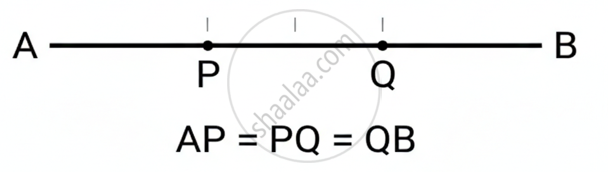
Let points P and Q lie on line segment AB and divide it into three equal parts, i.e., AP = PQ = QB; then P and Q are called points of trisection of AB.