Topics
Rational Numbers
- Rational Numbers
- Addition of Rational Number
- Subtraction of Rational Number
- Multiplication of Rational Numbers
- Division of Rational Numbers
- Rational Numbers on a Number Line
- Inserting Rational Numbers Between Two Given Rational Numbers
- Method of Finding a Large Number of Rational Numbers Between Two Given Rational Numbers
Number System
Ratio and Proportion
Exponents
- Concept of Exponents
- Law of Exponents (For Integral Powers)
- Negative Integral Exponents
- More About Exponents
Squares and Square Root
- Concept of Square Roots
- Finding Square Root by Division Method
- Finding Square Root Through Prime Factorisation
- To Find the Square Root of a Number Which is Not a Perfect Square (Using Division Method)
- Properties of Square Numbers
Algebra
Cubes and Cube Roots
Geometry
Mensuration
Playing with Numbers
- Arranging the Objects in Rows and Columns
- Generalized Form of Numbers
- Some Interesting Properties
- Letters for Digits (Cryptarithms)
- Divisibility by 10
- Divisibility by 2
- Divisibility by 5
- Divisibility by 3
- Divisibility by 6
- Divisibility by 11
- Divisibility by 4
Sets
- Concept of Sets
- Representation of a Set
- Cardinality of a Set
- Types of Sets
- Subset
- Proper Subset
- Super Set
- Universal Set
- Complement of a Set
- Difference of Two Sets
- Distributive Laws
- Venn Diagrams
Data Handling (Statistics)
Percent and Percentage
Profit, Loss and Discount
- Overhead Expenses
- To Find S.P., When C.P. and Gain (Or Loss) Percent Are Given
- To Find C.P., When S.P. and Gain (Or Loss) Percent Are Given
- Concept of Discount
Interest
- Calculation of Interest
- Concept of Compound Interest
- To Find the Principle (P); the Rate Percent (R) and the Time
- Interest Compounded Half Yearly
- Applications of Compound Interest Formula
Direct and Inverse Variations
- Types of Variation
- Unitary Method
- Concept of Arrow Method
- Time and Work
Algebraic Expressions
- Algebraic Expressions
- Degree of Polynomial
- Factors and Common Factors
- Classification of Terms in Algebra
- Combining like Terms
- Multiplying Monomial by Monomials
- Multiplying a Monomial by a Polynomial
- Multiplying a Polynomial by a Polynomial
- Dividing a Monomial by a Monomial
- Dividing a Polynomial by a Monomial
- Dividing a Polynomial by a Polynomial
- Simplification of Expressions
Identities
- Algebraic Identities
- Product of Sum and Difference of Two Terms
- Expansion Form of Numbers
- Important Formula of Expansion
- Cubes of Binomials
- Application of Formulae
Factorisation
- Factorisation by Taking Out Common Factors
- Factorisation by Taking Out Common Factors
- Factorisation by Grouping
- Factorisation by Difference of Two Squares
- Factorisation of Trinomials
- Factorising a Perfect Square Trinomial
- Factorising Completely
Linear Equations in One Variable
Linear Inequations
- Pair of Linear Equations in Two Variables
- Replacement Set and Solution Set
- Operation of Whole Numbers on Number Line
- Concept of Properties
Understanding Shapes
Special Types of Quadrilaterals
Constructions
- Introduction of Constructions
- Construction of an Angle
- To Construct an Angle Equal to Given Angle
- To Draw the Bisector of a Given Angle
- Construction of an Angle Bisector: 30°, 45°, 60°, 90°
- Construction of Bisector of a Line
- The Perpendicular Bisector
- Construction of Parallel Lines
- Constructing a Quadrilateral
- Construction of Parallelograms
- Construction of a Rectangle When Its Length and Breadth Are Given.
- Construction of Rhombus
- Square: Properties and Construction
- Reflection Symmetry (Mirror Symmetry)
Representing 3-D in 2-D
- 2dimensional Perspective of 3dimensional Objects
- Concept of Polyhedron
- Faces, Edges and Vertices of Polyhedron
- Euler's Formula
- Concept of Polyhedron
- Nets of 3D Figures
Symmetry
Circles
Area of a Trapezium and a Polygon
Surface Area, Volume and Capacity
Data Handling
- Mathematical Data Collection and Organisation
- Frequency
- Raw Data, Arrayed Data and Frequency Distribution
- Cumulative Frequency and Cumulative Frequency Table
- Frequency Distribution Table
- Class Intervals and Class Limits
- Frequency Distribution and Its Applications
Probability
- Introduction
- Definition: Sets
- Well-defined and Not Well-defined Sets
- Elements of a Set and Notation
- Properties of Sets
- Examples
- Real-Life Applications
- Key Points Summary
CISCE: Class 6
Introduction
Have you ever grouped all your favourite comics, crayons of the same colour, or the red marbles from a box?
When you make a collection of similar things, you are creating a set in mathematics!
CISCE: Class 6
Definition: Set
A set is a well-defined collection of distinct objects or elements.
- Example 1: A collection of books.
- Example 2: A group of students
CISCE: Class 6
Well-defined and Not Well-defined Sets
Well-Defined Set:
A set is well-defined if it is clear which objects belong to the set and which do not.
- Example 1: "Lovely Flowers" is not well-defined because "lovely" is subjective.
- Example 2: "Red Flowers" is well-defined because the colour is clear.
Not a well-defined set:
- A set of nice toys — “nice” can mean different things to different people.
CISCE: Class 6
Elements of a Set and Notation
Elements of a set:
The objects inside a set are called elements or members of that set.
- A = {p, q, r, s, t}
- Here, A is the set and p, q, r, s, and t are its elements.
Symbols used in set theory:
- "∈" means "belongs to" or "is an element of".
- "∉" means "does not belong to" or "is not an element of".
Example:
- If p ∈ A, it means "p belongs to A".
CISCE: Class 6
Properties of Sets
- Order doesn't matter:
{1, 2, 3} = {3, 2, 1} - No repeated elements:
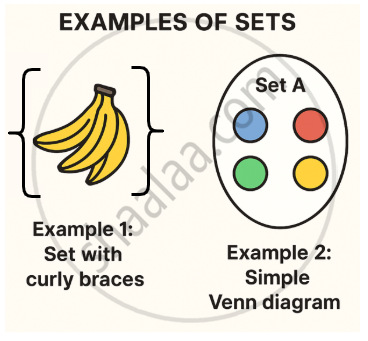
{a, a, b} = {a, b} - The elements of a set are written inside a pair of curly braces and separated by commas.
Example: A = {1, 2, 3, 4} - The set is represented by a capital letter.
Example: Set A = {1, 2, 3} - If the elements of a set are alphabets, these elements are written in small letters.
Example: Set B = {a, b, c}
CISCE: Class 6
Examples
1. Set of letters of the word “MEERUT”
- Set: {m, e, r, u, t}
2. Set of vowels in the word “MUSSOORIE”
- Set: {u, o, i, e}
CISCE: Class 6
Real-Life Applications
- Set of your friends who wear glasses.
- Set of the months with 31 days: {January, March, May, July, August, October, December}
- Set of books in your schoolbag.
CISCE: Class 6
Key Points Summary
| Word | Meaning |
|---|---|
| Set | Group of things with a common property |
| Element | Each thing in the set |
| Well-defined | Everyone knows what is in the set |
| ∈ | “is an element of” or “belongs to” |
| ∉ | “is not an element of” or “does not belong to” |
