Topics
Rational Numbers
- Rational Numbers
- Addition of Rational Number
- Subtraction of Rational Number
- Multiplication of Rational Numbers
- Division of Rational Numbers
- Rational Numbers on a Number Line
- Inserting Rational Numbers Between Two Given Rational Numbers
- Method of Finding a Large Number of Rational Numbers Between Two Given Rational Numbers
Number System
Ratio and Proportion
Exponents
- Concept of Exponents
- Law of Exponents (For Integral Powers)
- Negative Integral Exponents
- More About Exponents
Squares and Square Root
- Concept of Square Roots
- Finding Square Root by Division Method
- Finding Square Root Through Prime Factorisation
- To Find the Square Root of a Number Which is Not a Perfect Square (Using Division Method)
- Properties of Square Numbers
Algebra
Cubes and Cube Roots
Geometry
Mensuration
Playing with Numbers
- Arranging the Objects in Rows and Columns
- Generalized Form of Numbers
- Some Interesting Properties
- Letters for Digits (Cryptarithms)
- Divisibility by 10
- Divisibility by 2
- Divisibility by 5
- Divisibility by 3
- Divisibility by 6
- Divisibility by 11
- Divisibility by 4
Sets
- Concept of Sets
- Representation of a Set
- Cardinality of a Set
- Types of Sets
- Subset
- Proper Subset
- Super Set
- Universal Set
- Complement of a Set
- Difference of Two Sets
- Distributive Laws
- Venn Diagrams
Data Handling (Statistics)
Percent and Percentage
Profit, Loss and Discount
- Overhead Expenses
- To Find S.P., When C.P. and Gain (Or Loss) Percent Are Given
- To Find C.P., When S.P. and Gain (Or Loss) Percent Are Given
- Concept of Discount
Interest
- Calculation of Interest
- Concept of Compound Interest
- To Find the Principle (P); the Rate Percent (R) and the Time
- Interest Compounded Half Yearly
- Applications of Compound Interest Formula
Direct and Inverse Variations
- Types of Variation
- Unitary Method
- Concept of Arrow Method
- Time and Work
Algebraic Expressions
- Algebraic Expressions
- Degree of Polynomial
- Factors and Common Factors
- Classification of Terms in Algebra
- Combining like Terms
- Multiplying Monomial by Monomials
- Multiplying a Monomial by a Polynomial
- Multiplying a Polynomial by a Polynomial
- Dividing a Monomial by a Monomial
- Dividing a Polynomial by a Monomial
- Dividing a Polynomial by a Polynomial
- Simplification of Expressions
Identities
- Algebraic Identities
- Product of Sum and Difference of Two Terms
- Expansion Form of Numbers
- Important Formula of Expansion
- Cubes of Binomials
- Application of Formulae
Factorisation
- Factorisation by Taking Out Common Factors
- Factorisation by Taking Out Common Factors
- Factorisation by Grouping
- Factorisation by Difference of Two Squares
- Factorisation of Trinomials
- Factorising a Perfect Square Trinomial
- Factorising Completely
Linear Equations in One Variable
Linear Inequations
- Pair of Linear Equations in Two Variables
- Replacement Set and Solution Set
- Operation of Whole Numbers on Number Line
- Concept of Properties
Understanding Shapes
Special Types of Quadrilaterals
Constructions
- Introduction of Constructions
- Construction of an Angle
- To Construct an Angle Equal to Given Angle
- To Draw the Bisector of a Given Angle
- Construction of an Angle Bisector: 30°, 45°, 60°, 90°
- Construction of Bisector of a Line
- The Perpendicular Bisector
- Construction of Parallel Lines
- Constructing a Quadrilateral
- Construction of Parallelograms
- Construction of a Rectangle When Its Length and Breadth Are Given.
- Construction of Rhombus
- Square: Properties and Construction
- Reflection Symmetry (Mirror Symmetry)
Representing 3-D in 2-D
- 2dimensional Perspective of 3dimensional Objects
- Concept of Polyhedron
- Faces, Edges and Vertices of Polyhedron
- Euler's Formula
- Concept of Polyhedron
- Nets of 3D Figures
Symmetry
Circles
Area of a Trapezium and a Polygon
Surface Area, Volume and Capacity
Data Handling
- Mathematical Data Collection and Organisation
- Frequency
- Raw Data, Arrayed Data and Frequency Distribution
- Cumulative Frequency and Cumulative Frequency Table
- Frequency Distribution Table
- Class Intervals and Class Limits
- Frequency Distribution and Its Applications
Probability
- Construction of an Angle 30°
- Construction of an Angle 45°
- Construction of an Angle 60°
- Construction of an Angle 90°
Maharashtra State Board: Class 6
Construction of an angle bisector of an Angles of 30° and 45°
(1) Construction of an angle bisector of 30°:
Steps:
1. Draw angle ABC = 60°.
- Draw a line segment BC of any suitable length.
- With B as the centre. Draw an arc of any suitable radius that cuts BC at point D.
- With D as the centre and the same radius as taken in step 2, draw one more arc that cuts the previous arc at point E.
- Join BE and produce to any point A.
: ∠ ABC so obtained is of 60°, i.e., ∠ABC = 60°.
2. Construction of an angle bisector
Draw BP, the bisector of ∠ABC.
:. ∠PBC = `1/2`∠ ABC = `1/2` × 60° = 300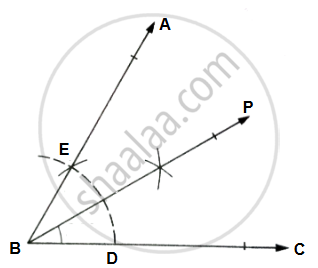 (2) Construction of an angle bisector of 45°:
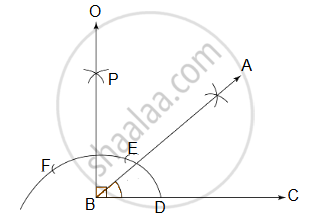
Steps:
1. Draw angle OBC = 90°
- Draw a line segment BC of any length.
- With B as the centre, draw an arc that cuts BC at point D.
- With D as the centre, draw an arc of the same radius to cut the first arc at E.
- With E as centre, draw another arc (same radius) to cut the first arc at F.
- With E and F as centres and a radius of more than half of EF, draw arcs intersecting at point P.
- Join BP and extend it to get point A.
∠ABC so obtained is of 90 0 i.e., ∠ABC = 900.
2. Construction of an angle bisector
- Draw a line segment BC of any suitable length.
- Construct angle OBC = 900
- Draw BA, the bisector of angle OBC.
∠ ABC so obtained is the angle of 45°.