Topics
Part 1
Fractions in Disguise
Rational Numbers
- Rational Numbers
- Closure Property of Rational Numbers
- Commutative Property of Rational Numbers
- Associative Property of Rational Numbers
- Distributive Property of Multiplication Over Addition for Rational Numbers
- Identity of Addition and Multiplication of Rational Numbers
- Negative Or Additive Inverse of Rational Numbers
- Concept of Reciprocals or Multiplicative Inverses
- Rational Numbers on a Number Line
- Rational Numbers Between Two Rational Numbers
- Multiples and Common Multiples
A Square and A Cube
Linear Equations in One Variable
- Constants and Variables in Mathematics
- Equation in Mathematics
- Expressions with Variables
- Word Problems on Linear Equations
- Solving Equations Which Have Linear Expressions on One Side and Numbers on the Other Side
- Some Applications Solving Equations Which Have Linear Expressions on One Side and Numbers on the Other Side
- Solving Equations Having the Variable on Both Sides
- Some More Applications on the Basis of Solving Equations Having the Variable on Both Sides
- Reducing Equations to Simpler Form
- Equations Reducible to Linear Equations
The Baudhayana-Pythagoras Theorem
Power Play
Part 2
Understanding Quadrilaterals
- Concept of Curves
- Different Types of Curves - Closed Curve, Open Curve, Simple Curve.
- Basic Concept of Polygons
- Classification of Polygons
- Properties of Quadrilateral
- Sum of Interior Angles of a Polygon
- Sum of Exterior Angles of a Polygon
- Quadrilaterals
- Properties of Trapezium
- Properties of Kite
- Properties of a Parallelogram
- Properties of Rhombus
- Property: The Opposite Sides of a Parallelogram Are of Equal Length.
- Property: The Opposite Angles of a Parallelogram Are of Equal Measure.
- Property: The adjacent angles in a parallelogram are supplementary.
- Property: The diagonals of a parallelogram bisect each other. (at the point of their intersection)
- Property: The diagonals of a rhombus are perpendicular bisectors of one another.
- Property: The Diagonals of a Rectangle Are of Equal Length.
- Properties of Rectangle
- Properties of a Square
- Property: The diagonals of a square are perpendicular bisectors of each other.
A Story of Numbers
Proportional Reasoning-2
Exploring Some Geometric Themes
Practical Geometry
- Geometric Tool
- Constructing a Quadrilateral When the Lengths of Four Sides and a Diagonal Are Given
- Constructing a Quadrilateral When Two Diagonals and Three Sides Are Given
- Constructing a Quadrilateral When Two Adjacent Sides and Three Angles Are Known
- Constructing a Quadrilateral When Three Sides and Two Included Angles Are Given
- Some Special Cases
Data Handling
Quadrilaterals
Tales by Dots and Lines
Squares and Square Roots
- Concept of Square Number
- Properties of Square Numbers
- Some More Interesting Patterns of Square Number
- Finding the Square of a Number
- Concept of Square Roots
- Finding Square Root Through Repeated Subtraction
- Finding Square Root Through Prime Factorisation
- Finding Square Root by Division Method
- Square Root of Decimal Numbers
- Estimating Square Root
Number Play
Algebra Play
Cubes and Cube Roots
We Distribute, Yet Things Multiply
Area
Proportional Reasoning-1
Comparing Quantities
- Ratio
- Increase Or Decrease as Percent
- Concept of Discount
- Estimation in Percentages
- Basic Concepts of Profit and Loss
- Calculation of Interest
- Concept of Compound Interest
- Deducing a Formula for Compound Interest
- Rate Compounded Annually Or Half Yearly (Semi Annually)
- Applications of Compound Interest Formula
Algebraic Expressions and Identities
- Algebraic Expressions
- Terms, Factors and Coefficients of Expression
- Classification of Terms in Algebra
- Addition of Algebraic Expressions
- Subtraction of Algebraic Expressions
- Multiplication of Algebraic Expressions
- Multiplying Monomial by Monomials
- Multiplying a Monomial by a Binomial
- Multiplying a Monomial by a Trinomial
- Multiplying a Binomial by a Binomial
- Multiplying a Binomial by a Trinomial
- Concept of Identity
- Expansion of (a + b)2 = a2 + 2ab + b2
- Expansion of (a - b)2 = a2 - 2ab + b2
- Expansion of (a + b)(a - b) = a2-b2
- Expansion of (x + a)(x + b)
Mensuration
Exponents and Powers
Visualizing Solid Shapes
Direct and Inverse Proportions
Factorization
- Factors and Common Factors
- Factorising Algebraic Expressions
- Factorisation by Taking Out Common Factors
- Factorisation by Regrouping Terms
- Factorisation Using Identities
- Factors of the Form (x + a)(x + b)
- Dividing a Monomial by a Monomial
- Dividing a Polynomial by a Monomial
- Dividing a Polynomial by a Polynomial
- Concept of Find the Error
Introduction to Graphs
Playing with Numbers
- Introduction
- Faces, Edges, and Vertices
- Cuboid
- Cube
- Cylinder
- Sphere
- Cone
- Prism
- Triangular Pyramid
- Quadrilateral Pyramid
- Key Points Summary
Introduction
Have you ever wondered what makes a dice different from a ball, or why a soda can holds so much more than a box of the same height? The answer lies in Solid Geometry, the study of three-dimensional (3D) objects.
3D shapes have length, width, and height, giving them volume and allowing them to take up space in the real world. Understanding them is crucial, as they form the foundation for architecture, engineering, packaging, and even video game design.
Faces, Edges, and Vertices

|
Component |
Simple Term |
Definition |
|---|---|---|
|
Vertex (V) |
Corner |
A point where two or more edges meet. |
|
Edge (E) |
Line |
A line segment where two faces meet. |
|
Face (F) |
Surface/Side |
A flat surface (like a square or triangle) or a curved surface that forms the boundary of the solid. |
Cuboid
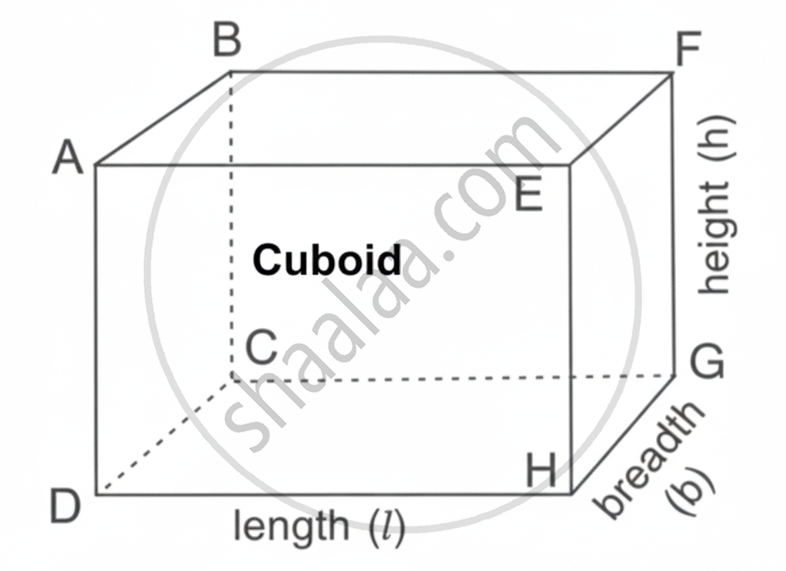
A cube is a special type of cuboid where all sides are equal. It is a symmetrical three-dimensional shape with:
-
Faces: 6 square faces (ABCD, ABFE, AEHD, CGHD, CGFB, and EFGH)
-
Edges: 12 edges (AB, BC, CD, DA, AE, EH, HD, EF, FG, GH, BF and CG)
-
Vertices: 8 corners (A, B, C, D, E, F, G, and H)
All faces are congruent (equal) squares, making length = breadth = height.
Cube
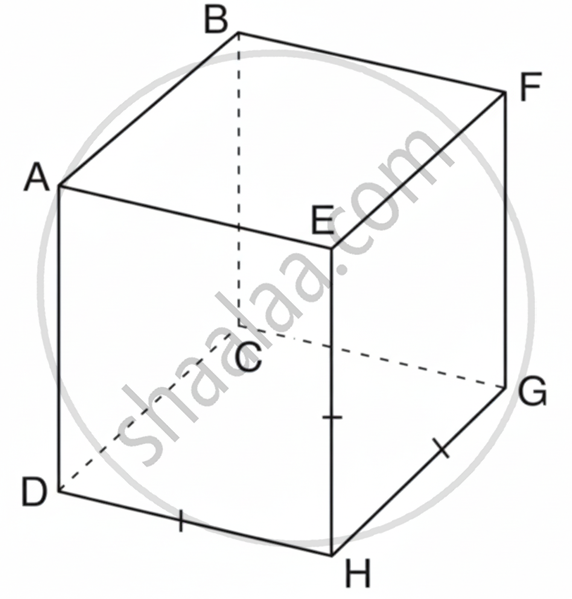
A cube is a special type of cuboid where all sides are equal. It is a symmetrical three-dimensional shape with:
-
Faces: 6 square faces (ABCD, ABFE, AEHD, CGHD, CGFB, and EFGH)
-
Edges: 12 edges (AB, BC, CD, DA, AE, EH, HD, EF, FG, GH, BF and CG)
-
Vertices: 8 corners (A, B, C, D, E, F, G, and H)
All faces are congruent (equal) squares, making length = breadth = height.
Cylinder
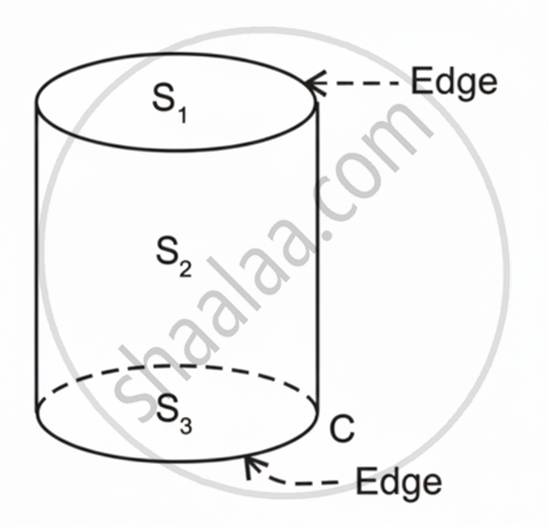
Has two equal circular ends and one curved surface.
-
Faces: S₁ (top), S₂ (bottom), S₃ (curved)
-
Edges: Two circular edges
-
Vertices: None
Sphere
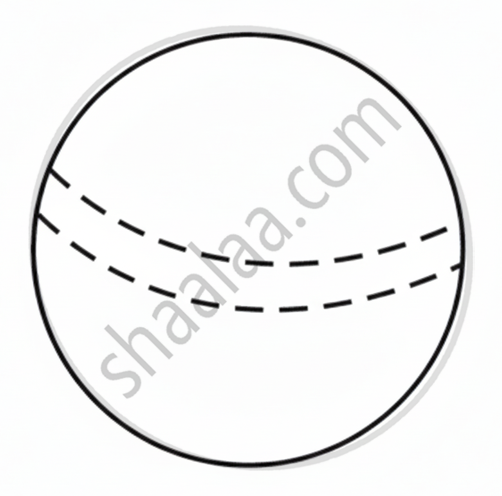
A sphere is a perfectly round solid where every point on its surface is equidistant from its center. It has:
-
Faces: 1 curved surface
-
Edges: 0 edges
-
Vertices: 0 vertices
The sphere is unique among 3D solids because it has no flat faces, edges, or corners—only a single continuous curved surface.
Cone
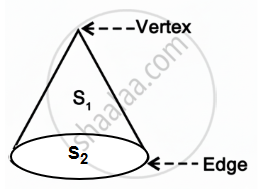
A cone is a solid that tapers from a circular base to a single point called the vertex (or apex). It consists of:
-
Faces: 2 surfaces (one circular base S2 and one curved surface S1)
-
Edges: 1 curved edge
-
Vertices: 1 vertex
The cone has one flat circular face at the bottom and a curved surface that narrows to a point at the top.
Prism
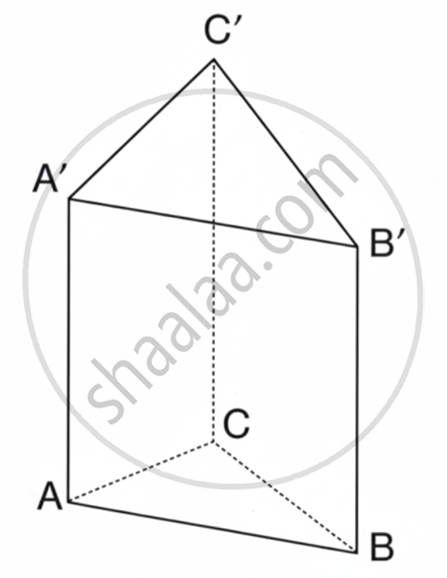
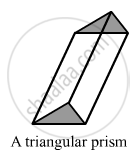
Has two triangular bases and three rectangular face
-
Faces: 3 side faces (AA'C'C, ABB'A', and BB'C'C) plus 2 triangular end faces (ABC and A'B'C')
-
Edges: 9 edges (AB, AC, BC, A'B', A'C', B'C', AA', BB', and CC')
-
Vertices: 6 vertices (A, B, C, A', B', and C')
The two triangular end faces are always parallel and congruent.
Triangular Pyramid
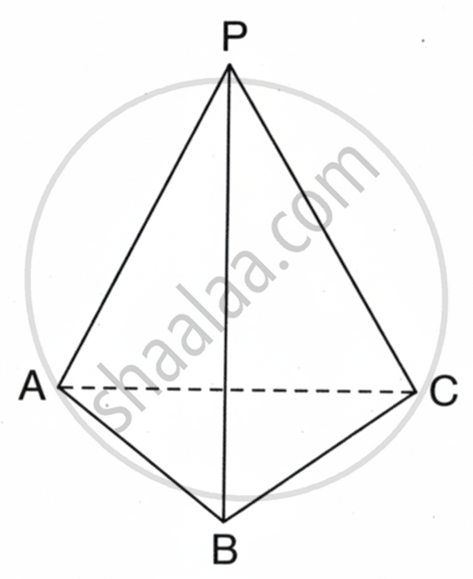
Has two triangular bases and three rectangular faces.
-
Faces: 4 triangular faces (triangular base ABC and three side faces PAB, PBC, and PAC)
-
Edges: 6 edges
-
Vertices: 4 vertices (including vertex P, the apex)
Quadrilateral Pyramid
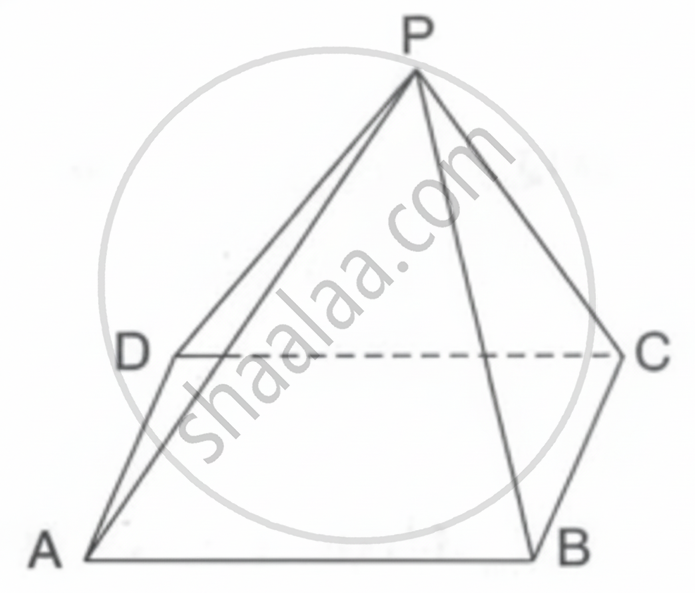
Has a quadrilateral base ABCD
-
Faces: 5 faces (quadrilateral base ABCD and four triangular side faces ΔPAB, ΔPBC, ΔPCD, and ΔPDA)
-
Edges: 8 edges
-
Vertices: 5 vertices (including vertex P, the apex)
Key Points Summary
| Shape | Faces | Edges | Vertices | Real-Life Examples |
|---|---|---|---|---|
| Cube | 6 | 12 | 8 | Dice, Ice cube, Rubik’s Cube |
| Cuboid | 6 | 12 | 8 | Book, Brick, Matchbox |
| Cylinder | 3 | 2 | 0 | Tin can, Pipe, Battery cell |
| Sphere | 1 | 0 | 0 | Ball, Light bulbs |
| Cone | 2 | 1 | 1 | Funnels, Party hat |
| Prism | 5 | 9 | 6 | Toblerone bar, Tent |
| Pyramid | 4–5 | 8–10 | 5 | Egyptian pyramid, Roof |