Topics
Part 1
Fractions in Disguise
Rational Numbers
- Rational Numbers
- Closure Property of Rational Numbers
- Commutative Property of Rational Numbers
- Associative Property of Rational Numbers
- Distributive Property of Multiplication Over Addition for Rational Numbers
- Identity of Addition and Multiplication of Rational Numbers
- Negative Or Additive Inverse of Rational Numbers
- Concept of Reciprocals or Multiplicative Inverses
- Rational Numbers on a Number Line
- Rational Numbers Between Two Rational Numbers
- Multiples and Common Multiples
A Square and A Cube
Linear Equations in One Variable
- Constants and Variables in Mathematics
- Equation in Mathematics
- Expressions with Variables
- Word Problems on Linear Equations
- Solving Equations Which Have Linear Expressions on One Side and Numbers on the Other Side
- Some Applications Solving Equations Which Have Linear Expressions on One Side and Numbers on the Other Side
- Solving Equations Having the Variable on Both Sides
- Some More Applications on the Basis of Solving Equations Having the Variable on Both Sides
- Reducing Equations to Simpler Form
- Equations Reducible to Linear Equations
The Baudhayana-Pythagoras Theorem
Power Play
Part 2
Understanding Quadrilaterals
- Concept of Curves
- Different Types of Curves - Closed Curve, Open Curve, Simple Curve.
- Basic Concept of Polygons
- Classification of Polygons
- Properties of Quadrilateral
- Sum of Interior Angles of a Polygon
- Sum of Exterior Angles of a Polygon
- Quadrilaterals
- Properties of Trapezium
- Properties of Kite
- Properties of a Parallelogram
- Properties of Rhombus
- Property: The Opposite Sides of a Parallelogram Are of Equal Length.
- Property: The Opposite Angles of a Parallelogram Are of Equal Measure.
- Property: The adjacent angles in a parallelogram are supplementary.
- Property: The diagonals of a parallelogram bisect each other. (at the point of their intersection)
- Property: The diagonals of a rhombus are perpendicular bisectors of one another.
- Property: The Diagonals of a Rectangle Are of Equal Length.
- Properties of Rectangle
- Properties of a Square
- Property: The diagonals of a square are perpendicular bisectors of each other.
A Story of Numbers
Proportional Reasoning-2
Exploring Some Geometric Themes
Practical Geometry
- Geometric Tool
- Constructing a Quadrilateral When the Lengths of Four Sides and a Diagonal Are Given
- Constructing a Quadrilateral When Two Diagonals and Three Sides Are Given
- Constructing a Quadrilateral When Two Adjacent Sides and Three Angles Are Known
- Constructing a Quadrilateral When Three Sides and Two Included Angles Are Given
- Some Special Cases
Data Handling
Quadrilaterals
Tales by Dots and Lines
Squares and Square Roots
- Concept of Square Number
- Properties of Square Numbers
- Some More Interesting Patterns of Square Number
- Finding the Square of a Number
- Concept of Square Roots
- Finding Square Root Through Repeated Subtraction
- Finding Square Root Through Prime Factorisation
- Finding Square Root by Division Method
- Square Root of Decimal Numbers
- Estimating Square Root
Number Play
Algebra Play
Cubes and Cube Roots
We Distribute, Yet Things Multiply
Area
Proportional Reasoning-1
Comparing Quantities
- Ratio
- Increase Or Decrease as Percent
- Concept of Discount
- Estimation in Percentages
- Basic Concepts of Profit and Loss
- Calculation of Interest
- Concept of Compound Interest
- Deducing a Formula for Compound Interest
- Rate Compounded Annually Or Half Yearly (Semi Annually)
- Applications of Compound Interest Formula
Algebraic Expressions and Identities
- Algebraic Expressions
- Terms, Factors and Coefficients of Expression
- Classification of Terms in Algebra
- Addition of Algebraic Expressions
- Subtraction of Algebraic Expressions
- Multiplication of Algebraic Expressions
- Multiplying Monomial by Monomials
- Multiplying a Monomial by a Binomial
- Multiplying a Monomial by a Trinomial
- Multiplying a Binomial by a Binomial
- Multiplying a Binomial by a Trinomial
- Concept of Identity
- Expansion of (a + b)2 = a2 + 2ab + b2
- Expansion of (a - b)2 = a2 - 2ab + b2
- Expansion of (a + b)(a - b) = a2-b2
- Expansion of (x + a)(x + b)
Mensuration
Exponents and Powers
Visualizing Solid Shapes
Direct and Inverse Proportions
Factorization
- Factors and Common Factors
- Factorising Algebraic Expressions
- Factorisation by Taking Out Common Factors
- Factorisation by Regrouping Terms
- Factorisation Using Identities
- Factors of the Form (x + a)(x + b)
- Dividing a Monomial by a Monomial
- Dividing a Polynomial by a Monomial
- Dividing a Polynomial by a Polynomial
- Concept of Find the Error
Introduction to Graphs
Playing with Numbers
Notes
Drawing a double Bar Graph:
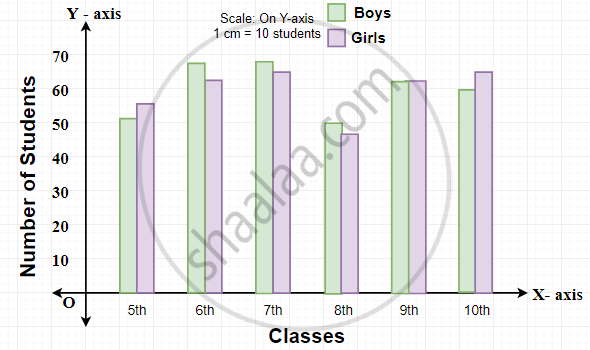
1) The number of boys and girls in a school is given. Draw a double bar graph to show this information.
| Class | 5th | 6th | 7th | 8th | 9th | 10th |
| Boys | 52 | 68 | 67 | 50 | 62 | 60 |
| Girls | 57 | 63 | 64 | 48 | 62 | 64 |
Solution:
Steps for drawing a Joint Bar Graph:
- On a graph paper, draw the X-axis and Y-axis and their point of intersection.
-
Keeping the distance between two sets of joint bars equal shows the classes on X-axis.
-
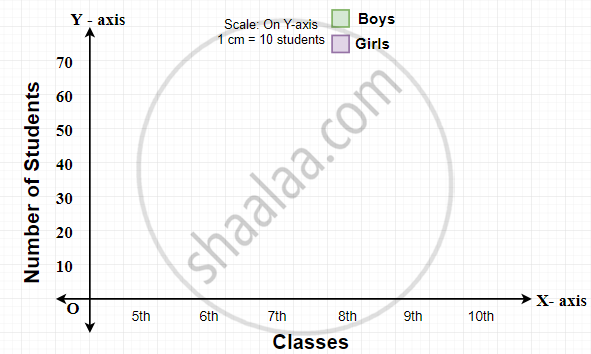
Choose a scale for the Y-axis. For example, 1 unit = 10 girls/boys. Mark the numbers of boys and girls on the Y-axis.
-
Using the scale, work out the height of columns required to show the numbers of boys and girls in each class. Use different colours to show the different bars in each set.
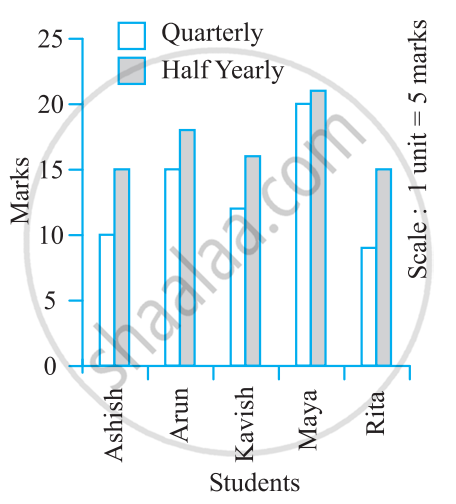
2) A mathematics teacher wants to see, whether the new technique of teaching she applied after a quarterly test was effective or not. She takes the scores of the 5 weakest children in the quarterly test (out of 25) and in the half-yearly test (out of 25):
| Students | Ashish | Arun | Kavish | Maya | Rita |
| Quarterly | 10 | 15 | 12 | 20 | 9 |
| Half-yearly | 15 | 18 | 16 | 21 | 15 |
To represent this data in the form of a double bar diagram, here are the steps.
- On a graph paper, draw the X-axis and Y-axis and their point of intersection.
- Keeping the distance between two sets of joint bars equal shows the students on X-axis.
- Choose a scale for the Y-axis. For example, 1 unit = 5 marks. Mark the numbers of marks on the Y-axis.
- Using the scale, work out the height of columns required to show the marks of quarterly and half-yearly of each student. Use different colours to show the different bars in each set.
Shaalaa.com | Drawing a Double Bar Graph
Related QuestionsVIEW ALL [7]
The table below shows the number of people who had different juices at a juice bar on a Saturday and a Sunday. Draw a joint bar graph for this data.
| Days | Fruits | Sweet Lim | Orange | Apple | Pineapple |
| Saturday | 43 | 30 | 56 | 40 | |
| Sunday | 59 | 65 | 78 | 67 | |
The percentage of literate people in the states of Maharashtra and Gujarat are given below. Draw a joint bar graph for this data.
| State | Year | 1971 | 1981 | 1991 | 2001 | 2011 |
| Maharashtra | 46 | 57 | 65 | 77 | 83 | |
| Gujarat | 40 | 45 | 61 | 69 | 79 | |
The maximum and minimum temperatures of five Indian cities are given in °C. Draw a joint bar graph for this data.
| Temperature | City | Delhi | Mumbai | Kolkata | Nagpur | Kapurthala |
| Maximum temperature | 35 | 32 | 37 | 41 | 37 | |
| Minimum temperature | 26 | 25 | 26 | 29 | 26 | |
The following numbers of votes were cast at 5 polling booths during the Gram Panchayat elections. Draw a joint bar graph for this data.
| Persons | Booth No. | 1 | 2 | 3 | 4 | 5 |
| Men | 200 | 270 | 560 | 820 | 850 | |
| Women | 700 | 240 | 340 | 640 | 470 | |
The numbers of children vaccinated in one day at the government hospitals in Solapur and Pune are given in the table. Draw a joint bar graph for this data.
| City | Vaccine | D.P.T. (Booster) |
Polio (Booster) |
Measles | Hepatitis |
| Solapur | 65 | 60 | 65 | 63 | |
| Pune | 89 | 87 | 88 | 86 | |
The number of saplings planted by schools on World Tree Day is given in the table below. Draw a joint bar graph to show these figures.
| School Name ↓ |
Name of sapling → | Almond | Karanj | Neem | Ashok | Gulmohar |
| Nutan Vidyalaya | 40 | 60 | 72 | 15 | 42 | |
| Bharat Vidyalaya | 42 | 38 | 60 | 25 | 40 | |
There are four polling booths for a certain election. The numbers of men and women who cast their vote at each booth is given in the table below. Draw a joint bar graph for this data.
| Polling Booths | Navodaya Vidyalaya |
Vidyaniketan School |
City High School | Eklavya School |
| Women | 500 | 520 | 680 | 800 |
| Men | 440 | 640 | 760 | 600 |
