Topics
Orienting Yourself: The Use of Coordinates
Number Systems
Number Systems
Part 1
Introduction to Polynomials
Introduction to Linear Polynomials
Part 2
Algebra
Algebraic Expressions
Algebraic Identities
Coordinate Geometry
The World of Numbers
Sequences and Progressions
Geometry
Exploring Algebraic Identities
Exploring Algebraic Identities
Area
Constructions
- Introduction of Constructions
- Geometric Constructions
- Some Constructions of Triangles
I’m Up and Down, and Round and Round
Mensuration
Linear Equations in Two Variables
Statistics and Probability
Coordinate Geometry
Measuring Space: Perimeter and Area
Probability
Introduction to Euclid’s Geometry: Axioms and Postulates
The Mathematics of Maybe: Introduction to Probability
Lines and Angles
- Introduction to Lines and Angles
- Basic Terms and Definitions
- Intersecting Lines and Non-intersecting Lines
- Parallel Lines
- Concept of Pairs of Angles
- Concept of Transversal Lines
- Basic Properties of a Triangle
Predicting What Comes Next: Exploring Sequences
Triangles: Congruence Theorems
4-gons (Quadrilaterals)
- Properties of Quadrilateral
- Another Condition for a Quadrilateral to Be a Parallelogram
- Theorem of Midpoints of Two Sides of a Triangle
- Property: The Opposite Sides of a Parallelogram Are of Equal Length.
- Theorem: A Diagonal of a Parallelogram Divides It into Two Congruent Triangles.
- Theorem : If Each Pair of Opposite Sides of a Quadrilateral is Equal, Then It is a Parallelogram.
- Property: The Opposite Angles of a Parallelogram Are of Equal Measure.
- Theorem: If in a Quadrilateral, Each Pair of Opposite Angles is Equal, Then It is a Parallelogram.
- Property: The diagonals of a parallelogram bisect each other. (at the point of their intersection)
- Theorem : If the Diagonals of a Quadrilateral Bisect Each Other, Then It is a Parallelogram
Circles
Area and Perimeter
- Area of a Triangle by Heron's Formula
- Application of Heron’s Formula in Finding Areas of Quadrilaterals
- Geometric Interpretation of the Area of a Triangle
Surface Area and Volume
Statistics
Introduction to Probability
- Introduction
- Definition: Circle
- Definition: Radius
- Definition: Diameter
- Definition: Chord
- Example
- Real-Life Applications
- Key Points Summary
Introduction
Have you ever wondered why bicycle wheels are always perfectly round? Or why a pizza slice is always cut from the center? Circles are everywhere! They are one of the most fundamental and perfect shapes in geometry.
This note will help you understand the simple rules and parts that make up a circle. Getting these concepts right is the key to mastering geometry!
Definition: Circle
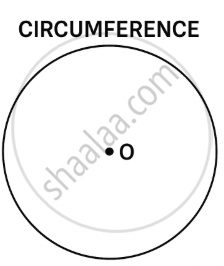
A circle is a closed curve where all points on the boundary (called the circumference) are at the same distance from a fixed point inside it.
-
The fixed point inside the circle is called the center (O)
Definition: Radius
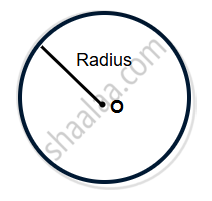
The radius is a straight line segment that connects the center of the circle to any point on its circumference.
Characteristics:
-
Symbol: Usually represented as r
-
All radii of a circle have the same length
-
A circle has infinite radii (one to every point on the circumference)
-
The radius is always half the diameter
- Radius = `"Diameter"/"2"`
Definition: Diameter
The diameter is a straight line segment that passes through the center of the circle and has both endpoints on the circumference.
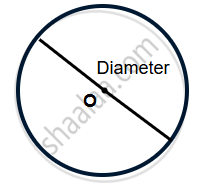
Characteristics:
-
The diameter passes through the center
-
A circle has infinite diameters
-
The diameter is the longest possible chord of a circle
-
The diameter is twice the radius
- Diameter = 2 × Radius and
Definition: Chord
A chord is a straight line segment that connects any two points on the circumference of the circle.
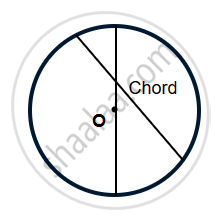
Characteristics:
-
A circle has infinite chords
-
The diameter is the longest chord in any circle
-
Chords closer to the centre are longer than chords farther from the center
Example
The centre of the circle below is O. There are other points and lines given in the diagram. Find the radii, chords, and diameters in the diagram and write their names in the box provided.
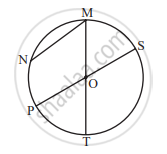
| Radius | OM, OS, OP, OT |
| Diameter | PS, MT |
| Chord | NM, MT, PS |
Real-Life Applications
Clock Face
- The center is where the hands attach
-
The hour hand and minute hand lengths represent different radii
-
Numbers on the clock edge lie on the circumference
Circular Pizza
-
The center is where you might place a utensil to cut
-
A cut from the center to the edge is a radius
-
A cut across the entire pizza through the center is a diameter
-
Any straight cut along the pizza's edge (not through center) is a chord
Key Points Summary
| Part | Definition | Passes Through Center? | Relation to Radius | Can Be Multiple? |
|---|---|---|---|---|
| Radius | Line from center to circumference. | No | Basic unit length of the circle. | Yes, infinite. |
| Diameter | Line through center. | Yes | 2 × Radius. | Yes, infinite. |
| Chord | Line joining any two points on circumference. | Not necessarily | Diameter is the longest chord. | Yes, infinite. |