Advertisements
Advertisements
प्रश्न
In the following figure, if ∠DAB = 60º, ∠ABD = 50º, then ∠ACB is equal to ______.

पर्याय
60º
50º
70º
80º
Advertisements
उत्तर
In the following figure, if ∠DAB = 60º, ∠ABD = 50º, then ∠ACB is equal to 70º.
Explanation:
Given: ∠DAB = 60°, ∠ABD = 50°
Using the theorem “angles in the same segment of the circle are equal”:
∴ ∠ADB = ∠ACB ...(i)
In triangle ABD, using the angle sum property of triangle, we have:
∠ABD + ∠ADB + ∠DAB = 180°
⇒ 50° + ∠ADB + 60° = 180°
⇒ ∠ADB = 180° – 50° – 60°
⇒ ∠ADB = 70°
From equation (i), we have:
∴ ∠ACB = 70°
APPEARS IN
संबंधित प्रश्न
In Fig. 1, QR is a common tangent to the given circles, touching externally at the point T. The tangent at T meets QR at P. If PT = 3.8 cm, then the length of QR (in cm) is :
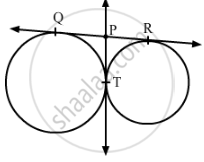
(A) 3.8
(B) 7.6
(C) 5.7
(D) 1.9
Fill in the blanks:
An arc is a __________ when its ends are the ends of a diameter.
A point P is 26 cm away from O of circle and the length PT of the tangent drawn from P to the circle is 10 cm. Find the radius of the circle.
If AB, BC and CD are equal chords of a circle with O as centre and AD diameter, than ∠AOB =
Choose correct alternative answer and fill in the blank.
Radius of a circle is 10 cm and distance of a chord from the centre is 6 cm. Hence the length of the chord is .........
The chord of length 30 cm is drawn at the distance of 8 cm from the centre of the circle. Find the radius of the circle
In the following figure, if AOB is a diameter and ∠ADC = 120°, then ∠CAB = 30°.

If two chords AB and CD of a circle AYDZBWCX intersect at right angles (see figure), prove that arc CXA + arc DZB = arc AYD + arc BWC = semi-circle.
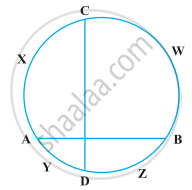
In the following figure, O is the centre of the circle. Name a chord, which is not the diameter of the circle.

Which is the longest straight line that can be drawn inside a circle?
