Advertisements
Advertisements
प्रश्न
Construct a triangle ABC with AB = 4.2 cm, BC = 6 cm and AC = 5cm. Construct the circumcircle of the triangle drawn.
Advertisements
उत्तर
Steps of Construction:
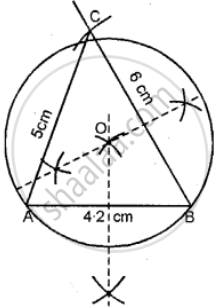
(i) Draw ∆ABC in which AB = 4.2 cm. BC = 6 cm. and AC = 5 cm.
(ii) Draw the perpendicular bisectors of any two sides of the triangle. Let these intersect at O.
(iii) Taking O as center and OA or OB or OC as radius draw a circle.
This circle will pass through vertices A, B and C.
APPEARS IN
संबंधित प्रश्न
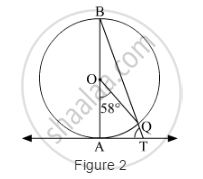
In Fig. 2, AB is the diameter of a circle with centre O and AT is a tangent. If ∠AOQ = 58°, find ∠ATQ.
n Fig. 2, PQ and PR are two tangents to a circle with centre O. If ∠QPR = 46°, then ∠QOR equals:
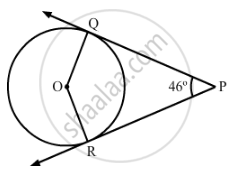
(A) 67°
(B) 134°
(C) 44°
(D) 46°
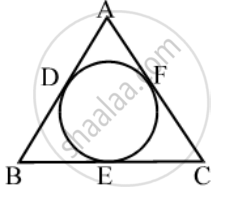
In Fig., if AB = AC, prove that BE = EC
Two tangent segments PA and PB are drawn to a circle with center O such that ∠APB = 120°. Prove that OP = 2AP
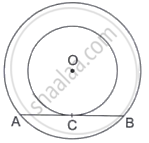
In the given figure, the chord AB of the larger of the two concentric circles, with center O, touches the smaller circle at C. Prove that AC = CB.
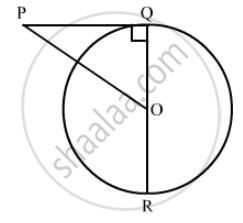
In the given figure, OQ : PQ = 3.4 and perimeter of Δ POQ = 60 cm. Determine PQ, QR and OP.
Use the figure given below to fill in the blank:
EF is a ______ of the circle.

The tangent to the circumcircle of an isosceles triangle ABC at A, in which AB = AC, is parallel to BC.
In the following figure, if ∠DAB = 60º, ∠ABD = 50º, then ∠ACB is equal to ______.

Is every diameter of a circle also a chord?
