Advertisements
Advertisements
प्रश्न
Construct a triangle ABC with AB = 4.2 cm, BC = 6 cm and AC = 5cm. Construct the circumcircle of the triangle drawn.
Advertisements
उत्तर
Steps of Construction:
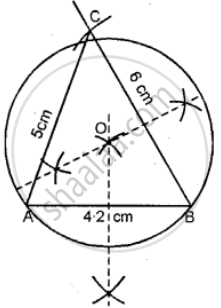
(i) Draw ∆ABC in which AB = 4.2 cm. BC = 6 cm. and AC = 5 cm.
(ii) Draw the perpendicular bisectors of any two sides of the triangle. Let these intersect at O.
(iii) Taking O as center and OA or OB or OC as radius draw a circle.
This circle will pass through vertices A, B and C.
APPEARS IN
संबंधित प्रश्न
O is the center of a circle of radius 8cm. The tangent at a point A on the circle cuts a line through O at B such that AB = 15 cm. Find OB
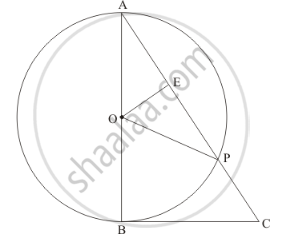
In the given figure, BC is a tangent to the circle with centre O. OE bisects AP. Prove that ΔAEO~Δ ABC.
Suppose You Are Given a Circle. Give a Construction to Find Its Centre.
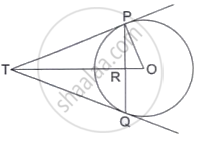
PQ is a chord of length 4.8 cm of a circle of radius 3 cm. The tangents at P and Q intersect at a point T as shown in the figure. Find the length of TP.
The perimeter (in cm) of a square circumscribing a circle of radius a cm, is
The center of a circle is at point O and its radius is 8 cm. State the position of a point P (point P may lie inside the circle, on the circumference of the circle, or outside the circle), when:
(a) OP = 10.6 cm
(b) OP = 6.8 cm
(c) OP = 8 cm
A point P is 10 cm from the center of a circle. The length of the tangent drawn from P to the circle is 8 cm. The radius of the circle is equal to ______
If A, B, C, D are four points such that ∠BAC = 30° and ∠BDC = 60°, then D is the centre of the circle through A, B and C.
Say true or false:
Two diameters of a circle will necessarily intersect.
Which is the longest straight line that can be drawn inside a circle?
