Advertisements
Advertisements
Question
Construct a triangle ABC with AB = 4.2 cm, BC = 6 cm and AC = 5cm. Construct the circumcircle of the triangle drawn.
Advertisements
Solution
Steps of Construction:
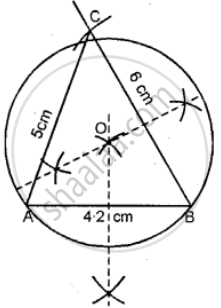
(i) Draw ∆ABC in which AB = 4.2 cm. BC = 6 cm. and AC = 5 cm.
(ii) Draw the perpendicular bisectors of any two sides of the triangle. Let these intersect at O.
(iii) Taking O as center and OA or OB or OC as radius draw a circle.
This circle will pass through vertices A, B and C.
APPEARS IN
RELATED QUESTIONS
n Fig. 2, PQ and PR are two tangents to a circle with centre O. If ∠QPR = 46°, then ∠QOR equals:
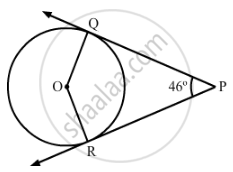
(A) 67°
(B) 134°
(C) 44°
(D) 46°
A chord of a circle of radius 14 cm subtends an angle of 120° at the centre. Find the area of the corresponding minor segment of the circle. `[User pi22/7 and sqrt3=1.73]`
ABC is a triangle with B as right angle, AC = 5 cm and AB = 4 cm. A circle is drawn with Aas centre and AC as radius. The length of the chord of this circle passing through C and B is
Use the figure given below to fill in the blank:
If PQ is 8 cm long, the length of RS = ________

Draw circle with diameter: 6 cm
In above case, measure the length of the radius of the circle drawn.
From a point P which is at a distance of 13 cm from the centre O of a circle of radius 5 cm, the pair of tangents PQ and PR to the circle are drawn. Then the area of the quadrilateral PQOR is ______
The length of the tangent from point A to a circle, of radius 3 cm, is 4 cm. The distance of A from the centre of the circle is ______
Prove that angle bisector of any angle of a triangle and perpendicular bisector of the opposite side if intersect, they will intersect on the circumcircle of the triangle.
From the figure, identify a sector.

In the given figure, O is the centre of the circle. If ∠AOB = 145°, then find the value of x.

