Advertisements
Advertisements
Question
Prove that angle bisector of any angle of a triangle and perpendicular bisector of the opposite side if intersect, they will intersect on the circumcircle of the triangle.
Advertisements
Solution
Given: ΔABC is inscribed in a circle. Bisector of ∠A and perpendicular bisector of BC intersect at point Q.
To prove: A, B, Q and C are con-cyclic.
Construction: Join BQ and QC.
Proof: We have assumed that, Q lies outside the circle.
In ΔBMQ and ΔCMQ,
BM = CM ...[QM is the perpendicular bisector of BC]
∠BMQ = ∠CMQ ...[Each 90°]
MQ = MQ ...[Common side]
∴ ΔBMQ ≅ ΔCMQ ...[By SAS congruence rule]
∴ BQ = CQ [By CPCT] ...(i)
Also, ∠BAQ = ∠CAQ [Given] ...(ii)
From equations (i) and (ii),
We can say that Q lies on the circle ...[Equal chords of a circle subtend equal angles at the circumference]
Hence, A, B, Q and C are con-cyclic.
Hence proved.
APPEARS IN
RELATED QUESTIONS
Find the length of the tangent drawn from a point whose distance from the centre of a circle is 25 cm. Given that the radius of the circle is 7 cm.
If the quadrilateral sides touch the circle prove that sum of pair of opposite sides is equal to the sum of other pair.
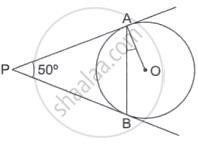
In the given figure, PA and PB are two tangents to the circle with centre O. If ∠APB = 50° then what is the measure of ∠OAB.
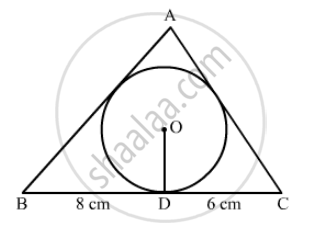
In the given figure, a ∆ABC is drawn to circumscribe a circle of radius 4 cm such that the segments BD and DC are of lengths 8 cm and 6 cm respectively. Find the lengths of sides AB and AC, when area of ∆ABC is 84 cm2.
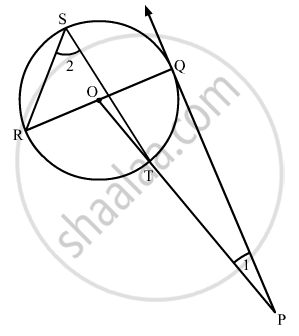
In Fig. 8.79, PQ is a tangent from an external point P to a circle with centre O and OP cuts the circle at T and QOR is a diameter. If ∠POR = 130° and S is a point on the circle, find ∠1 + ∠2.
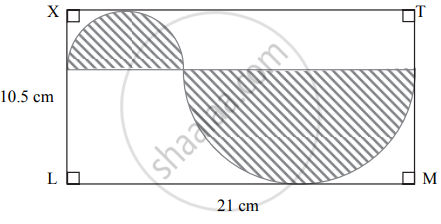
In the above figure, `square`XLMT is a rectangle. LM = 21 cm, XL = 10.5 cm. Diameter of the smaller semicircle is half the diameter of the larger semicircle. Find the area of non-shaded region.
Draw circle with diameter: 8.4 cm
In above case, measure the length of the radius of the circle drawn.
State, if the following statement is true or false:
The longest chord of a circle is its diameter.
Twice the radius is ________________
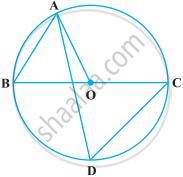
In the following figure, BC is a diameter of the circle and ∠BAO = 60º. Then ∠ADC is equal to ______.