Advertisements
Advertisements
प्रश्न
Prove that angle bisector of any angle of a triangle and perpendicular bisector of the opposite side if intersect, they will intersect on the circumcircle of the triangle.
Advertisements
उत्तर
Given: ΔABC is inscribed in a circle. Bisector of ∠A and perpendicular bisector of BC intersect at point Q.
To prove: A, B, Q and C are con-cyclic.
Construction: Join BQ and QC.
Proof: We have assumed that, Q lies outside the circle.
In ΔBMQ and ΔCMQ,
BM = CM ...[QM is the perpendicular bisector of BC]
∠BMQ = ∠CMQ ...[Each 90°]
MQ = MQ ...[Common side]
∴ ΔBMQ ≅ ΔCMQ ...[By SAS congruence rule]
∴ BQ = CQ [By CPCT] ...(i)
Also, ∠BAQ = ∠CAQ [Given] ...(ii)
From equations (i) and (ii),
We can say that Q lies on the circle ...[Equal chords of a circle subtend equal angles at the circumference]
Hence, A, B, Q and C are con-cyclic.
Hence proved.
APPEARS IN
संबंधित प्रश्न
In Fig., if AB = AC, prove that BE = EC
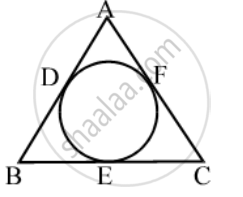
Write True or False. Give reasons for your answers.
A chord of a circle, which is twice as long as its radius, is a diameter of the circle.
Prove that the intercept of a tangent between two parallel tangents to a circle subtends a right angle at center.
A quadrilateral is drawn to circumscribe a circle. Prove that the sums of opposite sides are equal.
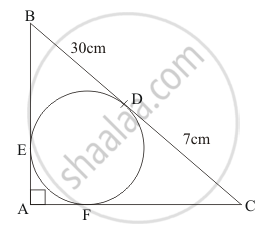
In the given figure, BDC is a tangent to the given circle at point D such that BD = 30 cm and CD = 7 cm. The other tangents BE and CF are drawn respectively from B and C to the circle and meet when produced at A making BAC a right angle triangle. Calculate (i) AF
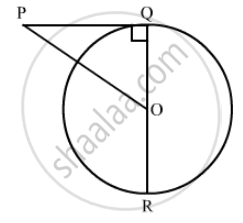
In the given figure, OQ : PQ = 3.4 and perimeter of Δ POQ = 60 cm. Determine PQ, QR and OP.
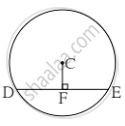
In the adjoining figure, seg DE is the chord of the circle with center C, seg CF ⊥ seg DE and DE = 16 cm, then find the length of DF?
A 7 m broad pathway goes around a circular park with a circumference of 352 m. Find the area of road.
The circumcentre of a triangle is the point which is ______.
Which is the longest straight line that can be drawn inside a circle?
