Advertisements
Advertisements
प्रश्न
Prove that angle bisector of any angle of a triangle and perpendicular bisector of the opposite side if intersect, they will intersect on the circumcircle of the triangle.
Advertisements
उत्तर
Given: ΔABC is inscribed in a circle. Bisector of ∠A and perpendicular bisector of BC intersect at point Q.
To prove: A, B, Q and C are con-cyclic.
Construction: Join BQ and QC.
Proof: We have assumed that, Q lies outside the circle.
In ΔBMQ and ΔCMQ,
BM = CM ...[QM is the perpendicular bisector of BC]
∠BMQ = ∠CMQ ...[Each 90°]
MQ = MQ ...[Common side]
∴ ΔBMQ ≅ ΔCMQ ...[By SAS congruence rule]
∴ BQ = CQ [By CPCT] ...(i)
Also, ∠BAQ = ∠CAQ [Given] ...(ii)
From equations (i) and (ii),
We can say that Q lies on the circle ...[Equal chords of a circle subtend equal angles at the circumference]
Hence, A, B, Q and C are con-cyclic.
Hence proved.
APPEARS IN
संबंधित प्रश्न
Prove that the line segment joining the point of contact of two parallel tangents to a circle is a diameter of the circle.
A chord PQ of a circle of radius 10 cm substends an angle of 60° at the centre of circle. Find the area of major and minor segments of the circle.
Prove that the intercept of a tangent between two parallel tangents to a circle subtends a right angle at center.
true or false
A chord of a circle, which is twice as long is its radius is a diameter of the circle.
A chord of a circle of radius 14 cm subtends an angle of 120° at the centre. Find the area of the corresponding minor segment of the circle. `[User pi22/7 and sqrt3=1.73]`
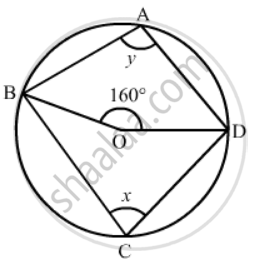
In the given figure, O is the centre of the circle. If ∠BOD = 160°, find the values of x and y.
Find the radius of the circle
Diameter = 24 cm
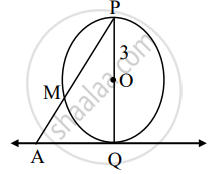
In the figure, O is the center of the circle. Line AQ is a tangent. If OP = 3, m(arc PM) = 120°, then find the length of AP.
A point P is 10 cm from the center of a circle. The length of the tangent drawn from P to the circle is 8 cm. The radius of the circle is equal to ______
A quadrilateral ABCD is inscribed in a circle such that AB is a diameter and ∠ADC = 130º. Find ∠BAC.
