Advertisements
Advertisements
प्रश्न
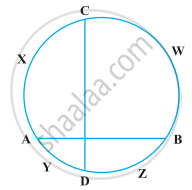
If two chords AB and CD of a circle AYDZBWCX intersect at right angles (see figure), prove that arc CXA + arc DZB = arc AYD + arc BWC = semi-circle.
Advertisements
उत्तर
Given: In a circle AYDZBWCX, two chords AB and CD intersect at right angles.
To prove: arc CXA + arc DZB = arc AYD + arc BWC = Semi-circle.
Construction: Draw a diameter EF parallel to CD having centre M.
Proof: Since, CD || EF
arc EC = arc PD ...(i)
arc ECXA = arc EWB [Symmetrical about diameter of a circle]
arc AF = arc BF ...(ii)
We know that, ar ECXAYDF = Semi-circle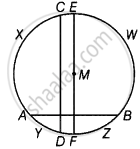
arc EA + arc AF = Semi-circle
⇒ arc EC + arc CXA = arc FB = Semi-circle ...[From equation (ii)]
⇒ arc DF + arc CXA + arc FB = Semi-circle ...[From equation (i)]
⇒ arc DF + arc FB + arc CXA = Semi-circle
⇒ arc DZB + arc C × A = Semi-circle
We know that, circle divides itself in two semi-circles, therefore the remaining portion of the circle is also equal to the semi-circle.
∴ arc AYD + arc BWC = Semi-circle
Hence proved.
APPEARS IN
संबंधित प्रश्न
Prove that in two concentric circles, the chord of the larger circle which touches the smaller circle, is bisected at the point of contact.
Fill in the blanks:
The centre of a circle lies in ____________ of the circle.
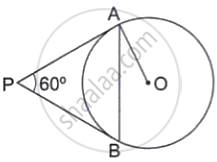
In the given figure, PA and PB are two tangents to the circle with centre O. If ∠APB = 60° then find the measure of ∠OAB.
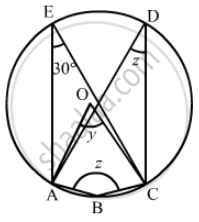
In the given figure, O is the centre of the circle. If ∠CEA = 30°, Find the values of x, y and z.
The length of three concesutive sides of a quadrilateral circumscribing a circle are 4 cm, 5 cm, and 7 cm respectively. Determine the length of the fourth side.
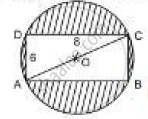
Find the area of the shaded region in the figure If ABCD is a rectangle with sides 8 cm and 6 cm and O is the centre of the circle. (Take π= 3.14)
Use the figure given below to fill in the blank:
R is the _______ of the circle.

Use the figure given below to fill in the blank:
______ is a chord of the circle.
State, if the following statement is true or false:
The longest chord of a circle is its diameter.
In the following figure, O is the centre of the circle, BD = OD and CD ⊥ AB. Find ∠CAB.

