Topics
Orienting Yourself: The Use of Coordinates
Number Systems
Number Systems
Part 1
Introduction to Polynomials
Introduction to Linear Polynomials
Part 2
Algebra
Algebraic Expressions
Algebraic Identities
Coordinate Geometry
The World of Numbers
Sequences and Progressions
Geometry
Exploring Algebraic Identities
Exploring Algebraic Identities
Area
Constructions
- Introduction of Constructions
- Geometric Constructions
- Some Constructions of Triangles
I’m Up and Down, and Round and Round
Mensuration
Linear Equations in Two Variables
Statistics and Probability
Measuring Space: Perimeter and Area
Coordinate Geometry
Probability
Introduction to Euclid’s Geometry: Axioms and Postulates
The Mathematics of Maybe: Introduction to Probability
Lines and Angles
- Introduction to Lines and Angles
- Basic Terms and Definitions
- Intersecting Lines and Non-intersecting Lines
- Parallel Lines
- Concept of Pairs of Angles
- Concept of Transversal Lines
- Basic Properties of a Triangle
Predicting What Comes Next: Exploring Sequences
Triangles: Congruence Theorems
4-gons (Quadrilaterals)
- Properties of Quadrilateral
- Another Condition for a Quadrilateral to Be a Parallelogram
- Theorem of Midpoints of Two Sides of a Triangle
- Property: The Opposite Sides of a Parallelogram Are of Equal Length.
- Theorem: A Diagonal of a Parallelogram Divides It into Two Congruent Triangles.
- Theorem : If Each Pair of Opposite Sides of a Quadrilateral is Equal, Then It is a Parallelogram.
- Property: The Opposite Angles of a Parallelogram Are of Equal Measure.
- Theorem: If in a Quadrilateral, Each Pair of Opposite Angles is Equal, Then It is a Parallelogram.
- Property: The diagonals of a parallelogram bisect each other. (at the point of their intersection)
- Theorem : If the Diagonals of a Quadrilateral Bisect Each Other, Then It is a Parallelogram
Circles
Area and Perimeter
- Area of a Triangle by Heron's Formula
- Application of Heron’s Formula in Finding Areas of Quadrilaterals
- Geometric Interpretation of the Area of a Triangle
Surface Area and Volume
Statistics
Introduction to Probability
Theorem
Theorem: Parallelograms on the same base and between the same parallels are equal in area.
Proof : Two parallelograms ABCD and EFCD, on the same base DC and between the same parallels AF and DC are given in following fig. 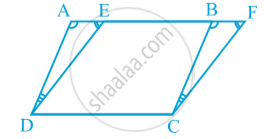
We need to prove that ar (ABCD) = ar (EFCD).
In ∆ ADE and ∆ BCF,
∠ DAE = ∠ CBF (Corresponding angles from AD || BC and transversal AF) (1)
∠ AED = ∠ BFC (Corresponding angles from ED || FC and transversal AF) (2)
Therefore, ∠ ADE = ∠ BCF (Angle sum property of a triangle) (3)
Also, AD = BC (Opposite sides of the parallelogram ABCD) (4)
So, ∆ ADE ≅ ∆ BCF [By ASA rule, using (1), (3), and (4)]
Therefore, ar (ADE) = ar (BCF) (Congruent figures have equal areas) (5)
Now, ar (ABCD) = ar (ADE) + ar (EDCB)
= ar (BCF) + ar (EDCB) [From(5)]
= ar (EFCD)
So, parallelograms ABCD and EFCD are equal in area.