Advertisements
Advertisements
प्रश्न
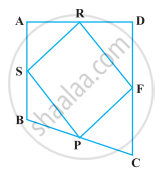
If the mid-points of the sides of a quadrilateral are joined in order, prove that the area of the parallelogram so formed will be half of the area of the given quadrilateral (Figure).
[Hint: Join BD and draw perpendicular from A on BD.]
Advertisements
उत्तर
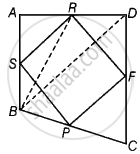
Given: Let ABCD is a quadrilateral and P, F, R and S are the mid-points of the sides BC, CD, AD and AB respectively and PFRS is a parallelogram.
To prove: ar (parallelogram PFRS) = `1/2` ar (quadrilateral ABCD)
Construction: Join BD and BR.
Proof: Median BR divides ΔBDA into two triangles of equal area.
∴ ar (ΔBRA) = `1/2` ar (ΔBDA) ...(i)
Similarly, median RS divides ΔBRA into two triangles of equal area.
∴ ar (ΔASR) = `1/2` ar (ΔBRA) ...(ii)
From equations (i) and (ii),
ar (ΔASR) = `1/4` ar (ΔBDA) ...(iii)
Similarly, ar (ΔCFP) = `1/4` ar (ΔBCD) ...(iv)
On adding equations (iii) and (iv), we get
ar (ΔASR) + ar (ΔCFP) = `1/4` ar (ΔBDA) ...[ar (ΔBDA) + ar (ΔBCD)]
⇒ ar (ΔASR) + ar (ΔCFP) = `1/4` ar (quadrilateral BCDA) ...(v)
Similarly, ar (ΔDRF) + ar (ΔBSP) = `1/4` ar (quadrilateral BCDA) ...(vi)
On adding equations (v) and (vi), we get
ar (ΔASR) + ar (ΔCFP) + ar (ΔDRF) + ar (ΔBSP) = `1/2` ar (quadrilateral BCDA) ...(vii)
But ar (ΔASR) + ar (ΔCFP) + ar (ΔDRF) + ar (ΔBSP) + ar (parallelogram PFRS) = ar (quadrialateral BCDA) ...(viii)
On subtracting equation (vii) from equation (viii), we get
ar (parallelogram PFRS) = `1/2` ar (quadrilateral BCDA)
Hence proved.
APPEARS IN
संबंधित प्रश्न
If E, F, G and H are respectively the mid-points of the sides of a parallelogram ABCD show that ar (EFGH) = 1/2ar (ABCD)
P and Q are any two points lying on the sides DC and AD respectively of a parallelogram ABCD. Show that ar (APB) = ar (BQC).
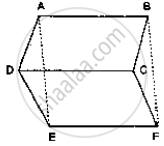
In the following figure, ABCD, DCFE and ABFE are parallelograms. Show that ar (ADE) = ar (BCF).

In the given below fig. ABCD, ABFE and CDEF are parallelograms. Prove that ar (ΔADE)
= ar (ΔBCF)
In which of the following figures, you find two polygons on the same base and between the same parallels?
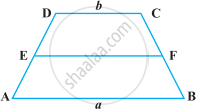
ABCD is a trapezium with parallel sides AB = a cm and DC = b cm (Figure). E and F are the mid-points of the non-parallel sides. The ratio of ar (ABFE) and ar (EFCD) is ______.
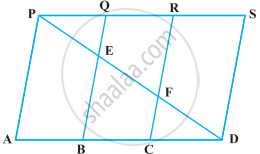
In the following figure, PSDA is a parallelogram. Points Q and R are taken on PS such that PQ = QR = RS and PA || QB || RC. Prove that ar (PQE) = ar (CFD).
ABCD is a square. E and F are respectively the mid-points of BC and CD. If R is the mid-point of EF (Figure), prove that ar (AER) = ar (AFR)

ABCD is a trapezium in which AB || DC, DC = 30 cm and AB = 50 cm. If X and Y are, respectively the mid-points of AD and BC, prove that ar (DCYX) = `7/9` ar (XYBA)
In the following figure, ABCD and AEFD are two parallelograms. Prove that ar (PEA) = ar (QFD). [Hint: Join PD].

