Advertisements
Advertisements
प्रश्न
ABCD is a parallelogram, G is the point on AB such that AG = 2 GB, E is a point of DC
such that CE = 2DE and F is the point of BC such that BF = 2FC. Prove that:
(1) ar ( ADEG) = ar (GBCD)
(2) ar (ΔEGB) = `1/6` ar (ABCD)
(3) ar (ΔEFC) = `1/2` ar (ΔEBF)
(4) ar (ΔEBG) = ar (ΔEFC)
(5)ΔFind what portion of the area of parallelogram is the area of EFG.
Advertisements
उत्तर
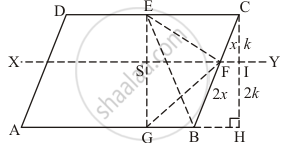
Given,
ABCD is a parallelogram
AG = 2GB,CE = 2DE and BF = 2FC
To prove :
(1) ar (ADEG) = ar (GBCE)
(2) ar (Δ EGB) = `1/6` are (ABCD)
(3) ar (Δ EFC) =`1/2` area (Δ EBF)
(4) area (ΔEBG) = 3/2 area (EFC)
(5) Find what portion of the area of parallelogram is the area of ΔEFG.
Construction: draw EP ⊥ AB and EQ ⊥ BC
Proof : we have,
AG = 2GB and CE = 2DE and BF = 2FC
⇒ AB - GB = 2GB and CD - DE = 2DE and BC - FC
⇒ AB -GB = 2GB and CD - DE = 2DE and BC - FC = 2FC.
⇒ AB =3GB and CD =3DE and BC = 3FC
⇒ `GB = 1/3 AB and DE = `1/3` CD and FC = 1/3 BC ` ............ (1)
(1) ar (ADEG) `1/2` (AG + DE) × EP
⇒ ` ar (ADEG) = 1/2 (2/3AB + 1/3CD) xx EP` [By using(1)]
⇒ `ar (ADEG) = 1/2 (2/3 AB + 1/3 AB)xx EP` [∴ AB = CD]
⇒ `ar (ADEG) = 1/2 xx AB xx EP` ........... (2)
`And ar (GBCE) = 1/2 (GB + CE) xx EP`
⇒ `ar (GBCE) = 1/2 [1/3 AB + 2/3 CD ] xx EP` [By using (1)]
⇒ `ar (GBCE) = 1/2 [1/3 AB + 2/3 AB ] xx EP` [∴ AB = CD]
⇒ `ar (GBCE) = 1/2 xx AB xx EP` ........ (1)
Compare equation (2) and (3)
(2) ar (ΔEGB) = `1/2xx GB xx EP`
= `1/6 xx AB xx EB`
= `1/6 ar (1^(9m) ABCD)`
(3) `Area (ΔEFC) = 1/2 xx FC xx EQ ......... (4)`
`And area (ΔEBF) = 1/2 xx BF xx EQ`
⇒ `ar (ΔEBF) = 1/2 xx2 FC xx EQ ` [BF = 2FC given]
⇒ `ar (ΔEBF) = FC xx EQ` ............. (5)
Compare equation 4 and 5
`Area (ΔEFC) = 1/2 xx area (ΔEBF) `
(4) From (1) part
`ar (ΔEGB ) = 1/6 ar (11^(5m )ABCD)` ....... (6)
Form (3) part
` ar (ΔEFC) =1/2 ar (EBF)`
⇒ `ar (ΔEFC) = 1/3 ar(ΔEBC)`
⇒ `ar (ΔEFC) = 1/3 xx 1/2 xx CE xx EP`
`= 1/2 xx 1/3 xx 2/3 CD xx EP`
`=1/6 xx 2/3 xx ar (11^(gm)ABCD)`
⇒ `ar (ΔEFC) = 2/3 xx ar (ΔEGB)` [By using]
⇒ `ar (ΔEGB) = 3/2 ar (ΔEFC). `
(5) Area (ΔEFG) = ar (Trap . BGEC) = - ar (ΔBGF) → (1)
`Now , area (trap BGEC) = 1/2 (GB + EC) xx EP`
= `1/2 (1/3 AB + 2/3 CD) xx EP `
= `1/2 AB xx EP`
= `1/2 ar (11^(5m)ABCD)`
`Area (ΔEFC) = 1/9 area (11^(5m)ABCD)` [Form 4 part]
And area (Δ BGF) = `1/2 BF xx GR`
`= 1/2 xx 2/3 BC xx GR`
`= 2/3 xx 1/2 BC xx GR `
`= 2/3 xx ar (Δ GBC) `
`= 2/3 xx 1/2 GB xx EP`
`= 1/3 xx 1/3 AB xx EP`
`= 1/9 AB xx EP`
` 1/9 ar ( 11^(gm) ABCD)` [ From (1)]
`ar ( ΔEFG) = 1/2 ar ( 11^(gm) ABCD) = 1/9 ar ( 11^(gm) ABCD) = 1/9 ar ( 11^(gm) ABCD)`
`= 5/18 ar ( 11^(gm) ABCD).`
APPEARS IN
संबंधित प्रश्न
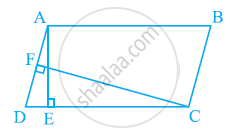
In the given figure, ABCD is parallelogram, AE ⊥ DC and CF ⊥ AD. If AB = 16 cm, AE = 8 cm and CF = 10 cm, find AD.
P and Q are any two points lying on the sides DC and AD respectively of a parallelogram ABCD. Show that ar (APB) = ar (BQC).
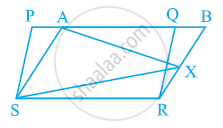
In the given figure, PQRS and ABRS are parallelograms and X is any point on side BR. Show that
(i) ar (PQRS) = ar (ABRS)
(ii) ar (AXS) = 1/2ar (PQRS)
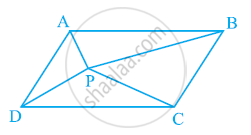
In the given figure, P is a point in the interior of a parallelogram ABCD. Show that
(i) ar (APB) + ar (PCD) = 1/2ar (ABCD)
(ii) ar (APD) + ar (PBC) = ar (APB) + ar (PCD)
[Hint: Through. P, draw a line parallel to AB]
In the given below fig. ABCD, ABFE and CDEF are parallelograms. Prove that ar (ΔADE)
= ar (ΔBCF)
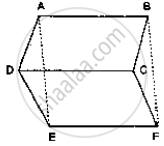
In the below fig. ABCD and AEFD are two parallelograms. Prove that
(1) PE = FQ
(2) ar (Δ APE) : ar (ΔPFA) = ar Δ(QFD) : ar (Δ PFD)
(3) ar (ΔPEA) = ar (ΔQFD)
Two parallelograms are on equal bases and between the same parallels. The ratio of their areas is ______.
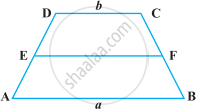
ABCD is a trapezium with parallel sides AB = a cm and DC = b cm (Figure). E and F are the mid-points of the non-parallel sides. The ratio of ar (ABFE) and ar (EFCD) is ______.
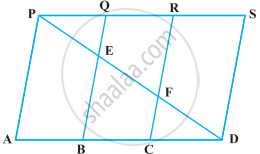
In the following figure, PSDA is a parallelogram. Points Q and R are taken on PS such that PQ = QR = RS and PA || QB || RC. Prove that ar (PQE) = ar (CFD).
ABCD is a parallelogram in which BC is produced to E such that CE = BC (Figure). AE intersects CD at F. If ar (DFB) = 3 cm2, find the area of the parallelogram ABCD.
