Advertisements
Advertisements
प्रश्न
The diagonals of a parallelogram ABCD intersect at a point O. Through O, a line is drawn to intersect AD at P and BC at Q. Show that PQ divides the parallelogram into two parts of equal area.
Advertisements
उत्तर
Given: In a parallelogram ABCD, diagonals intersect at O and draw a line PQ, which intersects AD and BC.
To prove: PQ divides the parallelogram ABCD into two parts of equal area.
i.e., ar (ABQP) = ar (CDPQ)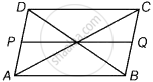
Proof: We know that, diagonals of a parallelogram bisect each other.
∴ OA = OC and OB = OD ...(i)
In ΔAOB and ΔCOD,
OA = OC
OB = OD ...[From equation (i)]
And ∠AOB = ∠COD ...[Vertically opposite angles]
∴ ΔAOB = ΔCOD ...[By SAS congruence rule]
Then, ar (ΔAOB) = ar (ΔCOD) ...(ii) [Since, congruent figures have equal area]
Now, in ΔAOP and ΔCOQ,
∠PAO = ∠OCQ ...[Alternate interior angles]
OA = OC ...[From equation (i)]
And ∠AOP = ∠COQ ...[Vertically opposite angles]
∴ ΔAOP ≅ ΔCOQ ...[By ASA congruence rule]
∴ ar (ΔAOP) = ar (ΔCOQ) ...(iii) [Since, congruent figures have equal area]
Similarly, ar (ΔPOD) = ar (ΔBOQ) ...(iv)
Now, ar (ABQP) = ar (ΔCOQ) + ar (ΔCOD) + ar (ΔPOD)
= ar (ΔAOP) + ar (ΔAOB) + ar (ΔBOQ) ...[From equations (ii), (iii) and (iv)]
⇒ ar (ABQP) = ar (CDPQ)
Hence proved.
APPEARS IN
संबंधित प्रश्न
If E, F, G and H are respectively the mid-points of the sides of a parallelogram ABCD show that ar (EFGH) = 1/2ar (ABCD)
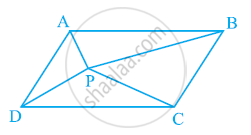
In the given figure, P is a point in the interior of a parallelogram ABCD. Show that
(i) ar (APB) + ar (PCD) = 1/2ar (ABCD)
(ii) ar (APD) + ar (PBC) = ar (APB) + ar (PCD)
[Hint: Through. P, draw a line parallel to AB]
In the following figure, ABCD is parallelogram and BC is produced to a point Q such that AD = CQ. If AQ intersect DC at P, show that
ar (BPC) = ar (DPQ).
[Hint: Join AC.]

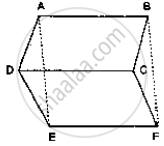
In the given below fig. ABCD, ABFE and CDEF are parallelograms. Prove that ar (ΔADE)
= ar (ΔBCF)
ABCD is a parallelogram, G is the point on AB such that AG = 2 GB, E is a point of DC
such that CE = 2DE and F is the point of BC such that BF = 2FC. Prove that:
(1) ar ( ADEG) = ar (GBCD)
(2) ar (ΔEGB) = `1/6` ar (ABCD)
(3) ar (ΔEFC) = `1/2` ar (ΔEBF)
(4) ar (ΔEBG) = ar (ΔEFC)
(5)ΔFind what portion of the area of parallelogram is the area of EFG.
In the below fig. ABCD and AEFD are two parallelograms. Prove that
(1) PE = FQ
(2) ar (Δ APE) : ar (ΔPFA) = ar Δ(QFD) : ar (Δ PFD)
(3) ar (ΔPEA) = ar (ΔQFD)
In which of the following figures, you find two polygons on the same base and between the same parallels?
PQRS is a rectangle inscribed in a quadrant of a circle of radius 13 cm. A is any point on PQ. If PS = 5 cm, then ar (PAS) = 30 cm2.
ABCD is a square. E and F are respectively the mid-points of BC and CD. If R is the mid-point of EF (Figure), prove that ar (AER) = ar (AFR)

ABCD is a trapezium in which AB || DC, DC = 30 cm and AB = 50 cm. If X and Y are, respectively the mid-points of AD and BC, prove that ar (DCYX) = `7/9` ar (XYBA)
