Advertisements
Advertisements
प्रश्न
In the below fig. ABCD and AEFD are two parallelograms. Prove that
(1) PE = FQ
(2) ar (Δ APE) : ar (ΔPFA) = ar Δ(QFD) : ar (Δ PFD)
(3) ar (ΔPEA) = ar (ΔQFD)
Advertisements
उत्तर
Given that, ABCD and AEFD are two parallelograms
To prove: (1) PE = FQ
(2) `"ar (ΔAPE)"/ "ar (ΔPFA)"` = `"ar (ΔQFD)"/"ar (ΔPED)"`
(3) ar (ΔPEA) = ar (ΔQFD)
Proof: (1) In ΔEPA and ΔFQD
∠PEA = ∠QFD [ ∴ Corresponding angles]
∠EPA = ∠FQD [Corresponding angles]
PA = QD [opp .sides of 11gm]
Then, ΔEPA ≅ ΔFQD [By. AAS condition]
∴ EP = FQ [c. p. c.t]
(2) Since, ΔPEA and ΔQFD stand on the same base PEand FQlie between the same
parallels EQ and AD
∴ ar (ΔPEA ) = ar (ΔQFD) → (1)
AD ∴ ar (ΔPFA) = ar (PFD) .....(2)
Divide the equation (1) by equation (2)
`"area of (ΔPEA)"/"area of (ΔPFA)"` = `"ar Δ(QFD)"/"ar Δ(PFD)"`
(3) From (1) part ΔEPA ≅ FQD
Then, ar (ΔEDA) = ar (ΔFQD)
APPEARS IN
संबंधित प्रश्न
P and Q are any two points lying on the sides DC and AD respectively of a parallelogram ABCD. Show that ar (APB) = ar (BQC).
Parallelogram ABCD and rectangle ABEF are on the same base AB and have equal areas. Show that the perimeter of the parallelogram is greater than that of the rectangle.
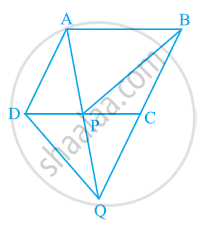
In the following figure, ABCD is parallelogram and BC is produced to a point Q such that AD = CQ. If AQ intersect DC at P, show that
ar (BPC) = ar (DPQ).
[Hint: Join AC.]
ABCD is a parallelogram, G is the point on AB such that AG = 2 GB, E is a point of DC
such that CE = 2DE and F is the point of BC such that BF = 2FC. Prove that:
(1) ar ( ADEG) = ar (GBCD)
(2) ar (ΔEGB) = `1/6` ar (ABCD)
(3) ar (ΔEFC) = `1/2` ar (ΔEBF)
(4) ar (ΔEBG) = ar (ΔEFC)
(5)ΔFind what portion of the area of parallelogram is the area of EFG.
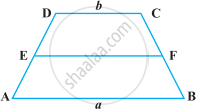
ABCD is a trapezium with parallel sides AB = a cm and DC = b cm (Figure). E and F are the mid-points of the non-parallel sides. The ratio of ar (ABFE) and ar (EFCD) is ______.
ABCD is a square. E and F are respectively the mid-points of BC and CD. If R is the mid-point of EF (Figure), prove that ar (AER) = ar (AFR)

ABCD is a parallelogram in which BC is produced to E such that CE = BC (Figure). AE intersects CD at F. If ar (DFB) = 3 cm2, find the area of the parallelogram ABCD.
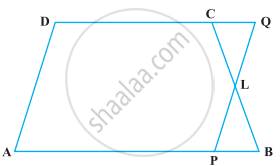
In trapezium ABCD, AB || DC and L is the mid-point of BC. Through L, a line PQ || AD has been drawn which meets AB in P and DC produced in Q (Figure). Prove that ar (ABCD) = ar (APQD)
ABCD is a trapezium in which AB || DC, DC = 30 cm and AB = 50 cm. If X and Y are, respectively the mid-points of AD and BC, prove that ar (DCYX) = `7/9` ar (XYBA)
In the following figure, ABCD and AEFD are two parallelograms. Prove that ar (PEA) = ar (QFD). [Hint: Join PD].

