Topics
Similarity
- Ratios of Areas of Two Triangles
- Basic Proportionality Theorem
- Property of an Angle Bisector of a Triangle
- Property of Three Parallel Lines and Their Transversals
- Similarity of Triangles (Corresponding Sides & Angles)
- Theorem of Areas of Similar Triangles
- Overview of Similarity
Pythagoras Theorem
- Pythagorean Triplet
- Property of 30°- 60°- 90° Triangle Theorem
- Property of 45°- 45°- 90° Triangle Theorem
- Theorem of Similarity in Right Angled Triangle
- Theorem of Geometric Mean
- Pythagoras Theorem
- Application of Pythagoras Theorem
- Apollonius Theorem
- Overview of Pythagoras Theorem
Circle
- Properties of Chords of a Circle
- Circles Passing Through One, Two, Three Points
- Secant and Tangent
- Tangent Theorem
- Tangent Segment Theorem
- Touching Circles
- Arc of the Circle
- Central Angle and the Measure of an Arc
- Congruence of Arcs
- Property of Sum of Measures of Arcs
- Inscribed Angle & Intercepted Arc
- Cyclic Quadrilateral
- Overview of Circle
- Theorem of Angle between Tangent and Secant
- Theorem of Internal Division of Chords
- Theorem of External Division of Chords
- Tangent Secant Segments Theorem
Geometric Constructions
- Construction of Similar Triangle
- Construction of a Tangent to a Circle at a Point on the Circle
- Construction of a Tangent to a Circle from a Point Outside the Circle
- Overview of Geometric Constructions
Co-ordinate Geometry
Trigonometry
Mensuration
Estimated time: 5 minutes
Maharashtra State Board: Class 12
CISCE: Class 10
CISCE: Class 10
Definition: Slope
The slope m of a line is m = tanθ
where θ is the inclination of the line with the positive x-axis.
Maharashtra State Board: Class 12
CISCE: Class 10
CISCE: Class 10
Formula: Slope Between Two Points
\[m=\frac{y_2-y_1}{x_2-x_1}\]
Maharashtra State Board: Class 12
CISCE: Class 10
CISCE: Class 10
Key Points: Concept of Slope
Nature of Slope
-
m > 0 → rising line
-
m < 0 → falling line
-
m = 0 → horizontal line
-
m = ∞→ vertical line
Parallel Lines
Two lines are parallel ⇔ , their slopes are equal, m1 = m2
Perpendicular Lines
Two lines are perpendicular ⇔
Collinearity of Three Points
Points A, B, and C are collinear
Method 1: Distance method
AB + BC = AC
Method 2: Slope method
Slope of AB = Slope of BC
Video Tutorials
Shaalaa.com | Gradient of a straight line
to track your progress
Related QuestionsVIEW ALL [124]
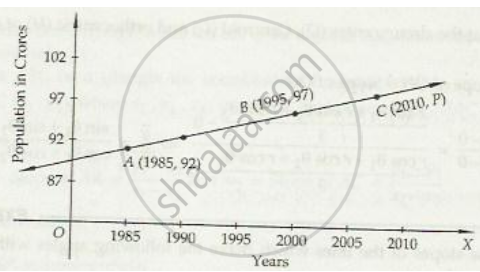
The equation of the line through the intersection of the lines 2x – 3y = 0 and 4x – 5y = 2 and
| Column C1 | Column C2 |
| (a) Through the point (2, 1) is | (i) 2x – y = 4 |
| (b) Perpendicular to the line (ii) x + y – 5 = 0 x + 2y + 1 = 0 is |
(ii) x + y – 5 = 0 |
| (c) Parallel to the line (iii) x – y –1 = 0 3x – 4y + 5 = 0 is |
(iii) x – y –1 = 0 |
| (d) Equally inclined to the axes is | (iv) 3x – 4y – 1 = 0 |
