Topics
Number System (Including Estimation and Approximation)
Theme 1 : Numbers
Number System(Consolidating the Sense of Numberness)
Number System
Ratio and Proportion
Numbers in Indian and International Systems (With Comparison)
Theme 2 : Ratio, Proportion and Arithmetic Problems
Estimation
Numbers in India and International System (With Comparison)
Natural Numbers and Whole Numbers (Including Number Line and Patterns)
Theme 3 : Algebra
Algebra
Theme 4 : Geometry
Negative Numbers and Integers
Place Value
Geometry
Natural Numbers and Whole Numbers (Including Patterns)
Mensuration
Theme 5 : Mensuration
Sets
Theme 6 : Statistics
Fractions
Negative Numbers and Integers
Data Handling
Decimal Fractions
Number Line
HCF and LCM
Playing with Numbers (Including H.C.F. and L.C.M.)
Ratio and Proportion (Including Unitary Method)
Playing with Numbers
- Simplification of Brackets
- Finding Factors Using Rectangular Arrangements and Division
- Factors and Common Factors
- Multiples and Common Multiples
- Concept of Even and Odd Number
- Tests for Divisibility of Numbers
- Divisibility by 2
- Divisibility by 4
- Divisibility by 8
- Divisibility by 3
- Divisibility by 6
- Divisibility by 9
- Divisibility by 5
- Divisibility by 11
Percent (Percentage)
Sets
Idea of Speed, Distance and Time
Ratio
Fundamental Concepts (With operations on Algebraic Expressions)
Proportion (Including Word Problems)
Unitary Method
Framing Algebraic Expressions (Including Substitution and Linear Equations)
Fractions
- Concept of Fraction
- Types of Fractions
- Concept of Proper and Improper Fractions
- Concept of Mixed Fractions
- Like and Unlike Fraction
- Concept of Equivalent Fractions
- Conversion between Improper and Mixed fraction
- Conversion between Unlike and Like Fractions
- Simplest Form of a Fractions
- Comparing Fractions
- Addition of Fraction
- Subtraction of Fraction
- Multiplication of Fraction
- Division of Fractions
- Using Operator 'Of' with Multiplication and Division
- BODMAS Rule
- Problems Based on Fraction
Fundamental Concepts (Including Angles and their Properties)
Triangles (Including Types and Properties of Triangles)
Decimal Fractions
Quadrilaterals
Percent (Percentage)
Idea of Speed, Distance and Time
Circles
Fundamental Concepts
Constructions
Symmetry
Fundamental Operations (Related to Algebraic Expressions)
Recognition of Solids
Substitution (Including Use of Brackets as Grouping Symbols)
Framing Algebraic Expressions (Including Evaluation)
Perimeter and Area of Plane Figures
Simple (Linear) Equations (Including Word Problems)
Data Handling (Including Mean and Median)
Fundamental Concepts
Angles (With Their Types)
Properties of Angles and Lines (Including Parallel Lines)
Triangles (Including Types, Properties and Constructions)
Quadrilateral
Polygons
The Circle
Symmetry (Including Constructions on Symmetry)
Recognition of Solids
Perimeter and Area of Plane Figures
Data Handling (Including Pictograph and Bar Graph)
Mean and Median
- Introduction
- Currency - Rupees and Paise
- Examples of Currency Conversion
- Measuring Lengths
- Examples of Length Conversion
- Measuring Weights (Mass)
- Examples of Weight Conversion
- Real-Life Application
- Key Points Summary
Introduction
Every day, you use measurements without even thinking about it! Understanding how to read, convert, and use these units is important whether you buy your favourite snacks, measure how tall you've grown, or help Mom weigh ingredients for cooking.
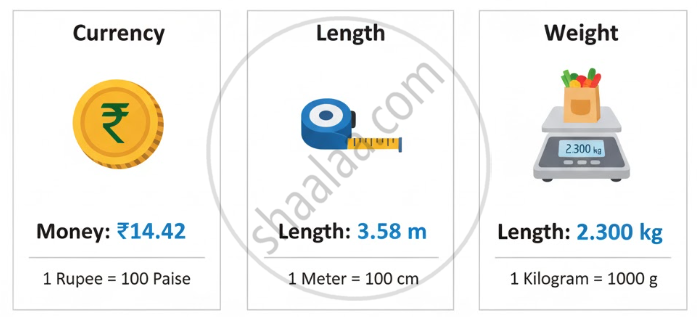
Currency - Rupees and Paise
Let's Start Simple:
Think of money like a pizza!
-
The whole pizza = 1 Rupee (₹)
-
Each slice = 1 Paisa (P)
-
The pizza has exactly 100 slices (100 paise = 1 rupee)
Step-by-Step Method:
-
Count your rupees → Write them before the dot
-
Count your paise. → Write them after the dot
-
If paise is less than 10, add a zero in front!
Examples of Currency Conversion
-
₹14 and 42 paise = ₹14.42
-
₹3 and 8 paise = ₹3.08 (Notice the zero!)
-
Only 5 paise = ₹0.05 (No rupees, so we write 0)
Measuring Lengths
-
The metre (m) is the standard unit of length.
-
1 meter = 100 centimeters (cm)
-
For smaller lengths, we use millimetres (mm).
-
For larger lengths, we use kilometres (km).
-
To write in decimals: meters.centimeters
Easy Trick: To convert cm to m, move the decimal point 2 places left!
Unit Conversions:
-
10 millimeters (mm) = 1 centimetre (cm)
-
10 centimeters (cm) = 1 decimetre (dm)
-
100 centimeters = 10 decimeters (dm) = 1 metre (m)
-
10 meters (m) = 1 decametre (dam)
-
10 dam = 1 hectometer (hm)
-
1000 meters = 10 hm = 1 kilometre (km)
Examples of Length Conversion
-
3 m 58 cm = 3.58 m
-
7 m 8 cm = 7.08 m
-
250 cm = 2.50 m
-
63 cm = 0.63 m
Measuring Weights (Mass)
Unit Conversions:
-
1 kilogram = 1000 grams
-
In decimals: kilograms.grams (as decimal)
Super Trick: To convert grams to kg, move the decimal point 3 places left!
Examples of Weight Conversion
-
1 kg 546 g = 1.546 kg
-
5 kg 68 g = 5.068 kg
-
64 kg 5 g = 64.005 kg
-
875 g = 0.875 kg
-
1546 g = 1.546 kg
Real-Life Application
At the Grocery Store:
- Rice packet: ₹45 and 50 paise = ₹45.50
-
Apple weight: 2 kg 300 g = 2.300 kg
-
Ribbon length: 3 m 25 cm = 3.25 m
Key Points Summary
Money (Currency):
- 100 paise = 1 rupee
- Format: ₹rupees.paise
- Always use 2 digits after the decimal for paise
- If paise < 10, add zero in front (₹5.05 not ₹5.5)
Length:
- 100 cm = 1 meter
- Format: metres.centimetres
- To convert cm to m: divide by 100
- To convert m to cm: multiply by 100
Weight:
- 1000 g = 1 kilogram
- Format: kilograms.grams (as decimal)
- To convert g to kg: divide by 1000
- To convert kg to g: multiply by 1000
Test Yourself
Related QuestionsVIEW ALL [35]
Complete the following table:
| Item | Cost per kg | Quantity | Amount | |
| (i) | A | Rs. 17.40 | 2.5 kg | ............... |
| (ii) | B | Rs. 42.25 | 1.6 kg | .............. |
| (iii) | C | Rs. 28.50 | 3.2 kg | .............. |
| Total = | ................ |
