Topics
Number System
Number System (Including Estimation and Approximation)
Number System(Consolidating the Sense of Numberness)
Theme 1 : Numbers
Ratio and Proportion
Numbers in Indian and International Systems (With Comparison)
Theme 2 : Ratio, Proportion and Arithmetic Problems
Estimation
Numbers in India and International System (With Comparison)
Natural Numbers and Whole Numbers (Including Number Line and Patterns)
Theme 3 : Algebra
Algebra
Theme 4 : Geometry
Negative Numbers and Integers
Geometry
Place Value
Sets
Natural Numbers and Whole Numbers (Including Patterns)
Mensuration
Theme 5 : Mensuration
Theme 6 : Statistics
Data Handling
Negative Numbers and Integers
Fractions
Number Line
Decimal Fractions
HCF and LCM
Playing with Numbers (Including H.C.F. and L.C.M.)
Playing with Numbers
- Simplification of Brackets
- Finding Factors Using Rectangular Arrangements and Division
- Factors and Common Factors
- Multiples and Common Multiples
- Concept of Even and Odd Number
- Tests for Divisibility of Numbers
- Divisibility by 2
- Divisibility by 4
- Divisibility by 8
- Divisibility by 3
- Divisibility by 6
- Divisibility by 9
- Divisibility by 5
- Divisibility by 11
Ratio and Proportion (Including Unitary Method)
Percent (Percentage)
Sets
Idea of Speed, Distance and Time
Ratio
Fundamental Concepts (With operations on Algebraic Expressions)
Proportion (Including Word Problems)
Unitary Method
Framing Algebraic Expressions (Including Substitution and Linear Equations)
Fractions
- Concept of Fraction
- Types of Fractions
- Concept of Proper and Improper Fractions
- Concept of Mixed Fractions
- Like and Unlike Fraction
- Concept of Equivalent Fractions
- Conversion between Improper and Mixed fraction
- Conversion between Unlike and Like Fractions
- Simplest Form of a Fractions
- Comparing Fractions
- Addition of Fraction
- Subtraction of Fraction
- Multiplication of Fraction
- Division of Fractions
- Using Operator 'Of' with Multiplication and Division
- BODMAS Rule
- Problems Based on Fraction
Fundamental Concepts (Including Angles and their Properties)
Triangles (Including Types and Properties of Triangles)
Decimal Fractions
Quadrilaterals
Percent (Percentage)
Idea of Speed, Distance and Time
Circles
Fundamental Concepts
Constructions
Symmetry
Fundamental Operations (Related to Algebraic Expressions)
Recognition of Solids
Substitution (Including Use of Brackets as Grouping Symbols)
Framing Algebraic Expressions (Including Evaluation)
Perimeter and Area of Plane Figures
Simple (Linear) Equations (Including Word Problems)
Data Handling (Including Mean and Median)
Fundamental Concepts
Angles (With Their Types)
Properties of Angles and Lines (Including Parallel Lines)
Triangles (Including Types, Properties and Constructions)
Quadrilateral
Polygons
The Circle
Symmetry (Including Constructions on Symmetry)
Recognition of Solids
Perimeter and Area of Plane Figures
Data Handling (Including Pictograph and Bar Graph)
Mean and Median
- Definition: Estimation
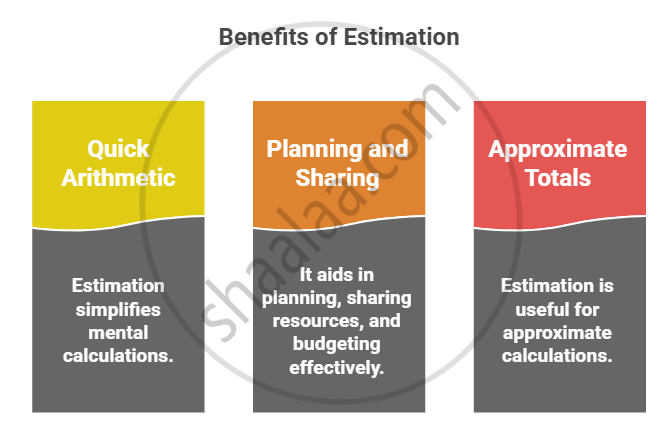
- Benefits of Estimation
- Real-Life Example
Definition: Estimation
Estimation is the process of determining an approximate value by rounding numbers to the nearest ten, hundred, thousand, or other place value to simplify calculations and judgements about size, cost, quantity, or other measurements.
Benefits of Estimation
Real-Life Examples
1. When a school plans an event (like Sports Day), they need to know roughly how much money they will spend.
- Expenditure on invitation cards = ₹ 1,530
- Expenditure on hiring the furniture = ₹ 7,250
- Expenditure on the dress of participants = ₹ 11,638
- Expenses on transportation = ₹ 4,547
- Expenditure on refreshments = ₹ 2,590
- Miscellaneous expenses = ₹ 6,240
Total estimate (approximate expenses) = ₹ 33,795
2. In a cricket match between India and Pakistan, 63,000 spectators watched the match sitting in the stadium and 53 million television viewers worldwide. Explain the statement.
Does the statement above indicate that exactly 63,000 spectators were in the stadium, or does it say that exactly 53 million viewers watched the match on television?
Explanation:
Saying 63,000 spectators at a match doesn’t mean exactly 63,000 people—it might be 62,500 or 64,000. It’s just close.
Saying 53 million viewers on TV means around 53 million—maybe 52.6 or 54 million.
Saying half an acre of land, about 800 m away, or around 200 guests at a wedding are all approximations.
3. Shopping Estimate: If invitation cards cost ₹1,530, furniture ₹7,250, and dresses ₹11,638, round and add for a quick estimate:
- Cards: ₹1,500
- Furniture: ₹7,000
- Dresses: ₹12,000
- Estimated total: ₹1,500 + ₹7,000 + ₹12,000 = ₹20,500
