Topics
Part 1
Integers
- Natural Numbers
- Whole Numbers
- Negative and Positive Numbers
- Integers
- Representation of Integers on the Number Line
- Ordering of Integers
- Addition of Integers
- Subtraction of Integers
- Properties of Addition and Subtraction of Integers
- Multiplication of a Positive and a Negative Integers
- Multiplication of Two Negative Integers
- Product of Three Or More Negative Integers
- Closure Property of Multiplication of Integers
- Commutative Property of Multiplication of Integers
- Multiplication of Integers with Zero
- Multiplicative Identity of Integers
- Associative Property of Multiplication of Integers
- Distributive Property of Multiplication of Integers
- Making Multiplication Easier of Integers
- Division of Integers
- Properties of Division of Integers
Large Numbers Around Us
Part 2
Arithmetic Expressions
Fractions and Decimals
- Concept of Fraction
- Types of Fractions
- Concept of Proper and Improper Fractions
- Concept of Mixed Fractions
- Concept of Equivalent Fractions
- Like and Unlike Fraction
- Comparing Fractions
- Addition of Fraction
- Subtraction of Fraction
- Multiplication of a Fraction by a Whole Number
- Using Operator 'Of' with Multiplication and Division
- Multiplication of Fraction
- Division of Fractions
- Concept of Reciprocals or Multiplicative Inverses
- Problems Based on Fraction
- The Decimal Number System
- Comparing Decimal Numbers
- Addition of Decimal Fraction
- Subtraction of Decimal Numbers
- Multiplication of Decimal Numbers
- Division of Decimal Numbers
- Problems Based on Decimal Numbers
A Peek Beyond the Point
Data Handling
Expressions using Letter-Numbers
Simple Equations
Lines and Angles
Parallel and Intersecting Lines
The Triangle and Its Properties
- Basic Concepts of Triangles
- Classification of Triangles based on Sides
- Classification of Triangles based on Angles
- Median of a Triangle
- Altitudes of a Triangle
- Exterior Angle of a Triangle and Its Property
- Some Special Types of Triangles - Equilateral and Isosceles Triangles
- Basic Properties of a Triangle
- Right-angled Triangles and Pythagoras Property
Number Play
Congruence of Triangles
- Similarity and Congruency of Figures
- Congruence Among Line Segments
- Congruence of Angles
- Congruence of Triangles
- Criteria for Congruence of Triangles
- Criteria for Similarity of Triangles
- SAS Congruence Criterion
- ASA Congruence Criterion
- RHS Congruence Criterion
- Exceptional Criteria for Congruence of Triangles
A Tale of Three Intersecting Lines
Comparing Quantities
- Ratio
- Concept of Equivalent Ratios
- Proportion
- Unitary Method
- Basic Concept of Percentage
- Estimation in Percentages
- Interpreting Percentages
- Conversion between Percentage and Fraction or Decimal
- Ratios to Percents
- Increase Or Decrease as Percent
- Basic Concepts of Profit and Loss
- Profit or Loss as a Percentage
- Calculation of Interest
Working with Fractions
Rational Numbers
- Rational Numbers
- Equivalent Rational Number
- Positive and Negative Rational Numbers
- Rational Numbers on a Number Line
- Rational Numbers in Standard Form
- Comparison of Rational Numbers
- Rational Numbers Between Two Rational Numbers
- Addition of Rational Number
- Subtraction of Rational Number
- Multiplication of Rational Numbers
- Division of Rational Numbers
Geometric Twins
Perimeter and Area
- Basic Concepts in Mensuration
- Concept of Perimeter
- Perimeter of a Rectangle
- Perimeter of Squares
- Perimeter of Triangle
- Perimeter of Polygon
- Concept of Area
- Area of Square
- Area of Rectangle
- Triangles as Parts of Rectangles and Square
- Generalising for Other Congruent Parts of Rectangles
- Area of a Parallelogram
- Area of a Triangle
- Circumference of a Circle
- Area of Circle
- Conversion of Units
- Problems based on Perimeter
- Problems based on Area
Algebraic Expressions
Operations with Integers
Practical Geometry
- Construction of a Line Parallel to a Given Line, Through a Point Not on the Line
- Construction of Triangles
- Constructing a Triangle When the Length of Its Three Sides Are Known (SSS Criterion)
- Constructing a Triangle When the Lengths of Two Sides and the Measure of the Angle Between Them Are Known. (SAS Criterion)
- Constructing a Triangle When the Measures of Two of Its Angles and the Length of the Side Included Between Them is Given. (ASA Criterion)
- Constructing a Right-angled Triangle When the Length of One Leg and Its Hypotenuse Are Given (RHS Criterion)
Exponents and Powers
- Concept of Exponents
- Multiplying Powers with the Same Base
- Dividing Powers with the Same Base
- Taking Power of a Power
- Multiplying Powers with Different Base and Same Exponents
- Dividing Powers with Different Base and Same Exponents
- Numbers with Exponent Zero, One, Negative Exponents
- Miscellaneous Examples Using the Laws of Exponents
- Decimal Number System Using Exponents and Powers
- Crores
Finding Common Ground
Symmetry
Another Peek Beyond the Point
Connecting the Dots
Visualizing Solid Shapes
Constructions and Tilings
Finding the Unknown
- Definition: Whole Numbers
- Characteristic of Whole Numbers
- Real-life Examples
- Key Points Summary
CISCE: Class 6
Definition: Whole numbers
Whole numbers are a foundational concept in mathematics, encompassing all non-negative integers starting from zero.
Example: 0, 1, 2, 3, 4, ..., 367, 368, ..., 237105, ...

CISCE: Class 6
Characteristic of Whole Numbers
- A whole number is either 0 or a natural number.
- The first and the smallest whole number is 0 (zero).
- It is impossible to obtain the last and greatest whole number. [Like natural numbers, whole numbers are also infinite].
- The difference between two consecutive whole numbers is 1 (one).
- By adding 1 to any whole number, its next whole number is obtained.
- All natural numbers are whole numbers; not all whole numbers are natural numbers.
The number line used to represent whole numbers is as given below:
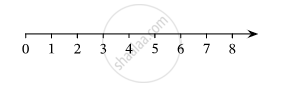
- Zero (0) is the smallest whole number.
- There is no whole number on the left side of 0.
- Each whole number (apart from 0) is on the right side of 0.
- A whole number is
(a) greater than every whole number on its left.
(b) smaller than every whole number on its right.
CISCE: Class 6
Real-Life Applications
-
Counting empty seats: If no one is present, “0” is a valid count.
-
Measuring zero weight on a scale: Zero is meaningful in science and math.
-
Bank balance: A balance of ₹0 is still counted as a whole number.
CISCE: Class 6
Key Points Summary
-
Whole numbers: 0,1,2,3,...0,1,2,3,...
-
First and smallest is 0.
-
Used in daily life for counting, inventory, scores, and much more.
-
No fractions, negatives, or decimals involved.
Test Yourself
Shaalaa.com | What Are Whole Numbers
to track your progress
