Topics
Living World and Classification of Microbes
Health and Diseases
Force and Pressure
- Introduction to Effects of Force
- Types of Forces>Contact and Non-Contact Forces
- Balanced and Unbalanced Forces
- Inertia and Mass
- Types of Inertia
- Thrust and Pressure
- Pressure on Solids
- Pressure of liquid
- Gas Pressure
- Atmospheric Pressure
- Buoyancy Force (Upthrust Force)
- Archimedes Principle
- Density of substance and Relative density
Current Electricity and Magnetism
Inside the Atom
Composition of Matter
- Matter (Substance)
- Characteristics of Particles (Molecules) of Matter
- States of Matter
- The Solid State
- The Liquid State
- The Gaseous State
- Elements
- Earth and Elements
- Non-Metals
- Type of Element: Metalloid
- Compound
- Types of Compound
- Mixture
- Types of Mixtures
- Introduction to Solutions
- Suspension Solution
- Colloidal Solution
- Molecular Formula of Compounds
- Periodic Trends in the Modern Periodic Table
Metals and Nonmetals
Pollution
- Pollution
- Air Pollution
- Prevention and Control of Air Pollution
- Water Pollution
- Effects of Water Pollution
- Prevention and Control of Water Pollution
- Soil Pollution
- Effects of Soil Pollution
- Prevention and Control of Soil Pollution
- Relationship of Soil Pollution with Air and Water Pollution
- Laws for Control, Regulation, and Prevention of Pollution by Indian Government
Disaster Management
Cell and Cell Organelles
- Cell: Structural and Functional Unit of Life
- Prokaryotic and Eukaryotic Cell
- Plant Cell Vs Animal Cell
- Cell Organelles
- Structure of the Cell > Cell Wall: “Supporter and Protector”
- Structure of the Cell > Plasma Membrane / Cell Membrane
- Structure of the Cell > Cytoplasm: “Area of Movement”
- Structure of the Cell > Nucleus: “Brain” of the Cell
- Endoplasmic Reticulum (ER)
- Golgi Apparatus - "The delivery system of the cell"
- Lysosome - “Suicidal Bag”
- Mitochondria - “Power House of the Cell”
- Plastids
- Non-living Substances Or Cell Inclusion
Human Body and Organ System
- Human Body
- Human Organ System
- Mechanism of Respiration > Breathing
- Human Respiratory System
- Blood Circulatory System
- Human Heart
- Blood Vessels
- Circulation of Blood in the Heart (Functioning of Heart)
- Heart Beat
- Blood
- Plasma (The Liquid Portion of Blood)
- Composition of Blood > Cellular Elements: Red Blood Cells (Erythrocytes)
- Composition of Blood > Cellular Elements: White Blood Cells (Leukocytes)
- Composition of Blood > Cellular Elements: Blood Platelets (Thrombocytes)
- Functions of Blood
- Blood Transfusion and Blood Groups (ABO and Rh system)
- Blood Pressure (B.P.)
- Heart Related Conditions
Introduction to Acid and Base
Chemical Change and Chemical Bond
Measurement and Effects of Heat
Sound
Reflection of Light
Man Made Materials
Ecosystems
Life Cycle of Stars
- Introduction of the Sun
- Properties of the Sun
Introduction of the Sun:
The Sun is the centre of our solar system and the most significant source of energy for life on Earth. It is a massive, nearly perfect sphere of hot plasma, primarily composed of hydrogen and helium. With a diameter of about 1.39 million kilometres, the Sun is approximately 109 times the size of Earth and accounts for about 99.86% of the total mass of the solar system. Its immense gravitational force keeps the planets, moons, asteroids, and comets in their orbits.
The Sun is classified as a G-type main-sequence star (G2V), commonly known as a yellow dwarf. It is an average-sized star compared to the billions of stars in the universe, yet its proximity to Earth (approximately 150 million kilometres or 93 million miles) makes it appear much larger and brighter than other stars in the sky. This distance is known as an Astronomical Unit (AU) and serves as a fundamental measurement in astronomy.

The Sun
Properties of the Sun:
1. Energy Production: At the core of the Sun, nuclear fusion occurs, where hydrogen atoms are converted into helium. This process releases an enormous amount of energy in the form of light and heat, sustaining life on Earth and driving the planet's weather and climate systems.
2. Surface and Layers:
- Core: The innermost region where nuclear fusion occurs, reaching temperatures of about 15 million Kelvin.
- Radiative Zone: Energy travels outward in the form of radiation.
- Convective Zone: Hot plasma rises and falls, creating convection currents.
- Photosphere: The visible surface of the Sun, with temperatures around 5,800 Kelvin.
- Chromosphere and Corona: Outer layers visible during solar eclipses, emitting ultraviolet and X-ray radiation.
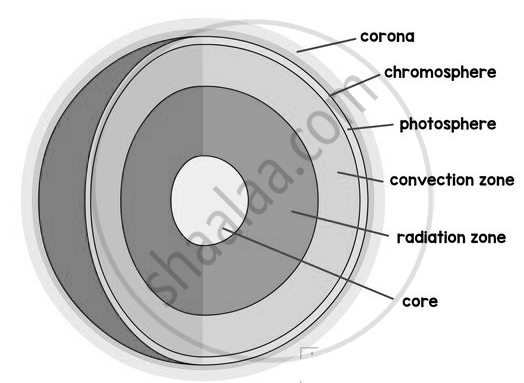
Layers of The Sun
3. Composition: The Sun is mainly composed of 72% hydrogen and 26% helium, with small amounts of heavier elements like oxygen, carbon, and iron.
4. Age and Lifecycle: The Sun is about 4.5 billion years old and is expected to remain in its current stable phase for another 4.5–5 billion years. Eventually, it will expand into a red giant and then shrink into a white dwarf as part of its natural lifecycle.
5. Comparison with Other Stars: Stars vary in size and mass. Their masses range from 1/10th the mass of the Sun (0.1 MSun) to 100 times the Sun’s mass (100 MSun). Radii of stars can range from 1/10th to 1000 times the Sun's radius.
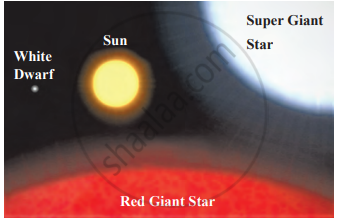
A comparison of sizes of different stars
6. Role in the Solar System:
- The Sun’s gravitational pull keeps all planets, asteroids, and comets in orbit around it.
- The Sun provides the light and heat necessary for photosynthesis, weather systems, and maintaining Earth's temperature. Without it, life as we know it would not exist.
