Topics
Force, Work, Power and Energy
Force
Light
Work, Energy and Power
- Concept of Work
- Measurement of Work
- Expression for Work (W = F S cosθ)
- Work Done by the Force of Gravity (W = mgh)
- Concept of Power
- Work vs Power
- Concept of Energy
- Energy vs Power
- Mechanical Energy > Potential Energy (U)
- Mechanical Energy > Kinetic Energy (K)
- Potential vs Kinetic Energy
- Conversion of Potential Energy into Kinetic Energy
- Forms of Energy > Solar Energy
- Forms of Energy > Heat Energy
- Forms of Energy > Light Energy
- Forms of Energy > Chemical Energy
- Forms of Energy > Hydro Energy
- Forms of Energy > Electrical Energy
- Forms of Energy > Nuclear Energy
- Forms of Energy > Geo Thermal Energy
- Forms of Energy > Wind Energy
- Forms of Energy > Sound Energy
- Forms of Energy > Magnetic Energy
- Forms of Energy > Mechanical Energy
- Conversion of Energies
- Principle of Conservation of Energy
- Proof: Kinetic + Potential Energy = Constant for Free Fall
- Application of the Principle of Conservation of Energy
Machines
- Concept of Machines
- Technical Terms Related to a Machine
- Principle of a Machine
- Efficiency, Mechanical Advantage, and Velocity Ratio
- Levers
- Types of Levers
- Pulley
- Single Fixed Pulley
- A Single Movable Pulley
- Single Pulley vs Single Movable Pulley
- Combination of Pulleys
- Using one fixed pulley and other movable pulleys
- Using several pulleys in two blocks (block and tackle system)
Sound
Electricity and Magnetism
Refraction of Light at Plane Surfaces
- Light: Reflection and Refraction
- Refraction of Light
- Laws of Refraction
- Speed of Light in Different Media
- Principle of Reversibility of the Path of Light
- Refraction Laws & Glass Index
- Refraction of Light Through a Rectangular Glass Block
- Multiple Images in a Thick Mirror
- Prism
- Refraction of Light through a Prism
- Real and Apparent Depth
- Apparent Bending of a Stick Under Water
- Consequences of Refraction of Light
- Transmission of Light From a Denser Medium to a Rarer Medium
- Critical Angle
- Relationship between Critical Angle and Refractive Index
- Total Internal Reflection
- Total Internal Reflection in a Prism
- Total Internal Reflection Through a Right-Angled Isosceles Prism
- Total Internal Reflection Through an Equilateral Prism
- Total Internal Reflection Through Right-angled prism
- Use of a Total Internal Reflecting Prism in Place of a Plane Mirror
- Total Internal Reflection vs Reflecting from a Plane Mirror
- Consequences of Total Internal Refraction
Heat
Refraction Through a Lens
- Concept of Lenses
- Action of a Lens as a Set of Prisms
- Technical Terms Related to a Lens
- Convex Lens vs Concave Lens
- Refraction of Light Through an Equi-Convex Lens and an Equi-Concave Lens
- Principal Rays for Ray Diagrams
- Real Image vs Virtual Image
- Construction of a Ray Diagram for a Lens
- Images Formed by Convex Lenses
- Images Formed by Concave Lenses
- Sign Convention
- Lens Formula and Magnification
- Linear Magnification
- Power of a Lens
- Magnifying Glass Or Simple Microscope
- Application of Lenses
- Experimental Determination of Focal Length of Convex Lens
- Convex Lens vs Concave Lens
Spectrum
- Deviation Produced by a Triangular Prism
- Colour in White Light with Their Wavelength and Frequency Range
- Dispersion of Light Through a Prism
- Electromagnetic Spectrum
- Properties and Uses of Different Radiations of the Electromagnetic Spectrum
- Distinction between Ultraviolet, Visible, and Infrared Radiations
- Scattering of Light-Rayleigh's Law
- Applications of Scattering of Light
Modern Physics
Sound
- Sound Waves
- Light Waves vs Sound Waves
- Reflection of Sound Waves
- Echo
- Determination of Speed of Sound by the Method of Echo
- Use of Echoes
- Natural Vibrations
- Damped Vibrations
- Natural Vibrations vs Damped Vibrations
- Forced Vibrations
- Natural Vibrations vs Forced Vibrations
- Resonance (a special case of forced vibrations)
- Demonstration of Resonance
- Forced Vibrations vs Resonant Vibrations
- Examples of Resonance
- Characteristics of Sound
- Loudness and Intensity
- Pitch and frequency
- Quality and Wave Form
- Music and Noise
Current Electricity
- Electric Charges
- Electric Current
- Potential Difference
- Electric Resistance
- Ohm's Law
- Experimental Verification of Ohm’s Law and Ohmic Resistors
- Ohmic and Non-ohmic Resistors
- Specific Resistance or Electrical Resistivity
- Choice of Material of a Wire
- Superconductors
- Electromotive Force of a Cell
- Terminal Voltage of a Cell
- Internal Resistance of a Cell
- Resistance of a System of Resistors
- Resistors in Series
- Resistors in Parallel
- Forms of Energy > Electrical Energy
- Measurement of Electrical Energy
- Electrical Power
- Commercial Unit of Electrical Energy
- Power Rating of Common Electrical Appliances
- Household Consumption of Electric Energy
- Heating Effect of Electric Current
Household Circuits
- Transmission of Power from the Power Generating Station to the Consumer
- Power Distribution to a House
- House Wiring (Ring System)
- Fuse
- Reason for connecting the fuse in the live wire
- Current Rating of a Fuse
- Switches
- Circuits with Dual Control Switches (Staircase Wire)
- Earthing
- Three-pin Plug and Socket
- Colour Coding of Wires in a Cable
- High Tension Wires
- Precautions to Be Taken While Using Electricity
Electro-Magnetism
- Oersted's Experiment
- Applications of Biot-Savart's Law > Magnetic Field Due to a Straight Current-carrying Conductor of Finite Size
- Right-hand Thumb Rule
- Applications of Biot-Savart's Law > Magnetic Field at the Axis of a Circular Current-carrying Loop
- Applications of Ampere’s Circuital Law > Magnetic Field of a Long Straight Solenoid
- Electromagnet
- Permanent Magnet
- Comparison of an Electro Magnet with a Permanent Magnet
- Advantages of an Electromagnet over a Permanent Magnet
- Uses of Electromagnet
- Force on a Current-Carrying Conductor Placed in a Uniform Magnetic Field
- Simple D.C. Motor
- Introduction to Electromagnetic Induction
- Electromagnetic Induction: Experimental Demonstration
- Faraday's Explanation
- Faraday's Laws of Electromagnetic Induction
- Alternating-Current Generator
- Frequency of an a.c. in Household Supplies
- Comparison Between A.C. Generator and D.C. Motor
- Transformers
Calorimetry
- Heat
- The Temperature and a Thermometer
- Factors Affecting the Quantity of Heat Absorbed to Increase the Temperature of a Body
- Heat vs Temperature
- Thermal or Heat Capacity
- Specific Heat Capacity
- Heat Capacity vs Specific Heat Capacity
- Specific Heat Capacity of Some Common Substances
- Calorimetry
- Principle of Method of Mixtures or Principle of Calorimetry
- Natural Phenomena and Consequences of High Specific Heat Capacity of Water
- Examples of High and Low Heat Capacity
- Change of State
- Melting and Freezing
- Melting Point and Its Effects
- Vaporisation or Boiling
- Boiling Point and Its Effects
- Latent Heat
- Specific Latent Heat of Fusion of Ice
- Explanation of Latent Heat of Melting based on Kinetic Model
- Natural Consequences of High Specific Latent Heat of Fusion of Ice
Radioactivity
- Structure of the Atom and Nucleus
- Atomic Models
- Isotopes
- Isobars
- Isotones
- Radioactivity
- Radioactivity as emission of Alpha, Beta, and Gamma Radiations
- Properties of Alpha Particles
- Properties of Beta Particles
- Properties of Gamma Radiations
- Distinction between the Properties of α, β, and γ Radiations
- Changes Within the Nucleus in Alpha, Beta and Gamma Emission
- Uses of Radioactive Isotopes
- Sources of Harmful Radiations
- Harmful Effects of Radiation
- Safety Precautions While Using Nuclear Energy
- Background Radiations
- Forms of Energy > Nuclear Energy
- Nuclear Fission
- Differences Between Radioactive Decay and Nuclear Fission
- Nuclear Fusion
- Difference between Nuclear Fusion and Neclear Fission
- Introduction
- Unit of Temperature
- Experiment: 1
- Experiment: 2
Introduction
- Temperature: When things like water or air get heat, they start to get warm, and if they get a lot of heat, they become hot. We usually put our hand or finger in the water to judge how hot it is, but that is not an accurate measure. Besides, if the substance is very hot, we could get scalded.
- Thermometer: Instead of touching something hot, we use a thermometer. A thermometer is a tool that tells us exactly how hot or cold something is. The temperature on a thermometer is measured in degrees Celsius (°C), which is a way to quantify how hot or cold something is.
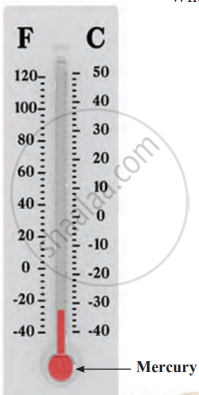
Thermometer
Types of Thermometers:
- Traditional Thermometers: Older thermometers have mercury inside them, which moves up and down a tube to show the temperature. But these are used less often now because mercury is dangerous if it breaks out.
- Digital Thermometers: Today, most thermometers are digital. They show the temperature on a small screen and are safer and quicker to use.
Experiment: 1
1. Aim: To determine the temperature of various substances using a mercury thermometer and understand how the temperature affects the mercury level.
2. Requirements: mercury thermometer, vessel with hot water, vessel with cold water or ice.
3. Procedure
- Take a mercury thermometer and observe the mercury column in the capillary tube, noting its position on the scale.
- To measure air temperature, read the temperature corresponding to the mercury level at the thermometer's bulb.
- For water temperature, immerse the thermometer bulb completely in room-temperature water and note the mercury level.
- Place the thermometer in a vessel of hot water, submerge the bulb fully, and record the temperature shown.
- Repeat the process with a vessel of cold water or ice, ensuring the bulb is submerged, and record the temperature.
4. Observations: Note the different temperatures recorded: in air, in room temperature water, in hot water, and in cold water or ice. Observe how the mercury level changes with the temperature.
5. Conclusion: The experiment shows the responsiveness of mercury in the thermometer to changes in temperature, indicated by the rise or fall of the mercury level in the capillary tube when exposed to different temperatures.
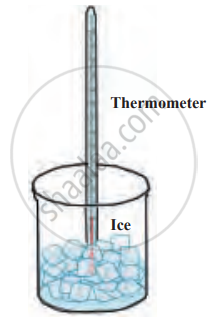
Recording the temperature
| Examples | Temperature |
|---|---|
| Boiling water | 100 °C |
| Freezing water | 0 °C |
| Air (winter night) | <15 °C |
| Air (summer afternoon) | >35 °C |
| Inside a fridge | <5 °C |
| Inside the freezer | < -18 °C |
| Body temperature | Approx. 37 °C |
Experiment: 2
1. Aim: To demonstrate how temperature perception is relative and cannot be accurately determined by touch.
2. Requirements: three similar vessels (labelled A, B, and C), hot water (for vessel A), cold water (for vessel B), and water at room temperature (mixed from A and B for vessel C).
3. Procedure
- Fill vessel A with hot water and vessel B with cold water.
- Mix some water from A and B into vessel C to make room-temperature water.
- Dip your right hand in vessel A (hot water) and your left hand in vessel B (cold water).
- Keep both hands immersed for 2-3 minutes.
- After 2-3 minutes, simultaneously dip both hands into vessel C (room-temperature water).
- Observe how each hand feels in the same water of vessel C.
4. Observation: The right hand (from hot water) feels the water in vessel C as cold. The left hand (from cold water) feels the water in vessel C as hot.
5. Conclusion: Temperature perception is relative and depends on the prior experience of the skin with different temperatures. This experiment shows that our sense of touch is not reliable for measuring temperature, emphasising the need for a device like a thermometer for accurate temperature measurement.
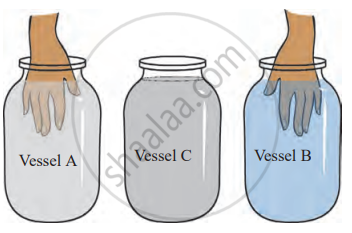
Relative sensation
Definition: Temperature
Temperature is a parameter which tells the thermal state of a body (i.e., the degree of hotness or coldness of the body). It determines the direction of flow of heat when two bodies at different temperatures are placed in contact.
Key Points: Temperature
- If no heat flows between two bodies in contact, they are said to be at the same temperature, even though their thermal energies may be different.
- The S.I. unit of temperature is kelvin (K), and absolute zero (0 K) is the temperature at which molecular motion ceases.
