Topics
Force, Work, Power and Energy
Force
Light
Work, Energy and Power
- Concept of Work
- Measurement of Work
- Expression for Work (W = F S cosθ)
- Work Done by the Force of Gravity (W = mgh)
- Concept of Power
- Work vs Power
- Concept of Energy
- Energy vs Power
- Mechanical Energy > Potential Energy (U)
- Mechanical Energy > Kinetic Energy (K)
- Potential vs Kinetic Energy
- Conversion of Potential Energy into Kinetic Energy
- Forms of Energy > Solar Energy
- Forms of Energy > Heat Energy
- Forms of Energy > Light Energy
- Forms of Energy > Chemical Energy
- Forms of Energy > Hydro Energy
- Forms of Energy > Electrical Energy
- Forms of Energy > Nuclear Energy
- Forms of Energy > Geo Thermal Energy
- Forms of Energy > Wind Energy
- Forms of Energy > Sound Energy
- Forms of Energy > Magnetic Energy
- Forms of Energy > Mechanical Energy
- Conversion of Energies
- Principle of Conservation of Energy
- Proof: Kinetic + Potential Energy = Constant for Free Fall
- Application of the Principle of Conservation of Energy
Machines
- Concept of Machines
- Technical Terms Related to a Machine
- Principle of a Machine
- Efficiency, Mechanical Advantage, and Velocity Ratio
- Levers
- Types of Levers
- Pulley
- Single Fixed Pulley
- A Single Movable Pulley
- Single Pulley vs Single Movable Pulley
- Combination of Pulleys
- Using one fixed pulley and other movable pulleys
- Using several pulleys in two blocks (block and tackle system)
Sound
Electricity and Magnetism
Refraction of Light at Plane Surfaces
- Light: Reflection and Refraction
- Refraction of Light
- Laws of Refraction
- Speed of Light in Different Media
- Principle of Reversibility of the Path of Light
- Refraction Laws & Glass Index
- Refraction of Light Through a Rectangular Glass Block
- Multiple Images in a Thick Mirror
- Prism
- Refraction of Light through a Prism
- Real and Apparent Depth
- Apparent Bending of a Stick Under Water
- Consequences of Refraction of Light
- Transmission of Light From a Denser Medium to a Rarer Medium
- Critical Angle
- Relationship between Critical Angle and Refractive Index
- Total Internal Reflection
- Total Internal Reflection in a Prism
- Total Internal Reflection Through a Right-Angled Isosceles Prism
- Total Internal Reflection Through an Equilateral Prism
- Total Internal Reflection Through Right-angled prism
- Use of a Total Internal Reflecting Prism in Place of a Plane Mirror
- Total Internal Reflection vs Reflecting from a Plane Mirror
- Consequences of Total Internal Refraction
Heat
Refraction Through a Lens
- Concept of Lenses
- Action of a Lens as a Set of Prisms
- Technical Terms Related to a Lens
- Convex Lens vs Concave Lens
- Refraction of Light Through an Equi-Convex Lens and an Equi-Concave Lens
- Principal Rays for Ray Diagrams
- Real Image vs Virtual Image
- Construction of a Ray Diagram for a Lens
- Images Formed by Convex Lenses
- Images Formed by Concave Lenses
- Sign Convention
- Lens Formula and Magnification
- Linear Magnification
- Power of a Lens
- Magnifying Glass Or Simple Microscope
- Application of Lenses
- Experimental Determination of Focal Length of Convex Lens
- Convex Lens vs Concave Lens
Spectrum
- Deviation Produced by a Triangular Prism
- Colour in White Light with Their Wavelength and Frequency Range
- Dispersion of Light Through a Prism
- Electromagnetic Spectrum
- Properties and Uses of Different Radiations of the Electromagnetic Spectrum
- Distinction between Ultraviolet, Visible, and Infrared Radiations
- Scattering of Light-Rayleigh's Law
- Applications of Scattering of Light
Modern Physics
Sound
- Sound Waves
- Light Waves vs Sound Waves
- Reflection of Sound Waves
- Echo
- Determination of Speed of Sound by the Method of Echo
- Use of Echoes
- Natural Vibrations
- Damped Vibrations
- Natural Vibrations vs Damped Vibrations
- Forced Vibrations
- Natural Vibrations vs Forced Vibrations
- Resonance (a special case of forced vibrations)
- Demonstration of Resonance
- Forced Vibrations vs Resonant Vibrations
- Examples of Resonance
- Characteristics of Sound
- Loudness and Intensity
- Pitch and frequency
- Quality and Wave Form
- Music and Noise
Current Electricity
- Electric Charges
- Electric Current
- Potential Difference
- Electric Resistance
- Ohm's Law
- Experimental Verification of Ohm’s Law and Ohmic Resistors
- Ohmic and Non-ohmic Resistors
- Specific Resistance or Electrical Resistivity
- Choice of Material of a Wire
- Superconductors
- Electromotive Force of a Cell
- Terminal Voltage of a Cell
- Internal Resistance of a Cell
- Resistance of a System of Resistors
- Resistors in Series
- Resistors in Parallel
- Forms of Energy > Electrical Energy
- Measurement of Electrical Energy
- Electrical Power
- Commercial Unit of Electrical Energy
- Power Rating of Common Electrical Appliances
- Household Consumption of Electric Energy
- Heating Effect of Electric Current
Household Circuits
- Transmission of Power from the Power Generating Station to the Consumer
- Power Distribution to a House
- House Wiring (Ring System)
- Fuse
- Reason for connecting the fuse in the live wire
- Current Rating of a Fuse
- Switches
- Circuits with Dual Control Switches (Staircase Wire)
- Earthing
- Three-pin Plug and Socket
- Colour Coding of Wires in a Cable
- High Tension Wires
- Precautions to Be Taken While Using Electricity
Electro-Magnetism
- Oersted's Experiment
- Applications of Biot-Savart's Law > Magnetic Field Due to a Straight Current-carrying Conductor of Finite Size
- Right-hand Thumb Rule
- Applications of Biot-Savart's Law > Magnetic Field at the Axis of a Circular Current-carrying Loop
- Applications of Ampere’s Circuital Law > Magnetic Field of a Long Straight Solenoid
- Electromagnet
- Permanent Magnet
- Comparison of an Electro Magnet with a Permanent Magnet
- Advantages of an Electromagnet over a Permanent Magnet
- Uses of Electromagnet
- Force on a Current-Carrying Conductor Placed in a Uniform Magnetic Field
- Simple D.C. Motor
- Introduction to Electromagnetic Induction
- Electromagnetic Induction: Experimental Demonstration
- Faraday's Explanation
- Faraday's Laws of Electromagnetic Induction
- Alternating-Current Generator
- Frequency of an a.c. in Household Supplies
- Comparison Between A.C. Generator and D.C. Motor
- Transformers
Calorimetry
- Heat
- The Temperature and a Thermometer
- Factors Affecting the Quantity of Heat Absorbed to Increase the Temperature of a Body
- Heat vs Temperature
- Thermal or Heat Capacity
- Specific Heat Capacity
- Heat Capacity vs Specific Heat Capacity
- Specific Heat Capacity of Some Common Substances
- Calorimetry
- Principle of Method of Mixtures or Principle of Calorimetry
- Natural Phenomena and Consequences of High Specific Heat Capacity of Water
- Examples of High and Low Heat Capacity
- Change of State
- Melting and Freezing
- Melting Point and Its Effects
- Vaporisation or Boiling
- Boiling Point and Its Effects
- Latent Heat
- Specific Latent Heat of Fusion of Ice
- Explanation of Latent Heat of Melting based on Kinetic Model
- Natural Consequences of High Specific Latent Heat of Fusion of Ice
Radioactivity
- Structure of the Atom and Nucleus
- Atomic Models
- Isotopes
- Isobars
- Isotones
- Radioactivity
- Radioactivity as emission of Alpha, Beta, and Gamma Radiations
- Properties of Alpha Particles
- Properties of Beta Particles
- Properties of Gamma Radiations
- Distinction between the Properties of α, β, and γ Radiations
- Changes Within the Nucleus in Alpha, Beta and Gamma Emission
- Uses of Radioactive Isotopes
- Sources of Harmful Radiations
- Harmful Effects of Radiation
- Safety Precautions While Using Nuclear Energy
- Background Radiations
- Forms of Energy > Nuclear Energy
- Nuclear Fission
- Differences Between Radioactive Decay and Nuclear Fission
- Nuclear Fusion
- Difference between Nuclear Fusion and Neclear Fission
- Definition: Power
- Formula: Power
- Key Points: Power
Introduction of Power:
Power is a measure of how quickly work is done. It tells us whether work is being completed at a fast or slow rate. In simple terms, power is the rate at which work is done. If a certain amount of work is done in time , the power can be calculated as:
Power =`"Work"/"Time"`
P=`"W"/"t"`
An introduction to scientists:
|
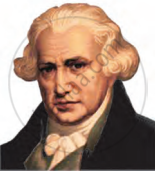
The steam engine was invented in 1781 by the Scottish scientist James Watt (1736–1819). This invention brought about an industrial revolution. The unit of power is called a watt in his honour. James Watt was the first to use the term ‘horsepower.’ |
James Watt (1736–1819) |
Units of Power:
1. SI Unit
The standard unit of work is the joule (J), and time is measured in seconds (s). Therefore, the SI unit of power is:
Power (P) =`"Joule (J)" / "Second(s)"` = Watt (W)
1 watt (W) means that 1 joule of work is done in 1 second.
2. Horsepower (hp)
In industries, power is also measured in horsepower (hp). 1 horsepower = 746 watts.
Commercial Units of Energy:
The unit used to measure large amounts of energy consumption, like electricity in homes, is the kilowatt-hour (kWh). 1 kilowatt-hour is the energy consumed when 1000 watts (1 kilowatt) of power is used for 1 hour. Conversion of 1 kWh to Joules:
1 kW = 1000 W, and 1 hour = 3600 seconds.
The energy used in 1 kWh is:
1 kWh = 1000 W × 3600 s = 3,600,000 J.
So, 1 kWh = 3.6 × 10⁶ J
In electricity bills, 1 kWh = 1 unit.
If a 1000 W (1 kW) heater is used for 2 hours, the energy consumption can be as follows:
Energy = 1 kW × 2 hours = 2 kWh.
This means 2 units of electricity were used.
Definition: Power
The rate of doing work is called power.
Formula: Power
Power P = \[\frac{\text{Work done }W}{\text{Time taken }t}\]
or
P = \[\frac {W}{t}\]
Key Points: Power
- S.I. unit: If 1 joule of work is done in 1 second, the power spent is said to be 1 watt.
- C.G.S. unit: The C.G.S. unit of power is erg per second (erg s-1).
- Relationship between S.I. and C.G.S. units:
1 W = 1 J s-1 = 107 erg s-1 - 1 horse power (H.P.) = 746 W = 0.746 kW
