English
Maharashtra State BoardSSC (English Medium) 8th Standard

Neils Bohr’s Model of an Atom

Advertisements

Topics

Estimated time: 17 minutes
Maharashtra State Board: Class 8

Introduction:

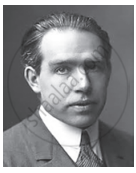
Niels Bohr was a Danish physicist born in 1885, renowned for his groundbreaking contributions to understanding atomic structure and quantum theory. He developed the Bohr model of the atom in 1913, introducing the concept of quantised energy levels for electrons, which helped explain atomic stability and spectral lines. His work laid the foundation for modern quantum mechanics, earning him the Nobel Prize in Physics in 1922.

He proposed that electrons move in fixed energy levels, or "shells," without losing energy, preventing them from spiralling into the nucleus. This explained the stability of most atoms and accounted for the specific energy emitted or absorbed by electrons, solving key issues in Rutherford’s model.
 
 
Niels Bohr
CBSE: Class 12
Maharashtra State Board: Class 11

Formula: Angular Momentum of Electron (Bohr's Quantum Condition)

\[L=mvr=\frac{nh}{2\pi},\quad n=1,2,3\ldots\]

CBSE: Class 12

Formula: Energy of Emitted/Absorbed Radiation

\[h\nu=E_2-E_1=\frac{hc}{\lambda}\]

Maharashtra State Board: Class 8

Bohr’s stable orbit atomic model:

In order to overcome the objections raised against Rutherford’s model of the atom, Niels Bohr put forward the following postulates about the model of an atom:

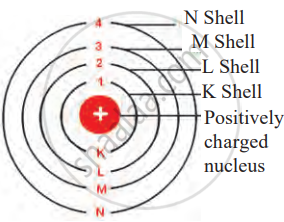
  1. Electrons move in fixed circular orbits around the nucleus at specific distances.
  2. An electron’s energy remains constant while it stays in a particular orbit.
  3. When an electron jumps to a higher orbit, it absorbs energy equal to the difference between energy levels, and when it moves to a lower orbit, it emits energy equal to that difference.

Bohr's stable orbit atomic model

These orbits or shells are represented by the letters K, L, M, N, … or the numbers n = 1, 2, 3, 4, … .

CBSE: Class 12
Maharashtra State Board: Class 11

Law: Bohr's Postulates

Bohr's First Postulate:
An atom consists of a small, massive central core called the nucleus, around which planetary electrons revolve. The centripetal force required for their rotation is provided by the electrostatic attraction between the electrons and the nucleus.

Bohr's Second Postulate (Quantum Condition):
The electrons are permitted to circulate only in those orbits in which the angular momentum of an electron is an integral multiple of \[\frac{h}{2\pi}\]; h being Planck's constant.

Bohr's Third Postulate:
While revolving in the permissible orbits, an electron does not radiate energy. These non-radiating orbits are called stationary orbits.

Bohr's Fourth Postulate:
An atom can emit or absorb radiation in the form of discrete energy photons only when an electron jumps from a higher to a lower orbit or from a lower to a higher orbit, respectively.
Maharashtra State Board: Class 8

Merits and Demerits:

Merits Demerits
Successfully explained why electrons do not spiral into the nucleus and how atoms remain stable. Could not explain the spectral patterns of atoms more complex than hydrogen.
Introduced quantised energy levels, matching observed spectral lines of hydrogen. Did not consider that electrons also behave like waves.
Accurately described the emission and absorption spectra of hydrogen. Failed to address finer details, such as the splitting of spectral lines observed under a magnetic field.
CBSE: Class 12

Key Points: Neils Bohr’s Model of an Atom

  • Bohr modified Rutherford's model - electrons move in fixed orbital shells, each with fixed energy levels.
  • The centripetal force for electron revolution is provided by electrostatic attraction between the electron and the nucleus.
  • An electron does not radiate energy while revolving in a stationary orbit.
  • Energy is emitted or absorbed only during electron transitions between orbits.
  • Limitations of Bohr's Model:
  • Fails to explain the Zeeman Effect (effect of high magnetic fields on atomic spectra).
  • Contradicts the Heisenberg Uncertainty Principle.
  • Unable to explain the spectra of larger/multi-electron atoms.

Shaalaa.com | Bohr and Quantum model, Neutrons

Shaalaa.com


Next video


Shaalaa.com


Bohr and Quantum model, Neutrons [00:07:02]
S
Series: series 1
0%


Advertisements
Share
Notifications

Englishहिंदीमराठी


      Forgot password?
Use app×