Topics
Intelligence and Ability
- Concept of Intelligence
- Nature of Intelligence in the Indian Context
- Judging Intelligence from Behaviour
- Measurement of Intelligence
- Mental Age
- Intelligence Quotient
- Intelligent Tests
- Types of Intelligence Tests
- Individual Test
- Group Test
- Verbal Test
- Non-Verbal Test
- Infant Intelligence Tests
- Culture Bias and Culture Fair Tests
- Non-Verbal Test> Raven's Progressive Matrices Test
- Validity of Intelligence Tests
- Levels of Intelligence
- Implications of Intelligence Levels
- Characteristics of Gifted Children
- Distribution of I.Q.s in the Population
- Constancy of I.Q.
- Age and Intelligence
- Significance and Implications of Intelligence Levels
- Determinants of Intelligence
- Hereditary Factors
- Hereditary Factors> Jensen’s Theory
- Environmental Factors
- Environmental Factors> Indian Studies on Environment and Intelligence
- Environmental Factors> Culture
- Environmental Factors> Sex Differences
- Environmental Factors> Health
- Environmental Factors> Family Size
- Environmental Factors> Social Deprivation
- Environmental Factors> Socio-economic Status
- Theories of Intelligence
- Charles Spearman's Two Factor Theory
- Louis Thurstone’s Multifactor Theory
- Guilford's Structural Model Theory
- E. L. Thorndike's Theory
- Modern Theories of Intelligence
- Howard Gardner's Multiple Intelligence Theory
- Sternberg’s Triarchic Theory
- Theory of Intelligence by Cattell
- The Pass Theory of Intelligence
- New Trends in Intelligence> Emotional Intelligence
- Characteristics of Emotional Intelligent Person
- New Trends in Intelligence> Artificial Intelligence
- Creativity and Intelligence
- Characteristics of Creative Person
- Factors Affecting Creativity
- Relation Between Creativity and Intelligence
- Concept of Aptitude
- Types of Aptitude Tools
- Types of Aptitude Test> General Aptitude Test Battery (GATB)
- Types of Aptitude Test> Differential Aptitude Test (DAT)
- Types of Aptitude Test> Special Aptitude Test
- Achievement Tests
- Uses of Achievement Tests
- Batteries of Achievement Tests
- Combination of Aptitude-Achievement Batteries
- Concept of Interest
- Interest Tests
- Types of Interest Test Tools> Strong Vocational Interest Blank
- Types of Interest Test Tools> Strong-Campbell Interest Inventory (1974)
- Comparison of Aptitude, Achievement, and Interest Tests
Personality
- Concept of Personality
- Psychological System
- Characteristics of Personality
- Personality Related Terms
- Classification of Personality
- Friedman's Theory of Personality
- Charak Samhita's of Ayurveda Theory of Personality
- Charak Samhita's of Ayurveda Theory of Personality> Personality Type of Charaka and Sushruta
- Charak Samhita's of Ayurveda Theory of Personality> Personality Types based on Triguna
- Kretschmer's Theory of Personality
- Sheldon’s Theory of Personality
- Determinants of Personality
- Situational Determinants
- Situational Determinants> Role of Home
- Situational Determinants> Effect of School and Education
- Situational Determinants> Sibling Rivalry
- Environmental Factors> Socio-economic Status
- Measurement of Personality
- Psychometric Tests
- Psychometric Tests> Questionnaires/Self Report Inventories
- Psychometric Tests> Use of Self-Report Inventories
- Psychometric Tests> Minnesota Multiphasic Personality Inventory (MMPI)
- Behavioural Analysis
- Projective Techniques
- Projective Techniques> Impressive
- Projective Techniques> Interpretive
- Rorschach Test
- Thematic Apperception Test
- Rosenzweig Picture Frustration Test
- Kahn Test of Symbol Digit Arrangement
- Word Association Test
- C.A.T. (Children’s Apperception Test)
- Indian Personality Tests
- Types of Personalities
- Theories of Personality
- Freud's Psychoanalytic Theory of Personality
- Freud's Psychoanalytic Theory of Personality> Pre-conscious or Sub-Conscious
- Freud's Psychoanalytic Theory of Personality> Structure of Freud's Theory of Personality
- Freud's Psychoanalytic Theory of Personality> Stages of Personality Development
- Phallic Stage
- Genital Stage
- Neo-Freudian Theory of Personality
- Carl Jung’s Theory of Personality
- A. Adler's Theory of Personality (1870-1937)
- Erik Erikson's Theory of Psycho-Social Development
- Karen Horney (1950)
- Humanistic Approach
- Carl Roger's Self Theory
- Maslow’s Theory of Self Actualization
- Descriptive Personality Theories
- Type Theories
- Type Theory> Jung's Type Theory
- Extroverts
- Introverts
- Ambiverts
- Type Theory> Hippocrates' Type Theory of Personality
- Type Theory> Eysenck Concept of Personality
- Trait Theories
- Trait Theory> Cattell’s Concept of Personality
- Catell's Concept of Personality> Criticism and Evaluation of Cattell’s Trait Theory
- Social Cognition and Social Learning Theories
- Social Learning Theory of Bandura
- Social Learning Theory by Julian Rotter (1954, 1982)
- Improving Social Skills through Imitation and Observation
- Trait Theory> Trait Theory of G. Allport
- Trait Theory> Types of Traits
- Trait Theory> Dimensions of Personality
Life Span Development
- Concept of Life Span Development
- Growth and Development of Life
- Principles and Characteristics of Development
- Trends of Development
- Factors Influencing Development
- Importance of Studying Childhood Development
- Maturation and Learning or Heredity and Environment
- Genetic Bases of Development
- Chromosome
- Genes
- Mechanism of Heredity Transmission
- Sex Determination
- Effect of Heredity on Human Beings
- Personality
- Concept of Intelligence
- Importance of Heredity in Development
- Heredity's Role in Human Development
- Environment's Role in Human Development
- Interaction between Heredity and Environment
- Bronfenbrenner's Ecological System Theory
- Levels of Ecological System
- Bronfenbrenner’s Views and Applications
- Technology and Ecological System
- Stages of Development> Period of Infancy
- Stages of Development> Prenatal Developmental Period
- Crying and Breathing
- Functions of Vital Organs
- Temperature
- Sensory Development of the Neonate
- Sensory Development of the Neonate> Reaction to Sound
- Sensory Development of the Neonate> Smell and Taste
- Sensory Development of the Neonate> Temperature
- Sensory Development of the Neonate> Pain
- Sex Differences in Development
- Activities and Needs of the Infant
- Perceptual Development of the Infant
- Stages of Development> Babyhood
- Stages of Development> Childhood
- Concept of Adolescence
- Physical Development
- Height and Weight
- Development of Nervous System
- Motor Skills during Preschool Age
- Motor Development
- Locomotor Development
- Bipedal Locomotion
- Development of Motor Skills
- Objective Performance
- Motor Development during Infancy
- Piaget's Concept of Cognitive Development
- Piaget’s Stages of Cognitive Development
- Sensory-Motor Period
- Sensory-Motor Period> Internal Mental Combination (18-24 months)
- Pre-Operational Period
- Period of Intuitive Thought
- Concrete Operation Stage
- Formal Operation Stage (11 Years and Above)
- Emotional Development during Infancy and Childhood
- Characteristics of Emotions
- Development of Emotion
- Bridges’ Theory of Emotional Development (1932)
- Role of Maturation in Emotional Development
- Role of Learning and Imitation
- Concept and Nature of Attachment
- Growth of Attachment
- Formation of Attachment
- Role of Feeding in Attachment
- Smile and Attachment Behaviour
- Attachment and Anxiety
- Importance of Attachment to Child Development
- Mary Ainsworth's Strange Situation Test (1965)
- Beginning of Social Behaviour
- Reaction to Mother
- Social Behaviour During Early Childhood
- Social Behaviour Development: 0–2 Years
- Eighteenth Month to Two Years
- Early Childhood (2 yrs – 6 yrs)
- Role of Peers in Social Development
- Forms of Social Behaviour
- Development of Gender Identity
- Development of Gender Roles
- Gender Typing
- Adjustment Demands of Adolescence
- Gender Stereotypes
- Sexual Behaviour during Adolescence
- Major Concerns of Adolescence
- Gender Differences in Development
- Major Concerns of Adolescence > Delinquency
- Elements of Gender Differences
- Conscience and Moral Development
- Major Concerns of Adolescence > Substance Abuse
- Major Psychological Disorder> Eating Disorders
- Factors Influencing Conscience
- Bulimia Nervosa
- Morality and Conscience in Adolescence
- Piaget's View on Moral Development
- Anorexia Nervosa
- Kohlberg's View on Moral Development
- Kohlberg's Stages of Moral Development
- Critique of Kohlberg's Moral Reasoning Theory
- Features & Challenges of Adolescence
- Socio-Emotional Impact on Adolescents
- Interrelation of Physical Development, Social Acceptance, and Personality
- Cognitive Development during Adolescence
Stress and Stress Management
- Concept of Stress
- Nature of Stress
- Process of Stress
- Levels of Stress
- Concept of Stressors
- Types of Stressors
- Characteristics of Stressors
- Concept of Burnt Out
- General Adoption Syndrome (G.A.S.)
- Limitations of G.A.S.
- Types of Stress
- Sources of Stress
- Sources of Stress> Environmental/Situational, External
- Sources of Stress> Environmental/Situational, External
- Frustration (Physical, Social, and Internal Stressors)
- Sources of Stress> Internal Sources of Stress
- Introversion and Extroversion
- Personality Types of Variables
- Effects of Stress on Physical Health
- Cardiovascular Disorder
- Coronary Heart Disease
- Essential Hypertension
- Tension Headaches
- Asthma
- Eczema
- Peptic Ulcers
- Colitis
- Diabetes
- Effects of Stress on Performance
- Relation between Stress and Performance
- Effects of Stress on Mental Illness
- Stress Management
- Effective Ways of Handling Stress
- Stress Management Techniques
- Stress Management Techniques> Sudarshan Kriya
- Stress Management Techniques> Biofeedback
- Stress Management Techniques> Relaxation Techniques
- Ineffective Ways of Handling Stress
- Ineffective Ways of Handling Stress> Ineffective Responses
- Ineffective Ways of Handling Stress> Defence Mechanisms of the Ego
- Repression
- Regression
- Projection
- Displacement
- Reaction Formation
- Promoting Positive Health and Well-being
- Impact of Stress on Well-Being
- Effective Lifestyle
Psychological Disorders and Psychotherapy
- Concept of Abnormal Behaviour
- Perspectives of Abnormal Behaviour> Statistical Perspective
- Perspectives of Abnormal Behaviour> Biological and Medical Perspectives
- Perspectives of Abnormal Behaviour> Psychological/Psychodynamic Perspective
- Perspectives of Abnormal Behaviour> Socio-Cultural Perspective
- Perspectives of Abnormal Behaviour> Diathesis-Stress Perspective
- Features of Abnormal Behaviour
- Classification of Psychological Disorders
- DSM-IV Classification System
- DSM-IV Classification System> DSM-IV Multiaxial System
- DSM-IV Classification System> Schizophrenia Symptoms (as per DSM-IV-TR)
- Limitations of DSM-IV
- APA Criteria of Abnormal Behaviour
- DSM-V Classification
- Major Psychological Disorder> Anxiety Disorders
- Symptoms of Anxiety Disorders
- Major Psychological Disorder> Obsessive Compulsive Disorder (OCD)
- Concept of Obsession
- Compulsive Disorder
- Mood Disorders
- Depressive Disorders
- Causes of Depression
- Major Psychological Disorder> Dissociative Disorders
- Dissociative Amnesia
- Personality Disorder
- Anti-social Personality Disorder
- Avoidant Personality Disorder
- Histrionic Personality Disorder
- Dependent Personality Disorder
- Passive and Aggressive Style Personality
- Major Psychological Disorder> Eating Disorders
- Anorexia Nervosa
- Bulimia Nervosa
- Behavioural and Developmental Disorders
- External Behaviour Disorders
- Internal Behaviour Disorders
- Autism
- Major Psychological Disorder> Schizophrenia
- Symptoms of Schizophrenia> Positive Symptoms
- Symptoms of Schizophrenia> Negative Symptoms
- Types of Schizophrenia
- Origin and Causes of Schizophrenia
- Treatment and Management of Schizophrenia
- Concept of Psychotherapy
- Forms of Psychotherapy
- Psychodynamic Therapies
- Psychodynamic Therapies> Psychoanalysis
- Techniques used in Psychoanalysis
- Psychodynamic Therapies> Alfred Adler's Psychodynamic Therapy
- Psychodynamic Therapies> Sullivan's Psychodynamic Therapy
- Humanistic-existential Therapy> Client Centred Therapy
- Behaviour Therapies
- Behaviour Therapies> Systematic Desensitisation
- Behaviour Therapies> Operant-Based Behaviour Therapy
- Aversion Therapy
- Flooding or Impulsive Therapy
- Modelling
- Assertive Training
- Thought Stopping
- Token Economy
- Behaviour Therapies> Evaluation of Behaviour Therapy
- Cognitive Therapy
- Rehabilitation
Social Thought and Social Behaviour
- Social Perception
- Concept of Attribution
- Biases in Forming Attribution or Judgments
- Biases in Attribution
- Influence of Feedback on Attribution
- Sources of Biases> Cognitive Bias
- Sources of Biases> Person Positively Bias
- Sources of Biases> Motivational Bias
- Sources of Biases> Motivational Skepticism
- Sources of Biases> False Consensus Effect
- Sources of Biases> Cultural Bias
- Sources of Biases> Hostile Attribution Bias
- Sources of Biases> Intergroup Attribution Bias
- Criticisms of Attribution Bias
- Reduction of Attribution Bias
- Social Groups
- Characteristics of Social Group
- Types of Social Group
- Formation of Groups
- Ingredients of Group Behaviour
- Functions of Group
- Group At Work
- Influence of Group on Individual Behaviour
- Changing Others’ Behaviour
- Reasons for Influencing Behaviour
- Techniques of Behaviour Change
- Concept of Social Norms
- Concept of Conformity
- Value of Conformity
- Conformity to Social Norms
- Asch's Study on Conformity
- Concept of Obedience
- Causes of Obedience
- Milgram's Experiment on Obedience
- Difference between Conformity and Obedience
- Factors Affecting Conformity and Obedience
Attitudes, Prejudice and Stereotypes
- Concept of Attitude
- Earlier Studies on Attitude
- Nature and Components of Attitudes
- Classification of Attitude
- Formation of Attitude
- Role of Genetic Factors in Attitude Formation
- Determinants of Attitude
- Motivational Determinants
- Perceptual Determinants
- Social Determinants
- Verbal Determinant
- Personality Factors
- Functions of Attitude
- Attitude and Related Concepts
- Attitude Change
- Social Groups
- Compliance
- Identification
- Internalization through Persuasion
- Direct Contact
- Increased Familiarity of the Attitudinal Object
- Education
- Frame of Reference
- Sudden Conversion due to Trauma
- Role Playing and Dramatic Experience
- Cognitive Dissonance
- Balance of the Psychological Field
- Programme of Action for Attitude Change
- Indian Research on Attitude and Change
- Prejudice and Discrimination
- Concept of Prejudice
- Origin and Development of Prejudice
- Gender Prejudice
- Causes of Prejudice
- Personality and Motivational Determinants
- Cultural Determinants
- Indian Studies on Social Prejudice
- Studies on Caste Prejudice
- Reducing and Resisting Prejudice and Discrimination
- Cognitive Approaches
- Educational Approaches
- Concept of Stereotypes
- Types of Stereotypes
- Caste Stereotypes
- Gender Stereotypes
- Community Stereotypes
- Change of Stereotypes
- Studies on Stereotypes
Applications of Psychology to Different Areas of Life
- Applications of Psychology
- Applications of Psychology > Clinical and Counselling Psychology
- Components of Counselling Process
- Areas of Counselling
- Application of Psychological Tests in Counselling
- Stages of Counselling Process
- Counselling and Psycho-Analysis
- Counselling and Anti-social Behaviour
- Case Studies Using Counselling Process
- Types of Counselling
- Counselling and Therapy
- Advantages of Counselling
- Ethics in Counselling
- Role of Counsellor
- Role of a Counsellor with Individuals, Couples and Families
- Role of a Counsellor with Couples
- Role of Counsellor in Family Issues
- Role of Counsellor with Group Problems
- Applications of Psychology > School and Educational Area
- Facilitation of Learning in School
- Effective Motivation for Study
- Stimulating School Environment
- Making the Study Material Meaningful
- Teacher–Student Relationship
- Difficulties of Teachers and Students
- Teaching and Evaluation Techniques
- Objective Type of Examination
- Role of School Psychologist
- Improvement of Memory of Students
- Method of LOCI
- Numerical Pegs
- Chunking
- Narrative Stories
- Individual Differences and Career Planning
- Career Counselling
- Role of Psychologist in Career Selection
- Requirements of a Job
- Job Analysis
- Testing Individuals
- Matching Individuals with Jobs
- Determinants of Judicious Choice of Career
- Career Information
- Aligning Career with Aptitude & Interest
- Don't Pursue a Job Due to Pressure
- Develop Insight into Self
- Opportunities, Hobbies, and Interests
- Applications of Psychology > Organisational Area
- Personnel Psychology
- Selection and Recruitment
- Training
- Scientific Management
- Planning and Time and Motion Study
- Time Study
- Motion Study
- Scientific Management
- Role of Social Industrial Psychology and Attitude
- Motivation, Incentives, Job Satisfaction and Work Environment
- Leadership Skills and Team Building
- Marketing and Consumer Behaviour
- Personal Consumer and Organizational Consumer
- Personality Factors of Consumers
- Self Image and Multiple Selves
- Role of Culture on Consumer Psychology
- Cross-Cultural Consumer Analysis
- Consumer's Decision-Making Process
- Application of Psychology to Crime and Criminals
- Increase in Crime
- Causes of Criminal Behaviour
- Psychological Causes of Crime
- Prevention of Criminals
- Probation System
- Control of Criminals
- Rehabilitation of Criminals
- Introduction
- Theoretical Foundation
- Three Categories of Situational Determinants
- Natural Environment
- Cultural Environment
- Social Environment
- Key Points: Situational Determinants
Introduction
The fundamental premise underlying situational determinants is that personality develops within environmental contexts. Human organisms exist in social situations requiring constant interaction with others to fulfill basic life needs. This environmental interaction serves as the primary mechanism through which personality traits develop and are refined throughout the lifespan.
Theoretical Foundation
Gordon Allport (1897-1967), a distinguished social psychologist, provided fundamental insights into personality development. His definition of personality as "the distinctive mode of adjustment adopted by each individual in his efforts to live" emphasizes the adaptive nature of personality formation.
Key Principles of Allport's Theory:
- Personality development is not predetermined at birth but begins from the moment of birth.
- Individual personality emerges through continuous environmental interaction.
- Each person develops unique adaptive strategies based on environmental experiences.
- Personality development is a lifelong process influenced by changing situational contexts.
Three Categories of Situational Determinants
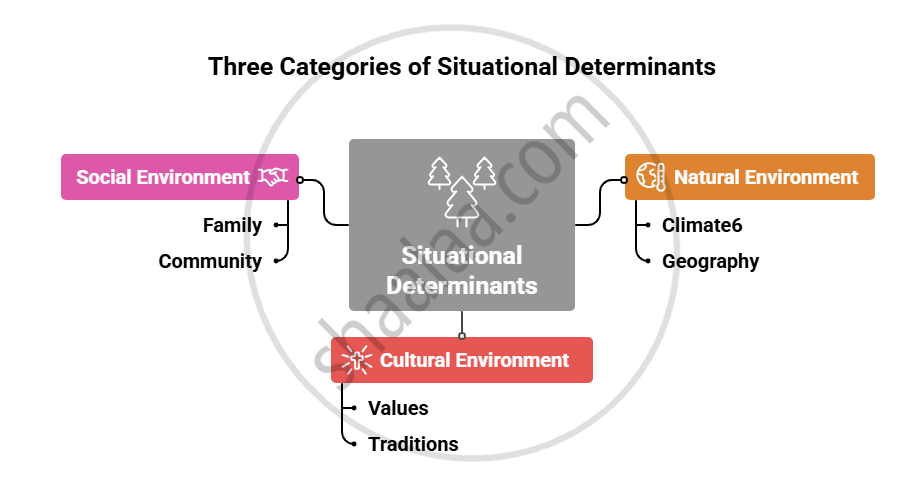
Natural Environment
Meaning: The physical and geographical conditions that characterize an individual's living environment, including climate, topography, and natural resources.
Components of Natural Environment:
- Geographical Features: Mountains, plains, coastal regions, and desert areas.
- Climate Patterns: Temperature variations, humidity, seasonal changes, and precipitation.
- Natural Resources: Availability of water, minerals, vegetation, and agricultural potential.
- Environmental Challenges: Natural disasters, extreme weather conditions, geographic isolation.
Mechanisms of Influence:
Natural environmental factors influence personality through:
- Physical Adaptation Requirements: Different climates and terrains require specific behavioral adaptations.
- Resource Management Strategies: Scarcity or abundance of resources shapes problem-solving approaches.
- Community Cooperation Patterns: Environmental challenges often necessitate collective responses.
- Lifestyle Constraints: Geographic conditions limit or enable certain activities and occupations.
Example:
Research indicates that individuals raised in harsh desert climates often develop personality traits including patience, resource conservation awareness, and strong community cooperation skills. Conversely, those in temperate coastal regions may develop different adaptive strategies focused on maritime activities and seasonal preparation patterns.
Cultural Environment
Meaning: The social customs, values, belief systems, and practices that characterize a particular society or community.
Components of Cultural Environment:
- Family Structure and Dynamics: Joint family systems, nuclear family arrangements, extended family relationships.
- Religious and Spiritual Practices: Belief systems, ritual observances, moral frameworks.
- Economic Systems: Socioeconomic stratification, occupation patterns, economic opportunities.
- Educational Institutions: Formal and informal learning environments, knowledge transmission methods.
- Language and Communication: Linguistic patterns, communication styles, cultural expressions.
Research Evidence for Cultural Influence:
Kluckhohn and Murray (1948) emphasized the critical importance of the socio-cultural matrix in personality development. Their research demonstrated that cultural anthropologists have consistently identified profound impacts of cultural factors on individual personality formation.
Social Environment
Meaning: The network of relationships, social interactions, and institutional contexts that surround an individual throughout their developmental process.
Key Components:
- Family Relationships: Parent-child dynamics, sibling interactions, extended family influences.
- Peer Group Interactions: Friendship patterns, social acceptance, and peer pressure influences.
- Educational Institution Climate: School culture, teacher-student relationships, and academic expectations.
- Community Social Structures: Neighborhood characteristics, community organizations, social support systems.
- Professional Environments: Workplace cultures, occupational role requirements, career development contexts.
Mechanisms of Social Influence:
- Modeling Processes: Observation and imitation of significant others' behaviors and attitudes.
- Social Feedback Systems: Responses from others that shape self-concept and behavioral patterns.
- Role Expectations: Social positions requiring specific behavioral adaptations and skill development.
- Support Networks: Availability of social resources during developmental challenges and transitions.
Key Points: Situational Determinants
- Situational Determinants of Personality refer to how our environment shapes who we are. These are grouped into:
- Natural Environment: Climate, geography, and natural resources influence habits, patience, survival skills, and lifestyle.
- Cultural Environment: Values, beliefs, family traditions, education, and religion shape thinking, behavior, and social roles.
- Social Environment: Family, school, peer groups, and community affect personality through interaction, feedback, and support.
