Topics
Variations in Psychological Attributes
- Individual Differences in Human Functioning
- Assessment of Psychological Attributes
- Concept of Intelligence
- Theories of Intelligence
- Binet's One-Factor Theory
- Charles Spearman's Two Factor Theory
- Louis Thurstone’s Multifactor Theory
- Jensen's Hierarchical Theory of Intelligence
- Guilford's Structural Model Theory
- Howard Gardner's Multiple Intelligence Theory
- Sternberg’s Triarchic Theory
- PASS Model of Intelligence
- Individual Differences in Intelligence
- Assessment of Intelligence
- Mental Age
- Intelligence Quotient
- Variations of Intelligence
- Types of Intelligence Tests
- Individual Test
- Group Test
- Verbal Test
- Non-Verbal Test
- Performance Test
- Culture Bias and Culture Fair Tests
- Misuses of Intelligence Tests
- Intelligence Testing in India
- Culture and Intelligence
- New Trends in Intelligence> Emotional Intelligence
- Special Abilities
- Creativity
- Creativity and Intelligence
Self and Personality
- Self and Personality
- Concept of Self
- Cognitive and Behavioural Aspects of Self
- Concept of Personality
- Culture and Self
- Characteristics of Personality
- Personality Related Terms
- Descriptive Personality Theories
- Type Theories
- Trait Theories
- Trait Theory> Trait Theory of G. Allport
- Trait Theory> Cattell’s Concept of Personality
- Type Theory> Eysenck Concept of Personality
- Psychodynamic Approach
- Freud's Psychoanalytic Theory of Personality> Stages of Personality Development
- Neo-Freudian Theory of Personality
- Carl Jung’s Theory of Personality
- Karen Horney (1950)
- Psychodynamic Therapies> Alfred Adler's Psychodynamic Therapy
- Erich Fromm's Theory
- Erik Erikson's Theory of Psycho-Social Development
- Behavioural Approach
- Cultural Approach
- Humanistic Approach
- Measurement of Personality
- Self Report Inventories
- Projective Techniques
- Behavioural Analysis
Meeting Life Challenges
Psychological Disorders
- Concept of Psychological Disorders
- Concept of Abnormal Behaviour
- Classification of Psychological Disorders
- Factors Underlying Abnormal Behaviour
- Major Psychological Disorder> Anxiety Disorders
- Major Psychological Disorder> Obsessive Compulsive Disorder (OCD)
- Major Psychological Disorder> Trauma and Stress Related Disorders
- Major Psychological Disorder> Somatic Symptom and Related Disorders
- Major Psychological Disorder> Dissociative Disorders
- Depressive Disorders
- Major Psychological Disorder> Bipolar Disorder
- Major Psychological Disorder> Schizophrenia
- Major Psychological Disorder> Neurodevelopmental Disorders
- Major Psychological Disorder> Disruptive, Impulse-Control and Conduct Disorders
- Major Psychological Disorder> Eating Disorders
- Major Psychological Disorder> Substance-Related and Addictive Disorders
Therapeutic Approaches
- Therapeutic Approaches in Psychology
- Concept of Psychotherapy
- Forms of Psychotherapy
- Behaviour Therapies
- Cognitive Therapy
- Humanistic-existential Therapy
- Humanistic-existential Therapy> Client Centred Therapy
- Healing Factors in Psychotherapy
- Ethics in Psychotherapy
- Alternative Therapies
- Rehabilitation of the Mentally Ill
Attitude and Social Cognition
Social Influence and Group Processes
Psychology and Life
- Introduction to Psychology and Life
- Human-environment Relationship
- Environmental Effects on Human Behaviour
- Promoting Pro-environmental Behaviour
- Psychology and Social Concerns
Developing Psychological Skills
- Introduction to Developing Psychological Skills
- Developing as an Effective Psychologist
- General Skills
- Observational Skills
- Specific Skills
- Interviewing Skills
- Counselling Skills
Estimated time: 19 minutes
- Introduction
- Dimensions of Classification
- Flowchart: Types of Groups
- Primary Groups and Secondary Groups
- Formal and Informal Groups
- In-Groups and Out-Groups
- Tajfel's Minimal Group Paradigm
- Key Points: Types of Social Groups
CBSE: Class 12
CISCE: Class 12
CISCE: Class 12
Introduction
An individual belongs to many groups — family, club, cricket team, etc. Some memberships are permanent (family); others are temporary (relief camp). Some are by birth (family, caste, religion); others are by choice (football club). Groups subdivide - family members form sub-groups (husband-wife, son's cricket team). All groups are different, so they must be classified.
CBSE: Class 12
CISCE: Class 12
CISCE: Class 12
Dimensions of Classification
- Size — from a two-member dyad to millions (a country).
- Permanence — from a 5-day relief camp to lifelong family membership.
- Geography — tribe, coastal, hills, plains, eastern, western communities.
- Determinants — blood relationship (family) vs. shared interest (book club).
CBSE: Class 12
CISCE: Class 12
CISCE: Class 12
Flowchart: Types of Groups
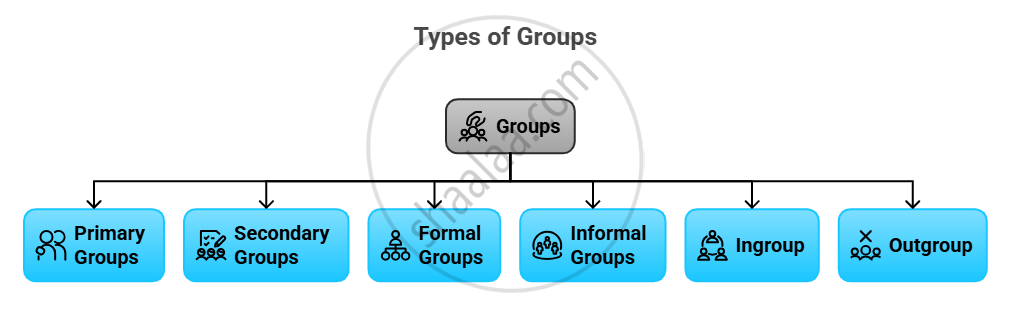
CBSE: Class 12
CISCE: Class 12
CISCE: Class 12
Primary Groups and Secondary Groups
Primary Groups:
- Small, intimate groups with close personal relationships.
- Membership is usually given by birth, not chosen.
- Face-to-face interaction with warm emotional bonds.
- Less permeable — members cannot simply leave (e.g., you can't quit your family).
- Central to shaping values, personality, and social identity.
- Examples: Family, close friends, playmates, neighbours, caste, religion.
Secondary Groups
- Larger, impersonal, goal-oriented groups voluntarily joined.
- Interaction is indirect and infrequent.
- Relationships are formal and role-based, not emotional.
- More permeable — easy to join and leave.
- Members work together toward a common goal using agreed-upon rules.
- Examples: Political party, hobby group, office colleagues, club membership.
CBSE: Class 12
CISCE: Class 12
CISCE: Class 12
Formal and Informal Groups
Formal Groups
- Roles, functions, and rules are explicitly and officially stated.
- Has a chain of command — decisions flow top-down.
- Formed on the basis of specific rules or laws.
- The behaviour and conduct of members are rigidly coded.
- Examples: Army, university, office, school.
Informal Groups
- Behaviour is not rigidly coded — no official written rules.
- Decisions are made mutually in informal settings.
- Held together by close personal relationships.
- More flexible and homogeneous in structure.
- Examples: Family, neighbours, close friends.
CBSE: Class 12
CISCE: Class 12
CISCE: Class 12
In-Groups and Out-Groups
In-Groups
- The group a person belongs to — referred to as "we/us."
- Members are perceived positively with desirable and admirable traits.
- Generates feelings of loyalty, solidarity, and commitment.
- Boosts the self-esteem and identity of the person.
- Based on factors like race, religion, age, sex, and occupation.
Out-Groups
- Any group a person does not belong to — referred to as "they/them."
- Members are often perceived negatively with undesirable traits.
- Can lead to prejudice, bias, and discrimination.
- Modern society promotes cultural diversity, reducing harmful out-group thinking.
- India's composite culture in art, architecture, and music celebrates plurality.
CISCE: Class 12
Tajfel's Minimal Group Paradigm
- Conducted by Henri Tajfel to find the minimum condition for in-group favouritism.
- British schoolboys grouped by painting preference (Kandinsky vs. Klee).
- Group members' identities hidden — only code numbers used.
- Children distributed money between in-group and out-group recipients.
- Result: Children favoured their own group despite a trivial grouping criterion.
- Proved that arbitrary group membership alone triggers in-group favouritism.
- Laid the foundation for Social Identity Theory (SIT).
CBSE: Class 12
CISCE: Class 12
CISCE: Class 12
Key Points: Types of Social Groups
- Primary groups – Close, face-to-face, emotional relations (e.g., family).
- Secondary groups – Impersonal and goal-oriented (e.g., political party).
- Formal groups – Have clear rules, structure, and defined roles (e.g., office).
- Informal groups – No fixed rules, based on personal relations (e.g., friends).
- In-group – “We” group; viewed positively.
- Out-group – “They” group; often viewed negatively.
- Tajfel’s finding – People favour their own group even when groups are formed on small differences.
