Advertisements
Online Mock Tests
Chapters
1: Real Numbers
Algebra
2: Polynomials
3: Linear Equations in Two Variables
4: Quadratic Equations
▶ 5: Arithmetic Progression
Coordinate Geometry
6: Coordinate Geometry
Geometry
7: Triangles
8: Circles
9: Constructions
Trigonometry
10: Trignometric Ratios
11: T-Ratios of Some Particular Angles
12: Trigonometric Ratios of Some Complemantary Angles
13: Trigonometric identities
14: Heights and Distances
Mensuration
15: Perimeter And Area of Plane Figures
16: Area of Circle, Sector and Segment
17: Volumes and Surface Areas of Solids
Statistics and Probability
18: Mean, Median, Mode of Grouped Data, Cumulative Frequency Graph and Ogive
19: Probability
Chapter 20: Additional Questions
![R.S. Aggarwal solutions for Mathematics [English] Class 10 chapter 5 - Arithmetic Progression - Shaalaa.com](/images/mathematics-english-class-10_6:8f062ea57bdf49abb4f6d22550b39d56.jpg "R.S. Aggarwal solutions for Mathematics [English] Class 10 chapter 5 - Arithmetic Progression")
Advertisements
Solutions for Chapter 5: Arithmetic Progression
Below listed, you can find solutions for Chapter 5 of CBSE, Karnataka Board R.S. Aggarwal for Mathematics [English] Class 10.
R.S. Aggarwal solutions for Mathematics [English] Class 10 5 Arithmetic Progression EXERCISE 5A [Pages 260 - 263]
Show that the progression given below is an AP. Find the first term, common difference and next term.
9, 15, 21, 27, ....
Show that the progression given below is an AP. Find the first term, common difference and next term.
11, 6, 1, –4, ....
Show that the progression given below is an AP. Find the first term, common difference and next term.
`-1, (-5)/6, (-2)/3, (-1)/2`, ....
Show that the progression given below is an AP. Find the first term, common difference and next term.
`sqrt(2), sqrt(8), sqrt(18), sqrt(32)`,....
Show that the progression given below is an AP. Find the first term, common difference and next term.
`sqrt(20), sqrt(45), sqrt(80), sqrt(125)`,....
Find the 20th term of the AP 9, 13, 17, 21,....
Find the 35th term of AP 20, 17, 14, 11,....
Find the 18th term of the AP `sqrt(2), sqrt(18), sqrt(50), sqrt(98)`,....
Find the 9th term of the AP `3/4, 5/4, 7/4, 9/4,`....
Find the 15th term of the AP –40, –15, 10, 35,....
Find the 37th term of the AP `6, 7 3/4, 9 1/2, 11 1/4,`....
Find the 25th term of the AP `5, 4 1/2, 4, 3 1/2, 3,`....
Find the value of p for which the numbers 2p – 1, 3p + 1, 11 are in AP. Hence, find the numbers.
Find the nth term of the following APs:
5, 11, 17, 23, ....
Find the nth term of the following APs:
16, 9, 2, –5, ....
If the nth term of a progression is (4n – 10) show that it is an AP. Find its (i) first term, (ii) common difference, and (iii) 16th term.
How many terms are there in the AP 6, 10, 14, 18, ..., 174?
How many terms are there in the AP 41, 38, 35, ...,8?
Find the number of terms in the following A.P.
`18, 15 1/2, 13, ..., – 47`
Which term of the AP 3, 8, 13, 18, ... is 88?
Which term of AP 72, 68, 64, 60, ... is 0?
Which term of the AP `5/6, 1, 1 1/6, 1 1/3,` ... is 3?
Which term of the AP 21, 18, 15, ... is –81?
Which term of the A.P. 8, 14, 20, 26, ... will be 72 more than its 41st term?
Which term of the A.P. 5, 15, 25, ... will be 130 more than its 31st term?
If the 10th term of an AP is 52 and 17th term is 20 more than its 13th term, find the AP.
Find the middle term of the AP 6, 13, 20, ..., 216.
Find the middle term of the AP 10, 7, 4, ..., (–62).
Find the sum of two middle most terms of the AP `-4/3, -1 (-2)/3, ..., 4 1/3.`
Find the 8th term from the end of the AP 7, 10, 13, ..., 184.
Find the 6th term form the end of the AP 17, 14, 11, ..., (–40).
Is 184 a term of the AP 3, 7, 11, 15, ...?
Is –150 a term of the AP 11, 8, 5, 2, ...?
Which term of the A.P. 121, 117, 113, ... is its first negative term?
[Hint: Find n for an < 0]
Which term of the A.P. `20, 19 1/4, 18 1/2, 17 3/4,` ... is the first negative term?
The 7th term of an AP is –4 and its 13th term is –16. Find the AP.
The 4th term of an AP is zero. Prove that its 25th term is triple its 11th term.
If the sixth term of an AP is zero then show that its 33rd term is threе times its 15th term.
The 4th term of an AP is 11. The sum of the 5th and 7th terms of this AP is 34. Find its common difference.
The 9th term of an AP is –32 and the sum of its 11th and 13th terms is –94. Find the common difference of the AP.
Determine the nth term of the AP whose 7th term is –1 and 16th term is 17.
If 4 times the 4th term of an A.P. is equal to 18 times its 18th term, then find its 22nd term.
If 10 times the 10th term of an AP is equal to 15 times the 15th term, show that its 25th term is zero.
Find the common difference of an AP whose first term is 5 and the sum of its first four terms is half the sum of the next four terms.
The sum of the 2nd term and the 7th term of an A.P. is 30. If its 15th term is 1 less than twice its 8th term, find the A.P.
For what value of n, the nth terms of the arithmetic progressions 63, 65, 67, ... and 3, 10, 17, ... equal?
The 17th term of AP is 5 more than twice its 8th term. If the 11th term of the AP is 43, find its nth term.
The 24th term of an AP is twice its 10th term. Show that its 72nd term is 4 times its 15th term.
The 19th term of an AP is equal to 3 times its 6th term. If its 9th term is 19, find the AP.
If the pth term of an AP is q and its qth term is p then show that its (p + q)th term is zero.
The first and last terms of an AP are a and l respectively. Show that the sum of the nth term from the beginning and the nth term form the end is (a + l).
How many two-digit numbers are divisible by 6?
How many two-digits numbers are divisible by 3?
How many three-digit numbers are divisible by 9?
How many numbers are there between 101 and 999, which are divisible by both 2 and 5?
In a flower bed, there are 43 rose plants in the first row, 41 in the second, 39 in the third, and so on. There are 11 rose plants in the last row. How many rows are there in the flower bed?
A sum of ₹ 2800 is to be used to award four prizes. If each prize after the first is ₹ 200 less than the preceding prize, find the value of each of the prizes.
Find how many integers between 200 and 500 are divisible by 8.
R.S. Aggarwal solutions for Mathematics [English] Class 10 5 Arithmetic Progression EXERCISE 5B [Pages 267 - 268]
Determine k so that (3k – 2), (4k – 6) and (k + 2) are three consecutive terms of an AP.
Find the value of x for which the numbers (5x + 2), (4x – 1) and (x + 2) are in AP.
If (3y – 1), (3y + 5) and (5y + 1) are three consecutive terms of an AP then find the value of y.
Find the value of x for which (x + 2), 2x, (2x + 3) are three consecutive terms of an AP.
Show that (a – b)2, (a2 + b2) and (a2 + b2) are in AP.
Find three numbers in AP whose sum is 15 and whose product is 105.
HINT: Let the numbers be (a – d), a, (a + d).
The sum of three numbers in AP is 3 and their product is –35. Find the numbers.
Divide 24 in three parts such that they are in AP and their product is 440.
The sum of three consecutive terms of an AP is 21 and the sum of the squares of these terms is 165. Find these terms.
The angles of a quadrilateral are in AP whose common difference is 10°. Find the angles.
Find four numbers in AP whose sum is 28 and the sum of whose squares is 216.
Divide 32 into four parts which are the four terms of an AP such that the product of the first and the fourth terms is to the product of the second and the third terms as 7 : 15.
HINT: Let these parts be (a – 3d), (a – d), (a + d) and (a + 3d).
The sum of first three terms of an AP is 48. If the product of first and second terms exceeds 4 times the third term by 12. Find the AP.
HINT: Let these terms be (a – d), a, (a + d).
The sum of three numbers in AP is 18. If the product of first and third number is five times the common difference, find the numbers.
HINT: Let these numbers be (a – d), a and (a + d).
If the numbers a, 7, b, 23, c are in AP, find a, b and c.
R.S. Aggarwal solutions for Mathematics [English] Class 10 5 Arithmetic Progression EXERCISE 5C [Pages 285 - 288]
Find the sum of the following APs:
2, 7, 12, 17, ... to 19 terms.
Find the sum of the following APs:
9, 7, 5, 3, ... to 14 terms.
Find the sum of the following APs:
–37, –33, –29, ... to 12 terms.
Find the sum of the following APs:
`1/15, 1/12, 1/10`, ... to 11 terms.
Find the sum of the following APs:
0.6, 1.7, 2.8, ... to 100 terms.
Find the sum of the following arithmetic series:
`7 + 10 1/2 + 14 + ... + 84`
Find the sum of the following arithmetic series:
34 + 32 + 30 + ... + 10
Find the sum of the following arithmetic series:
(–5) + (–8) + (–11) + ... + (–230)
Find the sum of the following arithmetic series:
5 + (–41) + 9 + (–39) + 13 + (–37) + 17 + ... + (–5) + 81 + (–3)
HINT: Given sum = (5 + 9 + 13 + 17 + ... + 81) + {(–41) + (–39) + ... + (–3)}.
Find the sum of first n terms of an AP whose nth term is (5 – 6n). Hence, find the sum of its first 20 terms.
The sum of the first n terms of an AP is (3n2 + 6n). Find the nth term and the 15th term of this AP.
The sum of the first n terms of an AP is given by Sn = (3n2 – 4n). Find its
- nth term,
- first term and
- common difference.
The sum of the first n terms of an AP is `((5n^2)/2 + (3n)/2)`. Find the nth term and the 20th term of this AP.
The sum of the first n terms of an AP is `((3n^2)/2 + (5n)/2)`. Find its nth term and the 25th term.
If mth term of an AP is `1/n` and nth term is `1/m` then find the sum of its first mn terms.
How many terms of the A.P. 21, 18, 15, ... must be added to get the sum 0?
How many terms of the AP. 9, 17, 25 … must be taken to give a sum of 636?
How many terms of the AP 63, 60, 57, 54, ... must be taken so that their sum is 693? Explain the double answer.
How many terms of the AP `20, 19 1/3 , 18 2/3, ...` must be taken so that their sum is 300? Explain the double answer.
Find the sum of the odd numbers between 0 and 50.
Find the sum of all natural numbers between 200 and 400 which are divisible by 7.
Find the sum of first 40 positive integers divisible by 6.
Find the sum of first 15 multiples of 8.
Find the sum of all multiples of 9 lying between 300 and 700.
Find the sum of all three-digits natural numbers which are divisible by 13.
Find the sum of first 100 even natural numbers which are divisible by 5.
Find the sum of n terms of the following series:
`(4 - 1/n) + (4 - 2/n) + (4 - 3/n) +` ....
In an AP, It is given that S5 + S7 = 167 and S10 = 235, then find the AP, where Sn denotes the sum of its first n terms.
In an AP, the first term is 2, the last term is 29 and the sum of all the terms is 155. Find the common difference.
In an AP, the first term is –4, the last term is 29 and the sum of all its terms is 150. Find its common difference.
The first and last terms of an AP are 17 and 350, respectively. If the common difference is 9, how many terms are there, and what is their sum?
The first term of an A.P. is 5, the last term is 45 and the sum is 400. Find the number of terms and the common difference.
In an AP, the first term is 22, nth terms is –11 and sum of first n terms is 66. Find n and hence find the common difference.
The 12th term of an AP is –13 and the sum of its first four terms is 24. Find the sum of its first 10 terms.
The sum of the first 7 terms of an AP is 182. If its 4th and 17th terms are in the ratio 1 : 5, find the AP.
The sum of the first 9 terms of an AP is 81 and that of its first 20 terms is 400. Find the first term and the common difference of the AP.
If the sum of first 7 terms of an A.P. is 49 and that of its first 17 terms is 289, find the sum of first n terms of the A.P.
Two APs have the same common difference. If the first terms of these APs be 3 and 8 respectively, find the difference between the sums of their first 50 terms.
The sum first 10 terms of an AP is –150 and the sum of its next 10 terms is –550. Find the AP.
The 13th term of an AP is 4 times its 3rd term. If its 5th term is 16, find the sum of its first 10 terms.
The 16th term of an AP is 5 times its 3rd term. If its 10th term is 41, find the sum of its first 15 terms.
An AP 5, 12, 19, ... has 50 terms. Find its last term. Hence, find the sum of its last 15 terms.
An AP 8, 10, 12, ... has 60 terms. Find its last term. Hence, find the sum of its last 10 terms.
The sum of first n terms of two APs are in the ratio (3n + 8) : (7n + 15). Find the ratio of their 12th terms.
The sum of the 4th and the 8th terms of an AP is 24 and the sum of its 6th and 10th terms is 44. Find the sum of its first 10 terms.
The sum of first m terms of an AP is (4m2 – m). If its nth term is 107, find the value of n. Also, find the 21st term of this AP.
The sum of first q terms of an AP is (63q – 3q2). If its pth term is –60, find the value of p. Also, find the 11th term of its AP.
Find the number of terms of the AP –12, –9, –6, ..., 21. If 1 is added to each term of this AP then find the sum of all terms of the AP thus obtained.
Sum of the first 14 terms of an AP is 1505 and its first term is 10. Find its 25th term.
Find the sum of first 51 terms of an AP whose second and third terms are 14 and 18 respectively.
In a school, students decided to plant trees in and around the school to reduce air pollution. It was decided that the number of trees that each section of each class will plant will be double of the class in which they are studying. If there are 1 to 12 classes in the school and each class has two section, find how many trees were planted by student. Which value is shown in the question?
In a potato race, a bucket is placed at the starting point, which is 5 m from the first potato and other potatoes are placed 3 m apart in a straight line. There are ten potatoes in the line.

A competitor starts from the bucket, picks up the nearest potato, runs back with it, drops it in the bucket, runs back to pick up the next potato, runs to the bucket to drop it in, and she continues in the same way until all the potatoes are in the bucket. What is the total distance the competitor has to run?
[Hint: to pick up the first potato and the second potato, the total distance (in metres) run by a competitor is 2 × 5 + 2 × (5 + 3)]
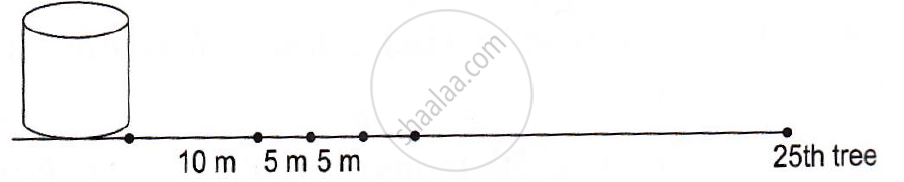
There are 25 trees at equal distance of 5 m in a line with a water tank, the distance of the water tank from the nearest tree being 10 m. A gardener waters all the trees separately, starting from the water tank and returning back to the water tank after watering each tree to get water for the next. Find the total distance covered by the gardener in order to water all the trees.
A sum of Rs 700 is to be used to give seven cash prizes to students of a school for their overall academic performance. If each prize is Rs 20 less than its preceding prize, find the value of each of the prizes.
A man saved ₹ 33000 in 10 months. In each month after the first, he saved ₹ 100 more than he did in the preceding month. How much did he save in the first month?
A man arranges to pay off a debt of ₹ 36000 by 40 monthly instalments which form an arithmetic series. When 30 of the instalments are paid, he dies leaving one-third of the debt unpaid. Find the value of the first instalment.
A contract on a construction job specifies a penalty for delay of completion beyond a certain date as follows: Rs. 200 for the first day, Rs. 250 for the second day, Rs. 300 for the third day, etc., the penalty for each succeeding day being Rs. 50 more than for the preceding day. How much money does the contractor have to pay as a penalty if he has delayed the work by 30 days?
R.S. Aggarwal solutions for Mathematics [English] Class 10 5 Arithmetic Progression EXERCISE 5D [Pages 293 - 294]
Very-Short and Short-Answer Questions
The first three terms of an AP are respectively (3y – 1), (3y + 5) and (5y + 1), find the value of y .
If k, (2k - 1) and (2k + 1) are the three successive terms of an AP, find the value of k.
If 18, a, (b – 3) are in AP, then find the value of (2a – b).
If the numbers a, 9, b, 25 from an AP, find a and b.
If the numbers (2n – 1), (3n + 2) and (6n – 1) are in AP, find the value of n and the numbers.
How many three-digit numbers are divisible by 7?
How many three-digit natural numbers are divisible by 9?
If the sum of first m terms of an AP is (2m2 + 3m) then what is its second term?
What is the sum of first n terms of the AP a, 3a, 5a, ....
What is the 5th term form the end of the AP 2, 7, 12, ..., 47?
If an denotes the nth term of the AP 2, 7, 12, 17, ..., find the value of (a30 - a20).
The nth term of an AP is (3n + 5). Find its common difference.
The nth term of an AP is (7 – 4n). Find its common difference.
Write the next term of the AP `sqrt(8), sqrt(18), sqrt(32),`....
Write the next term of the AP `sqrt(2), sqrt(8), sqrt(18),`....
Which term of the AP 21, 18, 15, ... is zero?
Find the sum of the first n natural numbers.
Find the sum of first n even natural numbers.
The first term of an AP is p and its common difference is q. Find its 10th term.
If `4/5`, a, 2 are in AP, find the value of a.
If (2p + 1), 13, (5p - 3) are in AP, find the value of p.
If (2p – 1), 7, 3p are in AP, find the value of p.
If the sum of first p terms of an AP is (ap2 + bp), find its common difference.
If the sum of first n terms is (3n2 + 5n), find its common difference.
Find an AP whose 4th term is 9 and the sum of its 6th and 13th terms is 40.
What is the common difference of an AP in which a27 – a7 = 84?
If 1 + 4 + 7 + 10 + ... + x = 287, find the value of x.
R.S. Aggarwal solutions for Mathematics [English] Class 10 5 Arithmetic Progression MULTIPLE-CHOICE QUESTIONS (MCQ) [Pages 296 - 298]
Choose the correct answer in each of the following questions:
The common difference of the AР `1/p, (1 - p)/p, (1 - 2p)/p,` ... is ______.
p
–p
–1
1
The common difference of the A.P. \[\frac{1}{3}, \frac{1 - 3b}{3}, \frac{1 - 6b}{3}, ...\] is ______.
- \[\frac{1}{3}\]
- \[\frac{-1}{3}\]
b
–b
The next term of the A.P. \[\sqrt{7}, \sqrt{28}, \sqrt{63}\] is ______.
- \[\sqrt{70}\]
\[\sqrt{84}\]
- \[\sqrt{97}\]
- \[\sqrt{112}\]
If 4, x1, x2, x3, 28 are in AP then x3 = ?
19
23
22
Cannot be determined
If the nth term of an AP is (2n + 1), then the sum of its first three terms is ______.
6n + 3
15
12
21
The sum of first n terms of an AP is (3n2 + 6n). The common difference of the AP is ______.
6
9
15
–3
The sum of first n terms of an AP is (5n – n2). The nth term of the AP is ______.
(5 – 2n)
(6 – 2n)
(2n – 5)
(2n – 6)
The sum of first n terms of an AP is (4n2 + 2n). The nth term of this AP is ______.
(6n – 2)
(7n – 3)
(8n – 2)
(8n + 2)
The 7th term of an AP is –1 and its 16th term is 17. The nth term of the AP is ______.
(3n + 8)
(4n – 7)
(15 – 2n)
(2n – 15)
The 5th term of an AP is –3 and its common difference is –4. The sum of its first 10 terms is ______.
50
–50
30
–30
The 5th term of an AP is 20 and the sum of its 7th and 11th terms is 64. The common difference of the AP is ______.
4
5
3
2
The 13th term of an AP is 4 times its 3rd term. If its 5th term is 16 then the sum of its first ten terms is ______.
150
175
160
135
An AP 5, 12, 19, ... has 50 terms. Its last term is ______.
343
353
348
362
The sum of first 20 odd natural numbers is ______.
100
210
400
420
The sum of first 40 positive integers divisible by 6 is ______.
2460
3640
4920
4860
How many two-digit numbers are divisible by 3?
25
30
32
36
How many three-digit numbers are divisible by 9?
86
90
96
100
What is the common difference of an AP in which a18 – a14 = 32?
8
– 8
4
– 4
If an denotes the nth term of the AP 3, 8, 13, 18, ... then what is the value of (a30 – a20)?
40
36
50
56
Which term of the AP 72, 63, 54, ... is 0?
8th
9th
10th
11th
Which term of the AP 25, 20, 15, ... is the first negative term?
10th
9th
8th
7th
Which term of the AP: 21, 42, 63, 84, ... is 210?
9th
10th
11th
12th
What is 20th term from the end of the AP 3, 8, 13, ..., 253?
163
158
153
148
(5 + 13 + 21 + ... + 181) = ?
2476
2337
2219
2139
The sum of first 16 terms of the AP: 10, 6, 2, ... is ______.
320
–320
–352
–400
How many terms of the AP 3, 7, 11, 15, ... will make the sum 406?
10
12
14
20
The 2nd term of an AP is 13 and its 5th term is 25. What is its 17th term?
69
73
77
81
The 17th term of an AP exceeds its 10th term by 21. The common difference of the AP is ______.
3
2
–3
–2
The 8th term of an AP is 17 and its 14th term is 29. The common difference of the AP is ______.
3
2
5
–2
The 7th term of an AP is 4 and its common difference is –4. What is its first term?
16
20
24
28
The number of terms in the AP 5, 9, 13, 17, ..., 185 is ______.
31
41
51
46
If (2p + 1), 10 and (5p + 5) are three consecutive terms of an AP, then p = ?
–1
–2
1
2
Solutions for 5: Arithmetic Progression
R.S. Aggarwal solutions for Mathematics [English] Class 10 chapter 5 - Arithmetic Progression
Shaalaa.com has the CBSE, Karnataka Board Mathematics Mathematics [English] Class 10 CBSE, Karnataka Board solutions in a manner that help students grasp basic concepts better and faster. The detailed, step-by-step solutions will help you understand the concepts better and clarify any confusion. R.S. Aggarwal solutions for Mathematics Mathematics [English] Class 10 CBSE, Karnataka Board 5 (Arithmetic Progression) include all questions with answers and detailed explanations. This will clear students' doubts about questions and improve their application skills while preparing for board exams.
Further, we at Shaalaa.com provide such solutions so students can prepare for written exams. R.S. Aggarwal textbook solutions can be a core help for self-study and provide excellent self-help guidance for students.
Concepts covered in Mathematics [English] Class 10 chapter 5 Arithmetic Progression are .
Using R.S. Aggarwal Mathematics [English] Class 10 solutions Arithmetic Progression exercise by students is an easy way to prepare for the exams, as they involve solutions arranged chapter-wise and also page-wise. The questions involved in R.S. Aggarwal Solutions are essential questions that can be asked in the final exam. Maximum CBSE, Karnataka Board Mathematics [English] Class 10 students prefer R.S. Aggarwal Textbook Solutions to score more in exams.
Get the free view of Chapter 5, Arithmetic Progression Mathematics [English] Class 10 additional questions for Mathematics Mathematics [English] Class 10 CBSE, Karnataka Board, and you can use Shaalaa.com to keep it handy for your exam preparation.
