Advertisements
Online Mock Tests
Chapters
1: Forces: Turning Forces and Uniform Circular Motion
2: Work, Power and Energy
3: Machines
(B) Light
4: Refraction of Light
5: Electromagnetic Waves and Spectrum
(C) Sound
6: Sound
(D) Electricity and Magnetism
▶ 7: Electric Circuits, Resistance and Ohm's Law
8: Electric Energy, Power and Household Circuits
9: 1. Electromagnetism 2. Magnetic Effects of Electric Current 3. Electromagnetic Induction
(E) Heat
10: Calorimetry
(F) Modern Physics
11: Radioactivity
Advertisements
Solutions for Chapter 7: Electric Circuits, Resistance and Ohm's Law
Below listed, you can find solutions for Chapter 7 of CISCE Goyal Brothers Prakashan for A New Approach to ICSE Physics [English] Class 10.
Goyal Brothers Prakashan solutions for A New Approach to ICSE Physics [English] Class 10 7 Electric Circuits, Resistance and Ohm's Law NUMERICAL PROBLEMS [Page 145]
A charge of 1000 C flows through a conductor for 3 min and 20 s. Find the magnitude of current flowing through the conductor.
Practice Problems 1:
A charge of 5000 C flows through an electric circuit in 2 hours and 30 minutes. Calculate the magnitude of current in a circuit.
A charge of 8860 C flows through an electric circuit in 2 min and 40 s. Calculate the magnitude of current in a circuit.
Goyal Brothers Prakashan solutions for A New Approach to ICSE Physics [English] Class 10 7 Electric Circuits, Resistance and Ohm's Law EXERCISE-1 [Pages 149 - 152]
Define “quantity of charge”.
State SI unit of electric charge and define it.
One coulomb is equal to charge on 6.25 × 10¹⁸ electrons. What is magnitude of electric charge on a single electron?
What do you understand by the term electric current?
If Q is the electric charge which flows through a conductor in the time 't' such that 'I' is the magnitude of current, what is the relation between Q, t and I?
State and define the SI unit of electric current.
State one bigger and one smaller unit of electric current.
A charge of 1000 C flows through a conductor in 1 minute and 40 s. What is the magnitude of current flowing though conductor?
What do you understand by the term electric potential?
If 'W' is the amount of work done in bringing a Q unit of positive charge from infinity to given point in an electric field, such that 'V' is potential at that point, then what is the relation between W, Q and V?
State the unit of electric potential and define it.
400 joules of work is done in bringing a charge of 2 coulombs from infinity to a given point, what is the potential at that point?
Define the term potential difference.
State the mathematical expression for potential difference.
1000 J of work is done in moving 5 C of charge from point A to B. What is the potential difference between A and B?
Name the instrument which is used to measure the potential difference.
- What do you understand by the term ‘closed electric circuit’?
- Draw a diagram in support of your answer.
- You switch off a glowing electric bulb in an electric circuit. What kind of circuit you have achieved, open electric circuit or closed electric circuit?
- Define the answer in (a) and support your answer by a diagram.
Define the term resistance.
State and define the S.I. unit of resistance.
Name two bigger units of resistance.
Name two smaller units of resistance.
State the law of length for an electric resistance.
If l1 and l2 are the two length of same material and same area of cross-section such that R1 and R2 are their respective resistances then derive relation between R1, R2, l1, l2.
A conductor of length 80 cm has a resistance of 4.80 Ω, calculate the resistance of similar conductor of length 640 cm.
State the law of area of cross-section for an electric resistance.
If a1 and a2 are the area of cross-sections of the two conductors of length 'l' each, such that R1 and R2 are their electrical resistance derive a relationship between R1, R2, a1 and a2.
Two resistances A and B of same length have area of cross-section 0.2 mm2 and 0.4 mm2. If the resistance of A is 16 Ω. What is the resistance of B?
What is specific resistance?
If ρ is the specific resistance of a conductor of length ‘l’, area of cross-section ‘a’ and resistance ‘R’, what is the relationship between ρ, l, a and R?
Two aluminium wires are of same length, but one is thicker than the other.
- Which wire will have more resistance?
- Which wire will have more specific resistance?
What would be the length of resistance wire of area of cross-section 3 mm2 used for making a resistance of 100 Ω? The specific resistance of the wire is 0.000070 ohm cm.
What is a superconductor?
- State the approximate range of temperature at which a conductor tends to be a superconductor.
- Name two materials that behave like superconductors in the range mentioned above.
- Will the specific resistance of a conductor change with a change in temperature?
- Give reasons for answer (i).
A nichrome wire has a length of 80 cm and a resistance of 50 ohms. If the wire is folded four times, find the new resistance of the wire.
Name two materials whose resistance increases with the rise in temperature.
Name two materials whose resistance decreases with the rise in temperature.
Name two materials whose resistance practically remains constant with the rise in temperature.
A constantan wire has a length of 100 cm and a resistance of 12 Ω. If the specific resistance of constantan is 5 × 10⁻³ ohm cm. Calculate the area of cross-section of wire.
Bring out clearly two differences between electric resistance and electric specific resistance.
A metal wire of resistance 8 Ω is stretched so that its length is increased 4 times the original length. What is the new resistance of the wire?
How is the resistance of a semiconductor affected with the rise in temperature?
MULTIPLE CHOICE QUESTIONS Choose the most appropriate option.
Two conductors A and B have 500 and 100 units of negative charge. When the conductors are connected by an electric wire, the conventional current flows from:
A to B
B to A
current does not flow
none of these
A conductor at 4.2 K is found to offer no resistance. Such a conductor is called:
zero conductor
superconductor
absolute conductor
none of these
A metallic conductor has a resistivity of 2.63 × 10⁻⁸ Ωm at 20°C. If the temperature of the conductor is raised to 200°C, its resistivity will:
increase
decrease
remain unaffected
none of these
Amongst the following substances, the resistance will decrease with the increase in temperature in case of:
copper
carbon
brass
nichrome
The amount of work done (energy spent) in moving a unit positive charge from infinity to a given point in an electric field is called:
potential difference
electric potential
terminal voltage
none of these
If ‘V’ denotes electric potential, ‘W’ the energy spent in bringing a Q units positive charge from infinity to a given point in an electric field then:
$$V = \frac{W}{Q}$$
$$V = \frac{Q}{W}$$
$$V = Q \times W$$
$$V = Q + W$$
The unit of electric potential is ______.
ohm
ampere
volt
watt
The number of charges (electrons) which drift from a higher to a lower potential is called:
current
quantity of charge
electrical potential
none of these
The quantity of electric charge which will deposit 0.00118 g of silver on a cathode, when passed through silver nitrate solution is called:
one ampere
one ohm
one volt
one coulomb
When 1 coulomb charge flows through a conductor, the number of electrons which flow through the conductor are:
6.25 × 10¹⁹ electron
5.26 × 10¹⁹ electrons
6.25 × 10¹⁸ electrons
6.25 × 10¹⁶ electrons
The charge on a single electron is:
1.6 × 10⁻¹⁸ C
1.6 × 10⁻¹⁹ C
1.6 × 10⁻¹⁶ C
none of these
The rate of flow of charge in an electric circuit is called:
electric energy
electric potential
electric current
none of these
If Q units of charge flow through a conductor in the time ‘t’, such that ‘I’ is the current, then:
\[\text{I} = \frac{\text{Q}}{t}\]
\[\text{I} = \frac{t}{\text{Q}}\]
I = t × Q
I = t + Q
When 4C charge flows through a conductor in 4 s, the current flowing through conductor is:
4 A
2 A
1 A
8 A
Which is the smallest unit of electric current?
kA
MA
μA
mA
If n electrons of charge e−, flow a circuit in t seconds, then the current I in amperes is:
\[\text{I} = \frac{n e^{-}}{t}\]
\[\text{I} = \frac{t}{n e^{-}}\]
I = n e⁻ × t
I = n e⁻ + t
A charge of 9600 C flows through an electric circuit in 2 min and 40 s. The magnitude of current flowing through the electric circuit is:
0.60 A
6.0 A
60.0 A
40.0 A
A work of 400 J is done in moving a 10000 C charge from one point to another point in an electric field. The potential difference between the points is:
4.0 V
0.4 V
0.004 V
0.04 V
he obstruction or the opposition experienced by drifting electrons in an electric circuit is called:
electric friction
electric opposition
electric resistance
resistivity
The resistance of a metallic wire is:
directly proportional to its length
inversely proportional to its area of cross-section
nature of the material of wire
all of these
A wire of length 100 cm and area of cross-section 0.2 mm2 has a resistance of 1.2 Ω. The specific resistance of the wire is:
2.4 × 10⁻⁴ Ω cm
2.4 × 10⁻⁵ Ω cm
2.4 × 10⁻³ Ω cm
4.2 × 10⁻−4 Ω cm
A constantan wire of length ‘l’ and area of cross-section ‘a’, has a resistance of 8.50 Ω. If another constantan wire is of length 4l and area of cross-section `a/4`, its resistance will be:
136 Ω
124 Ω
112 Ω
148 Ω
Direction for Q. Numbers 23 to 27: The questions given below are Assertion (A) and Reason (R) type questions. Choose the correct answer from options given below:
Assertion (A): In a non-conductor (insulator), the charge resides at a point, where there is an excess or deficit of electrons. It does not flow.
Reason (R): A conductor has a large number of free elections in it, which can flow throughout the volume of the conductor.
Both Assertion (A) and Reason (R) are true and Reason (R) is the correct explanation of Assertion (A).
Both Assertion (A) and Reason (R) are true but Reason (R) is not the correct explanation of Assertion (A).
Assertion (A) is false, but Reason (R) is true.
Assertion (A) is true, but Reason (R) is false.
Assertion (A): Superconductors are not in common use.
Reason (R): Mercury below 4.2 K is a superconductor. It is a very difficult to achieve such a low temperature.
Both Assertion (A) and Reason (R) are true and Reason (R) is the correct explanation of Assertion (A).
Both Assertion (A) and Reason (R) are true but Reason (R) is not the correct explanation of Assertion (A).
Assertion (A) is false, but Reason (R) is true.
Assertion (A) is true, but Reason (R) is false.
Assertion (A): A torch bulb when cold has a resistance 1 Ω and it draws a current 300 mA. When glowing from a source of potential difference 3 V, the resistance of the bulb is 10 Ω.
Reason (R): Resistance of the filament of the bulb increases with the decrease in temperature.
Both Assertion (A) and Reason (R) are true and Reason (R) is the correct explanation of Assertion (A).
Both Assertion (A) and Reason (R) are true but Reason (R) is not the correct explanation of Assertion (A).
Assertion (A) is false, but Reason (R) is true.
Assertion (A) is true, but Reason (R) is false.
Assertion (A): Potential difference is the amount of work done in moving a unit charge from one point to another point in an electric field.
Reason (R): The unit of electric potential or potential difference is volt.
Both Assertion (A) and Reason (R) are true and Reason (R) is the correct explanation of Assertion (A).
Both Assertion (A) and Reason (R) are true but Reason (R) is not the correct explanation of Assertion (A).
Assertion (A) is false, but Reason (R) is true.
Assertion (A) is true, but Reason (R) is false.
Assertion (A): The resistance offered by a unit cube [1 cm3 or 1 m3] such that current enters and leaves from its opposite ends is called specific resistance.
Reason (R): Specific resistance is a constant quantity at a given temperature.
Both Assertion (A) and Reason (R) are true and Reason (R) is the correct explanation of Assertion (A).
Both Assertion (A) and Reason (R) are true but Reason (R) is not the correct explanation of Assertion (A).
Assertion (A) is false, but Reason (R) is true.
Assertion (A) is true, but Reason (R) is false.
Complete the following by choosing correct answers from the brackets.
Two copper wires can have different resistivity if they have different ______.
lengths
temperatures
The metal which becomes superconductor at 4.2 K is ______.
copper
gold
mercury
The resistance offered by a conductor is ______ proportional to its length.
inversely
directly
The resistance offered by a unit cube, such that current enters and leaves from its opposite ends is measured in ______.
ohm
ohm-cm
The ratio of charge in coulombs and time in seconds is called electric ______.
potential
current
potential difference
Match the statements in column A with those in column B.
| Column A | Column B |
|---|---|
| (a) Superconductor | (i) Resistance offered by a unit cube such that current enters and leaves from its opposite ends. |
| (b) One coulomb | (ii) A ratio between work done in joules and the charge moved from infinity to a given point. |
| (c) Specific resistance | (iii) Ratio between charge in coulombs and time in seconds. |
| (d) Electric potential | (iv) A material which does not offer resistance to electric current. |
| (e) Electric current | (v) Amount of charge equal to the charge of 6.25 × 10¹⁸ flowing electrons. |
Goyal Brothers Prakashan solutions for A New Approach to ICSE Physics [English] Class 10 7 Electric Circuits, Resistance and Ohm's Law NUMERICALS ON SPECIFIC RESISTANCE [Pages 152 - 153]
The resistance of a wire of length 100 cm and of uniform area of cross-section 0.020 cm2, is found to be 2.0 ohm. Calculate the sp. resistance of the wire.
Practice Problems 1:
A wire of resistance 4.5 Ω and length 150 cm, has an area of cross-section of 0.04 cm2. Calculate the sp. resistance of the wire.
A wire of length 40 cm and area of cross-section 0.1 mm2 has a resistance of 0.8 Ω. Calculate the sp. resistance of the wire.
What should be the length of nichrome wire of resistance 5.6 Ω, if the length of a similar wire is 80 cm and its resistance is 4.2 Ω?
Practice Problems 2:
The resistance of a conductor of length 75 cm is 3.25 Ω. Calculate the length of a similar conductor whose resistance is 13.25 Ω.
A conductor of length 85 cm has a resistance of 3.75 Ω. Calculate the resistance of a similar conductor of length 540 cm.
A nichrome wire has a resistance of 10 Ω. Find the resistance of another nichrome wire, whose length three times and area of cross-section is four times the first wire.
Practice Problems 3:
A resistance wire made from German silver has a resistance of 4.25 Ω. Calculate the resistance of another wire, made from the same material, such that its length increases by 4 times and area of cross-section decreases by three times.
A nichrome wire of length \(l\) and area of cross-section \(a / 4\) has a resistance R. Another nichrome wire of length \(3 l\) and area of cross-section \(a / 2\) has a resistance of \(\text{R}_{1}\). Find the ratio of \(\text{R}_{1}: \text{R}\).
Goyal Brothers Prakashan solutions for A New Approach to ICSE Physics [English] Class 10 7 Electric Circuits, Resistance and Ohm's Law EXERCISE-2 [Pages 159 - 163]
Define a series circuit.
State three characteristics of a series circuit.
How does resistance change when two or more resistors are connected in series?
How does potential difference change across various resistors in a series circuit?
How does the current change in various resistors in a series circuit?
What do you understand by the term parallel circuit?
How does the equivalent resistance of a parallel circuit compare with resistance of individual resistors?
How does the current in the parallel resistors compare with the main current flowing into the parallel resistors?
How does the potential difference across parallel circuit compare with potential difference across individual resistors in parallel circuit?
If 'R' is the equivalent resistance of a parallel circuit and \(r_{1}, r_{2}, r_{3}\) are the resistances of individual resistors, what is the relation between \(\mathrm{R}, r_{1}, r_{2}\) and \(r_{3}\)?
State and define Ohm’s law.
Refer to the diagram alongside and answer the following questions:
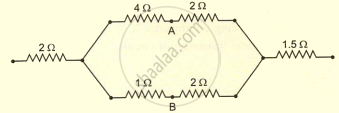
- Resistance of the wing marked as A.
- Resistance of the wing marked as B.
- Equivalent resistance of A and B.
- Equivalent resistance of the whole circuit.
State the limitations of Ohm’s law.
Study the adjoining diagram carefully and calculate:
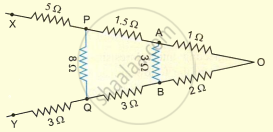
- Equivalent resistance between points A and B.
- Equivalent resistance between points P and Q.
- Equivalent resistance between points X and Y.
Draw a fully labelled diagram for the verification of Ohm's law.
Study the figure carefully.
What is the equivalent resistance in the figure when the current enters at A and leaves at D?
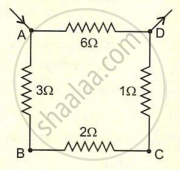
Study the figure carefully.
What is the equivalent resistance in the figure when the current enters at D and leaves at B?
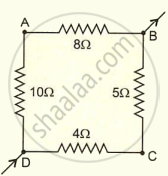
What is an ohmic resistance? Support your answer by two examples.
Study the adjoining diagram carefully and answer the following questions:
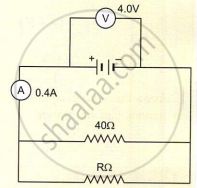
- By using the reading of voltmeter and ammeter, calculate the equivalent resistance of 40 Ω and R.
- Calculate the value of R.
- Calculate the current flowing through R.
What are non-ohmic resistances? Support your answer by two examples.
Four cells, each with an e.m.f. 1.5 V and internal resistance of 0.25 Ω are connected in series. This battery of cells is connected to an external resistance of 5 Ω.
- Draw the figure for the circuit diagram.
- Calculate total resistance of circuit.
- Calculate total current flowing through external circuit.
- Drop in potential across the terminals of the cell.
Mention two factors which determine the internal resistance of a cell.
Study the diagram alongside carefully and answer the following:
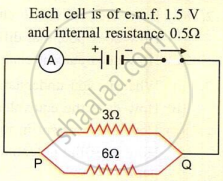
- Equivalent resistance between P and Q.
- Reading shown by the ammeter.
- Current flowing in the 3 Ω resistor.
What is the difference between electromagnetic force and potential difference?
In the figure given below, A, B and C are three ammeters. The ammeter B reads 0.5A. (All the ammeters have negligible resistance.)
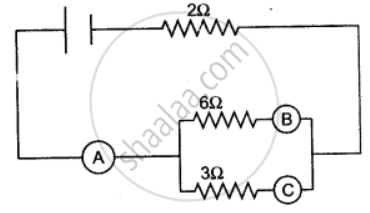
Calculate:
(i) the readings in the ammeters A and C.
(ii) the total resistance of the circuit.
The circuit depicted in the figure is employed for studying Ohm’s Law. Instead of using a standard resistor, a student opts for a glass tube filled with mercury (tube 1), connected to the circuit through two electrodes, E1 and E2. He records the readings of the ammeter and voltmeter, thereby calculating the resistance. The student repeats the experiment by substituting tube 1 with tube 2, where the same amount of mercury fills tube 2.
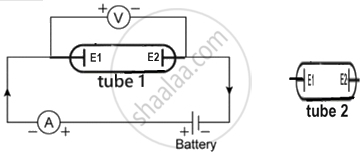
Neglecting internal resistance of the cell use (> or < or =) to compare:
- the resistance in both the cases.
- the voltmeter readings in both the cases.
- the specific resistance in both the cases.
Three bulbs of powers P1, P2 and P3 (P1 < P2 < P3) are connected in a certain way such that P3 glows brightest.
- What type of connection exists between these bulbs?
- Compare the voltage across these bulbs. (Use >, < or =)
- Will the circuit still function if one of the bulbs is fused?
Diagram alongside shows graphs for four resistors A, B, C and D for voltage against current.
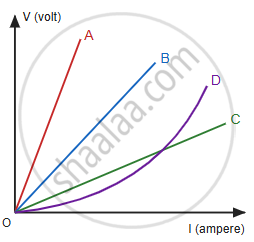
- Which resistor is suitable for making a filament of an electric bulb?
- Give a reason for your answer.
State whether a semiconducting material has an ohmic or a non-ohmic resistance.
What happens to the resistance of a semiconducting material when its temperature is raised?
Two resistors of 12 Ω and 6 Ω are connected in parallel and draw a current of 0.6 A from a cell.
- Draw the circuit diagram of the above arrangement.
- Calculate the magnitude of the current in each resistor.
MULTIPLE CHOICE QUESTIONS Choose the most appropriate option.
The graph between `V/I` for a conductor is a straight line. The slope of the graph represents:
resistivity
resistance
electric potential
none of these
Which of the following is non-ohmic resistance?
Copper wire
Brass wire
Copper wire wound on an electromagnet
Constantan wire
Which of the following is an ohmic resistance?
Diode valve
Filament of a bulb
Carbon arc light
Manganin wire
In a series circuit:
p.d across all resistors is same
current flowing through all resistors is same
The combined resistance of all resistors is less than individual resistors.
none of the above
In a parallel circuit:
p.d across all resistors is same
current flowing through all resistors is same
the equivalent resistance of all resistors is more than any of the individual resistors
none of the above
Two resistors of 2Ω each are connected in parallel. The equivalent resistance is:
less than 2Ω but more than 1Ω
one ohm
four ohm
between 4Ω and 2Ω
A new cell is marked 1.5 V. When connected to an external resistance, the voltmeter connected to its terminals reads 1.2 V. The drop in potential across the terminals of the cell is due to the:
internal resistance of cell
external resistance
both internal resistance of cell and external resistance
none of these
A potentiometer is connected to a cell through switch in series. To one end of the potentiometer is attached a voltmeter with the help of connecting wire and a jockey. When the jockey is moved over the potentiometer wire from zero end to 100 cm the reading shown by voltmeter is likely to:
decrease
increase
not change
none of these
When the current is drawn from a cell in a closed circuit, the potential difference between the terminals of cell is called:
e.m.f.
p.d
terminal voltage
both e.m.f. and p.d
Which is not the characteristic of a series circuit?
The sum total of all resistances is more than any individual resistance.
There is a continuous fall in potential all along in series circuit.
The current is not a constant quantity in a series circuit.
If 'V' is the total drop in potential in series circuit and V1, V2 and V3 are the drops in potential across individual resistors then, V = V1 + V2 + V3.
The physical conditions of a conductor remaining same, the current flowing through it is directly proportional to the potential difference at its ends. The above law was stated by:
Michael Faraday
Fleming
Oersted
Georg Simon Ohm
Internal resistance of a cell is:
inversely proportional to the surface area of electrodes in contact with electrolyte
directly proportional to the distance between the electrodes
dependant on the temperature of electrolyte
all of these
If 'r' is the internal resistance of a cell, such that 'E' is its e.m.f. and 'V' the p.d. and R the external resistance of the circuit, then the expression for internal resistance is:
$$r = \frac{\mathrm{R}(\mathrm{E} - \mathrm{V})}{\mathrm{V}}$$
$$r = \frac{\mathrm{E} - \mathrm{V}}{\mathrm{RV}}$$
$$r = \frac{\mathrm{V}}{\mathrm{R}(\mathrm{E} - \mathrm{V})}$$
none of these
If large current is drawn from the cell, i.e., external resistance is low, then drop in potential across the terminals of cell is:
very small
very large
does not change
none of these
A current 0.8 A is drawn from a cell of e.m.f. 1.5 V, when internal resistance of cell is 1.6 Ω. The drop in potential across the terminal of cell will be:
1.24 V
1.28 V
1.20 V
1.16 V
Which one is a non-ohmic resistance?
constantan wire
electric bell
coil of heater
eureka wire
A bulb of resistance 440 Ω is connected to 220 V supply. The current flowing through bulb is:
0.5 A
1.0 A
0.8 A
0.4 A
An electric heater draws a current of 10 A when connected to 250 V mains. The resistance of the heating element of the heater is:
20 Ω
22.5 Ω
25 Ω
40 Ω
A current of 0.15 A flows through the filament of a bulb with a resistance of 400 Ω. The p.d. of the electric supply is:
120 V
60 V
80 V
100 V
In the circuit given below, identify the correct relation between the currents flowing through the 2 Ω, 3 Ω, and 5 Ω resistors:

current through 2 Ω > current through 3 Ω
current through 5 Ω < current through 3 Ω
current through 2 Ω = current through 5 Ω
current through 5 Ω > current through 3 Ω
Direction for Q. Numbers 21 to 25: The questions given below are Assertion (A) and Reason (R) type questions. Choose the correct answer from options given below:
Assertion (A): When no current is drawn from a cell, the potential difference produced by the chemical reaction between the terminals of the cell is called its electromotive force.
Reason (R): When current is drawn from a cell, the potential difference between the electrodes of the cell is known as its terminal voltage.
Both Assertion (A) and Reason (R) are true and Reason (R) is the correct explanation of Assertion (A).
Both Assertion (A) and Reason (R) are true but Reason (R) is not the correct explanation of Assertion (A).
Assertion (A) is false, but Reason (R) is true.
Assertion (A) is true, but Reason (R) is false.
Assertion (A): When the resistance of the combination is to be increased, they are combined in series.
Reason (R): When the resistance of the combination is to be decreased, they are combined in parallel.
Both Assertion (A) and Reason (R) are true and Reason (R) is the correct explanation of Assertion (A).
Both Assertion (A) and Reason (R) are true but Reason (R) is not the correct explanation of Assertion (A).
Assertion (A) is false, but Reason (R) is true.
Assertion (A) is true, but Reason (R) is false.
Assertion (A): The resistance of an ohmic current increases with the rise in temperature.
Reason (R): Ohm's law cannot be verified at higher temperatures.
Both Assertion (A) and Reason (R) are true and Reason (R) is the correct explanation of Assertion (A).
Both Assertion (A) and Reason (R) are true but Reason (R) is not the correct explanation of Assertion (A).
Assertion (A) is false, but Reason (R) is true.
Assertion (A) is true, but Reason (R) is false.
Assertion (A): Potential difference across all the resistors connected in parallel is a constant quantity.
Reason (R): All the resistors in parallel have a common positive and common negative ends.
Both Assertion (A) and Reason (R) are true and Reason (R) is the correct explanation of Assertion (A).
Both Assertion (A) and Reason (R) are true but Reason (R) is not the correct explanation of Assertion (A).
Assertion (A) is false, but Reason (R) is true.
Assertion (A) is true, but Reason (R) is false.
Assertion (A): The equivalent resistance in series is greater than any of the resistor in series circuit.
Reason (R): In series circuit the equivalent resistance is sum total of individual resistors.
Both Assertion (A) and Reason (R) are true and Reason (R) is the correct explanation of Assertion (A).
Both Assertion (A) and Reason (R) are true but Reason (R) is not the correct explanation of Assertion (A).
Assertion (A) is false, but Reason (R) is true.
Assertion (A) is true, but Reason (R) is false.
Complete the following by choosing correct answers from brackets.
Potential difference at the ends of resistors in ______ circuit is a constant quantity.
series
parallel
The internal resistance of a cell is ______ proportional to distance between the electrodes of the cell.
inversely
directly
The potential difference across the terminals of a cell, when no current is flowing in external circuit is called ______.
terminal voltage
electromotive force
There is a continuous drop of ______ all along in the series circuit.
electric potential
electric current
The potential difference across the terminals of resistors in series circuit is a ______ quantity.
constant
variable
Match the statements in column A with those in column B.
| Column A | Column B |
|---|---|
| (a) Resistances in series | (i) A law which gives a relation between the current flowing through circuit and potential difference. |
| (b) Non-ohmic resistance | (ii) A combination of two or more resistances, such that equivalent resistance is less than any of the resistance in circuit. |
| (c) Ohm's law | (iii) The potential difference across the terminals of cell when current flows in external circuit. |
| (d) Resistance in parallel | (iv) A resistance which does not obey Ohm's law. |
| (e) Terminal voltage | (v) Combination of two or more resistance such that magnitude of current in resistors is same. |
Goyal Brothers Prakashan solutions for A New Approach to ICSE Physics [English] Class 10 7 Electric Circuits, Resistance and Ohm's Law NUMERICAL PROBLEMS ON RESISTANCE [Pages 163 - 165]
Calculate the equivalent resistance between points A and C, as shown in the figure.
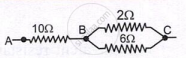
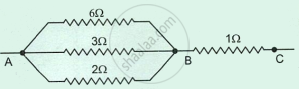
Calculate the equivalent resistance
- between points A and B
- between points A and C.
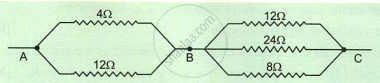
In the figure, calculate equivalent resistance between points (a) A and B (b) B and C (c) A and C.
Calculate the equivalent resistance.
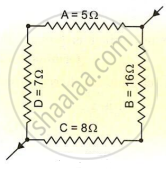
Calculate the equivalent resistance.
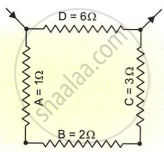
Practice Problems 2:
Calculate the equivalent resistance between points
- B and E
- A and F.
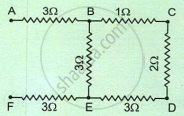
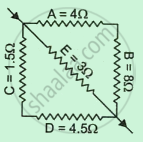
Calculate the equivalent resistance of the circuit diagram shown in the figure.
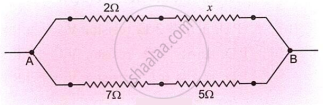
The equivalent resistance of the circuit is 4 Ω. Calculate the resistance of x.
Practice Problems 3:
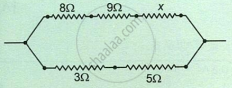
The equivalent resistance of the circuit is 6 Ω. Calculate the value of x.
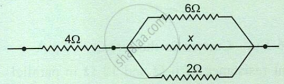
The equivalent resistance of the circuit is 5 Ω. Calculate the value of x.
Goyal Brothers Prakashan solutions for A New Approach to ICSE Physics [English] Class 10 7 Electric Circuits, Resistance and Ohm's Law NUMERICAL PROBLEMS ON OHW'S LAW [Pages 165 - 171]
An incandescent lamp with a resistance of 40 Ω draws a current of 5.0 A. Find the line voltage.
Practice Problems 1:
A current of 0.2 A flows through a conductor of resistance 4.5 Ω. Calculate the p.d. at the ends of the conductor.
A bulb of resistance 400 Ω is connected to 200 V mains. Calculate the magnitude of the current.
An electric heater draws a current of 5 A, when connected to 220 V mains. Calculate the resistance of its filament.
Three resistors of 2 Ω, 4 Ω and 6 Ω are connected in series to a battery of e.m.f. 12 V and negligible internal resistance. Draw the circuit diagram and calculate (a) current drawn from the cell (b) p.d. at the ends of each resistor.
Practice Problems 2:
Four resistors of resistance 0.5 Ω, 1.5 Ω, 4 Ω and 6 Ω are connected in series to a battery of e.m.f. 6 V and negligible internal resistance. Calculate (a) current drawn from the cell (b) p.d. at the ends of each resistor.
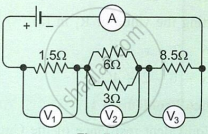
The figure shows a circuit diagram with a 24 V battery and negligible internal resistance. Calculate : (a) the reading of the ammeter. (b) reading of V1, V2 and V3.
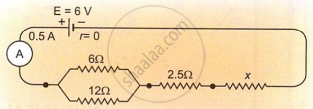
Carefully study the circuit diagram shown in the figure, and calculate the value of the resistor x in ohms.
Practice Problems 3:
Three resistors of 6 Ω, 2 Ω and x are connected in series to a cell of e.m.f. \[ \frac{3}{2} \ \text{V} \], when the current registered in the circuit is \[ \frac{1}{6} \ \text{A} \]. Draw the circuit diagram and calculate the value of x.
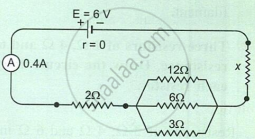
Carefully study the circuit diagram and calculate the value of resistor x.
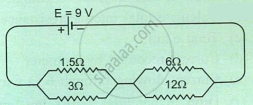
Three resistors of 3 Ω, 1.5 Ω and 1 Ω are connected in parallel. The combination of the above resistors is connected in series to a resistance of 8.5 Ω and then to a battery with an e.m.f. 4.5 V. If the internal resistance of the cell is negligible:
- Draw the circuit diagram.
- Calculate the current in the main circuit.
- Calculate the current in each of the resistors in parallel.
Practice Problems 4:
Three resistors of 4 Ω, 6 Ω and 12 Ω are connected in parallel. The combination of these resistors is connected in series to a resistance of 2 Ω and then to a battery of e.m.f. 6 V and negligible internal resistance
- Draw the circuit diagram.
- Calculate the current in the main circuit.
- Calculate the current in each of the resistors in parallel.
Study the circuit diagram carefully and calculate:
- current in the main circuit.
- current in each of the resistors in the parallel circuit.
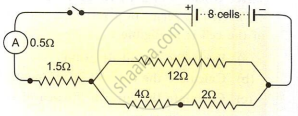
The figure shows a circuit diagram containing 8 cells of em.f. 1.5 V and an internal resistance of 0.25 Ω. Calculate (a) total e.m.f. of battery (b) total internal resistance, (c) total external resistance (d) current recorded by ammeter (e) current flowing through (i) 12 Ω resistor (ii) 2 Ω resistor (f) drop in potential across the terminals of the cell.
Practice Problems 5:
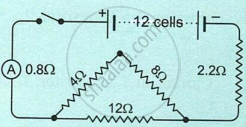
The figure shows a circuit diagram containing 12 cells, each of e.m.f. 1.5 V and internal resistance 0.25 Ω. Calculate :
- Total internal resistance
- Total e.m.f.
- Total external resistance
- Reading shown by the ammeter
- Current in 12 Ω and 8 Ω resistors
- p.d. across 2.2 Ω resistor
- Drop in potential across the terminals of the cell.
Four cells, each of e.m.f. 2 V and internal resistance 0.2 Ω each are connected in series to form a battery. This battery is connected to an ammeter, a resistance 1.2 Ω and then to a set of resistance of 4 Ω, 6 Ω and 12 Ω in parallel to complete the overall circuit in series.
- Draw circuit diagram of arrangement.
- Calculate total internal resistance.
- Total e.m.f.
- Current recorded by ammeter.
- Current flowing through 6 Ω wire in parallel.
- Drop in potential across the terminals of the battery.
Four cells, each of e.m.f. 1.5 V and internal resistance 2 Ω are connected in parallel, to form a battery. The battery is connected to the external resistance of 1.5 Ω and a set of two resistances of 3 Ω and 1.5 Ω in parallel. Draw a circuit diagram and answer the following:
- What is the current in the main circuit?
- What is the current in 3 Ω wire?
- What is the drop in potential?
Practice Problems 6:
Two cells, each of e.m.f. 1.5 V and internal resistance 1 Ω are connected in parallel, to form a battery. The battery is connected to an external resistance of 0.5 Ω and two resistances of 3 Ω and 1.5 Ω in parallel.
- Draw the circuit diagram.
- Calculate the current in the main circuit.
- Calculate the current in the 1.5 Ω resistor.
- Calculate the drop in potential across the terminals of the battery.
Four cells, each of e.m.f. 1.5 V and internal resistance 2 Ω each are connected in parallel to form a battery. The battery is connected to an external resistance of 0.5 Ω and three resistances of 12 Ω, 6 Ω and 4 Ω in parallel.
- Draw the circuit diagram.
- Calculate the current in the main circuit.
- Calculate the current in the 4 Ω resistor.
- Calculate the drop in potential across the terminals of the battery.
A cell of e.m.f. 1.5 V, records a p.d. of 1.0 V, when connected to an external resistance R, such that current flowing through the circuit is 0.4 A. Calculate the value of R and the internal resistance of the cell.
Practice Problems 7:
A cell of e.m.f. 1.5 V, records a p.d. of 1.35 V, when connected to an external resistance R, such that current flowing through the circuit is 0.75 A. Calculate the value of R and internal resistance of the cell.
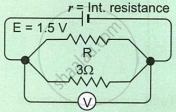
In the figure, a current of 1 A flows through the circuit when the p.d. recorded at the ends of the parallel resistors is 1 volt. Calculate the values of R and r.
A cell of e.m.f. 1.5 V is connected to an external resistance of 2.0 Ω, when p.d. recorded at the ends of the resistance is 1.2 V. Calculate the internal resistance of the cell.
Practice Problems 8:
A cell of e.m.f. 1.8 V is connected to an external resistance of 2 Ω, when p.d. recorded at the ends of resistance is 1.6 V. Calculate the internal resistance of the cell.
Study the circuit diagram in the figure, and hence, calculate the internal resistance of the cell.
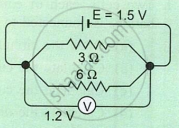
A cell when connected to an external resistance of 2 Ω shows a p.d. of 1.2 V. If the 2 Ω resistance is replaced by 1 Ω resistor the p.d. drops to 1 V. Calculate (a) e.m.f., (b) internal resistance of the cell.
Practice Problems 9 :
A cell, when connected to an external resistance of 4.5 Ω shows a p.d. of 1.35 V. If 4.5 Ω resistance is replaced by 2.5 Ω resistance the p.d. drops to 1.25 V. Calculate (a) e.m.f., (b) internal resistance of the cell.
Study the figures carefully, then calculate the values of E and r.
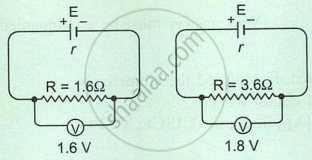
Goyal Brothers Prakashan solutions for A New Approach to ICSE Physics [English] Class 10 7 Electric Circuits, Resistance and Ohm's Law COMPETENCY-FOCUSED PRACTICE QUESTIONS RELEASED BY CISCE [Pages 171 - 173]
Given that the resistivity of Gold and Platinum is 2.1 × 10⁻⁸ and 10.5 × 10⁻⁸ ohm m, respectively, which is the correct statement?
STATEMENT A: 5 metres of platinum wire will have the same resistance as one metre of gold wire.
STATEMENT B: Gold wire of 1 cm radius will have the same resistance as platinum wire of 5 cm radius.
Only statement A is correct.
Only statement B is correct.
Both statements A and B are correct.
Both statements A and B are incorrect.
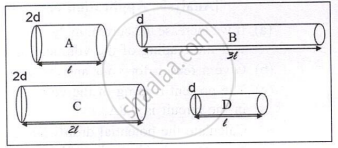
The diagram shows different copper conductors of diameters (d) and (2d) and lengths, which are multiples of (l). The increasing order of their resistances will be:
A < B < C < D
A < C < D < B
A < D < C < B
D < A < C < B
If three resistors R1, R2 and R3 are connected in series and by R1 > R2 > R3, then what is the relation between the currents I1, I2 and I3 respectively flowing through them?
I1 = I2 = I3
I1 < I2 < I3
I1 > I2 > I3
`1/I_1 < 1/I_2 < 1/I_3`
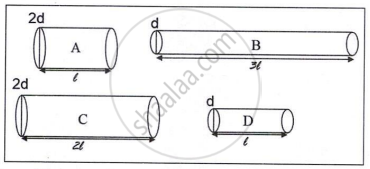
In the diagram, calculate the ratio of the resistances A, B, C and D.
There are two copper wires of length ratio 1 : 2 that have their cross-sectional areas in the ratio 1 : 4. What will be the ratio of their:
- resistances?
- specific resistances?
You are given three resistors of magnitude 3 Ω each. You can join them either in a series or in a parallel combination. How will you arrange them so that the equivalent resistance would become:
- maximum
- minimum
(Your answer must be accompanied by proper mathematical calculations)
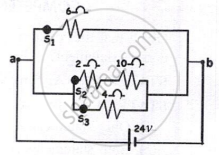
In the given circuit diagram, Minakshi replaced the ammeter by a voltmeter by mistake. Will this circuit work?
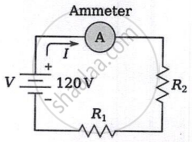
Which one of the switches, S1, S2 or S3 should be opened so that:
- total resistance is equal to 4 ohms.
- the total resistance is equal to 3 ohms.
- the current through 4 ohms is \[\frac{3}{5}\] th of the total current.
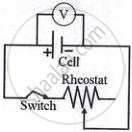
Observe the electric circuit and answer the questions that follow.
- If we increase the current in the above circuit using a rheostat, will the reading of the voltmeter decrease or increase?
- Give a reason for your answer in 'a'.
- The present reading of the voltmeter is 2V, and the current in the circuit is 0.8A.
Calculate the potential drop when the current in the circuit becomes 1 A. Given E = 3V.
The circuit depicted in the figure is employed to study Ohm's Law. Rather than employing a conventional resistor, a glass tube of length 'l' and cross-sectional area 'a', which is half-filled with mercury of resistivity 'd', is connected to the circuit via two electrodes, E1 and E2. These electrodes are linked to a battery with an emf of 'E' and negligible internal resistance. Provide the answer in terms of 'a', 'l', 'd', and 'E'.
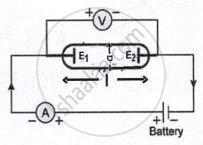
- Resistance of mercury in the tube.
- The ammeter reading.
- Voltmeter reading.
- Which of the measurements are altered when the tube is entirely filled with mercury?
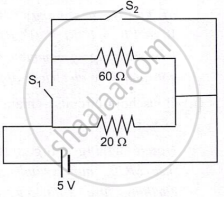
In the circuit diagram, calculate the power consumed in the circuit when:
- the switch S1 is closed, and the switch S2 is open.
- the switch S2 is closed, and the switch S1 is open.
Solutions for 7: Electric Circuits, Resistance and Ohm's Law
Goyal Brothers Prakashan solutions for A New Approach to ICSE Physics [English] Class 10 chapter 7 - Electric Circuits, Resistance and Ohm's Law
Shaalaa.com has the CISCE Mathematics A New Approach to ICSE Physics [English] Class 10 CISCE solutions in a manner that help students grasp basic concepts better and faster. The detailed, step-by-step solutions will help you understand the concepts better and clarify any confusion. Goyal Brothers Prakashan solutions for Mathematics A New Approach to ICSE Physics [English] Class 10 CISCE 7 (Electric Circuits, Resistance and Ohm's Law) include all questions with answers and detailed explanations. This will clear students' doubts about questions and improve their application skills while preparing for board exams.
Further, we at Shaalaa.com provide such solutions so students can prepare for written exams. Goyal Brothers Prakashan textbook solutions can be a core help for self-study and provide excellent self-help guidance for students.
Concepts covered in A New Approach to ICSE Physics [English] Class 10 chapter 7 Electric Circuits, Resistance and Ohm's Law are .
Using Goyal Brothers Prakashan A New Approach to ICSE Physics [English] Class 10 solutions Electric Circuits, Resistance and Ohm's Law exercise by students is an easy way to prepare for the exams, as they involve solutions arranged chapter-wise and also page-wise. The questions involved in Goyal Brothers Prakashan Solutions are essential questions that can be asked in the final exam. Maximum CISCE A New Approach to ICSE Physics [English] Class 10 students prefer Goyal Brothers Prakashan Textbook Solutions to score more in exams.
Get the free view of Chapter 7, Electric Circuits, Resistance and Ohm's Law A New Approach to ICSE Physics [English] Class 10 additional questions for Mathematics A New Approach to ICSE Physics [English] Class 10 CISCE, and you can use Shaalaa.com to keep it handy for your exam preparation.
