Advertisements
Advertisements
Question
Study the diagram alongside carefully and answer the following:
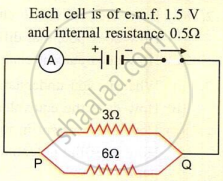
- Equivalent resistance between P and Q.
- Reading shown by the ammeter.
- Current flowing in the 3 Ω resistor.
Advertisements
Solution
Given Data:
Number of cells connected in series (n) = 2
e.m.f. of each cell (E) = 1.5 V
Internal resistance of each cell (r) = 0.5 Ω
Total e.m.f.
\[ \mathrm{E}_{total} = 2 \times 1.5 \]
\[ = 3 \ \text{V} \]
Total internal resistance
\[ r_{total} = 2 \times 0.5 \]
\[ = 1 \ \Omega \]
i. The 3 Ω and 6 Ω resistors are connected in parallel between points P and Q.
\[ \frac{1}{\mathrm{R}_{PQ}} = \frac{1}{3} + \frac{1}{6} \]
\[ = \frac{2 + 1}{6} \]
\[ = \frac{3}{6} \]
\[ = \frac{1}{2} \]
\[ \therefore \mathrm{R}_{PQ} = 2 \ \Omega \]
ii. The ammeter is in the main circuit, so it measures the total current.
\[ \mathrm{R}_{total} = \mathrm{R}_{PQ} + r_{total} \]
\[ = 2 + 1 \]
\[ = 3 \ \Omega \]
\[ \mathrm{I} = \frac{\mathrm{E}_{total}}{\mathrm{R}_{total}} \]
\[ = \frac{3}{3} \]
\[ = 1 \ \text{A} \]
iii. Potential difference across P and Q
\[ \mathrm{V}_{PQ} = \mathrm{I} \times \mathrm{R}_{PQ} \]
\[ = 1 \times 2 \]
\[ = 2 \ \text{V} \]
Current in the 3 Ω resistor
\[ \mathrm{I}_{3} = \frac{\mathrm{V}_{PQ}}{3} \]
\[ = \frac{2}{3} \]
\[ \approx 0.67 \ \text{A} \]
