Advertisements
Online Mock Tests
Chapters
1: Forces: Turning Forces and Uniform Circular Motion
2: Work, Power and Energy
3: Machines
(B) Light
4: Refraction of Light
▶ 5: Electromagnetic Waves and Spectrum
(C) Sound
6: Sound
(D) Electricity and Magnetism
Chapter 7: Electric Circuits, Resistance and Ohm's Law
Chapter 8: Electric Energy, Power and Household Circuits
Chapter 9: 1. Electromagnetism 2. Magnetic Effects of Electric Current 3. Electromagnetic Induction
(E) Heat
Chapter 10: Calorimetry
(F) Modern Physics
Chapter 11: Radioactivity
Advertisements
Solutions for Chapter 5: Electromagnetic Waves and Spectrum
Below listed, you can find solutions for Chapter 5 of CISCE Goyal Brothers Prakashan for A New Approach to ICSE Physics [English] Class 10.
Goyal Brothers Prakashan solutions for A New Approach to ICSE Physics [English] Class 10 5 Electromagnetic Waves and Spectrum EXERCISE [Pages 113 - 117]
Name the unit in which wavelength of electromagnetic waves is measured.
What is the range of wavelengths of visible light?
How does the colour of visible light change as its wavelength gradually decreases?
- A mixture of red, blue, and green light rays is passed through a convex lens, as illustrated in the diagram below. State whether the ray passes through a single point or through different points on the principal axis after refraction.

- Name the invisible radiation which is studied using the quartz prism.
- State one use of the radiation mentioned by you in (b) above.
- Name one type of radiation with a wavelength greater than that of the radiation mentioned by you in (b) above.
Define the term dispersion of light.
Define the following:
Scattering of light
Define the following:
Spectrum
- By drawing a neat diagram, trace the path of ray of white light, through an equiangular glass prism, till it emerges out of a prism and strikes a white screen.
- Write the sequence of colours formed on the white screen from bottom upward.
- What is your observation, if white screen is replaced by a green screen? Give a reason.
Diagrams given below shows two equilateral glass prisms and a ray of white light incident on prism A.
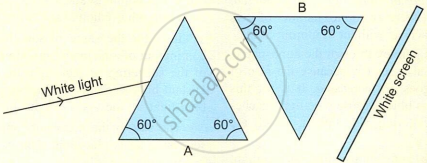
- Copy the diagram and trace the course of white ray of light, till it strikes the screen.
- Write about two conclusions which you can draw about the nature of white light.
Which physical quantity determines colour of visible light?
Which colour of visible light deviates least in an optical medium?
Which colour of visible light deviates most in an optical medium?
For which colour the refractive index of an optical medium is maximum?
For which colour the refractive index of an optical medium is minimum?
What name is given to electromagnetic waves beyond red?
What name is given to electromagnetic waves beyond violet?
What do you understand by the invisible spectrum?
Name four broad electromagnetic wave bands of invisible spectrum, beyond the red band of visible spectrum.
Name four broad electromagnetic wave bands of invisible spectrum, beyond the violet band of visible spectrum.
What are infrared radiations?
What is the range of infrared radiation in Å?
How can you detect infrared radiation? Explain briefly.
State the properties of infrared radiation.
State two uses of infrared radiations.
Does our body emit infrared radiation. If so state their approximate range.
What are ultraviolet radiations?
What is the range of ultraviolet radiation in Å?
How can you detect ultraviolet radiation? Explain briefly.
State the properties of ultraviolet radiation.
State two uses of ultraviolet radiation.
State one harm, the ultraviolet radiation can cause to human body.
How does nature protect us from the harmful effects caused by ultraviolet radiation.
Which optical material absorbs least amount of ultraviolet radiation?
How is ultraviolet radiation useful to human being?
How is ultraviolet radiation useful to jewellers?
How is ultraviolet radiation useful to bankers?
Amongst the sources listed below, name two powerful sources of ultraviolet radiations.
- A room heater
- Sun
- Electric lamp
- Arc welding
Why does a welder keep a special kind of glass between the object to be welded and his eyes? Explain.
Why is the infrared radiation preferred over visible light for photography in the fog?
Which colour of white light scatters most?
Which colour of white light scatters least?
Why does the sky appear in blue colour?
Why does sky appear black on the surface of moon?
Why does distant hill appear blue on sunny days?
Why does we soak over washed clothes in ultramarine?
Why are yellow or orange head lights used in foggy weather?
Why does the sun appear red at sunset?
Why does smoke from a chimney appear blue, instead of black during winter morning?
Name any two electromagnetic waves which have a frequency higher than that of violet light. State one use of each.
What is Newton’s disc?
What does Colour disc experiment establish about the nature of light.
- Name the high energetic invisible electro-magnetic wave which helps in the study of structure of crystals.
- State one more use of the wave named in part (a).
How does the speed of light in glass change on increasing the wavelength of light?
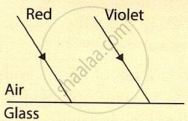
Two parallel rays of red and violet travelling through air meet the air-glass boundary as shown in the diagram. Will their paths inside the glass be parallel? Give a reason for your answer. Compare the speeds of the two rays inside the glass.
Name the radiations that are used for photography at night.
Name the radiations used for the detection of fracture in bones.
Name the radiations whose wavelength range is from 100 Å to 4000 Å (or 10 nm to 400 nm).
Name the material prism required for obtaining the spectrum of ultraviolet light.
Name the radiation which can be detected by a thermopile.
Why is the colour red used as a sign of danger?
MULTIPLE CHOICE QUESTIONS Choose the most appropriate option.
Visible light has electromagnetic waves between ______.
8000 Å and 6000 Å
8000 Å and 1000 Å
8000 Å and 4000 Å
8000 Å and 2000 Å
1 Angstrom unit (Å) is equal to ______.
10−10 m
10−12 m
10−8 m
10−6 m
The most visible colour of visible spectrum is ______.
blue
red
green
orange
The band of seven colours formed, when white light passes through an equilateral prism is called ______.
dispersion
colour band
spectrum
none of these
Violet, green, red and yellow are the four colours formed on a white screen when a polychromatic light is dispersed. The arrangement of colours in the decreasing order of wavelengths is:
green, red, yellow and violet
red, yellow, green and violet
violet, green, yellow and red
violet, green, red and yellow
The angle of deviation is maximum for ______ when the dispersion of polychromatic light takes place.
red
violet
green
blue
Which is not a source of ultraviolet radiations?
Sun
Arc lamp
Electric heater
Stars
The electromagnetic radiation which are useful in night photography is ______.
infrared rays
ultraviolet rays
visible light
X-rays
The electromagnetic wave associated with high energy is ______.
ultraviolet ray
X-ray
gamma ray
infrared ray
During the Sunset the colour which scatters closest to the eye of observer is:
yellow
red
blue
violet
Infrared rays with very large wavelength are easily reflected by ______.
air
glass
carbon dioxide molecules
both glass and carbon dioxide molecules
X-rays are produced by:
oscillating circuits in special vacuum tubes
excitation of outermost electronic shell of an atom
excitation of inner electron of atom and is sudden annihilation of high energy free electrons.
nucleus of an atom, by the destruction of high energy particle.
The electromagnetic waves which produce heating effect in material bodies are:
light rays
infrared rays
X-rays
all of these
The greenhouse effect is caused when ______.
infrared rays of longer wavelength are reflected by CO2 molecules.
infrared rays of longer wavelength are reflected by CH4 molecules.
infrared rays of longer wavelength are reflected by CO2 and CH4 molecules.
none of these
The sensation of colour depends upon the ______.
wavelength of visible light
velocity of visible light
both wavelength and velocity of visible light
none of these
A wave having a wavelength between 5780 Å and 5000 Å produce a sensation of green. If wavelength is between 5000 Å and 4640 Å, the sensation of colour will be:
yellow
orange
blue
violet
When all the seven bands of colour of white light are simultaneously incident on the retina the final perception of colour is:
black
white
brilliant blue
none of these
The sensation produced in the brain when a visible light of some specific wavelength excites retina is called ______.
monochromatic light
polychromatic light
colour
dye
Colour is a ______.
physical state of matter
sensation in brain
invisible energy
sensation in brain and invisible energy
When the white light enters into a glass prism:
the different wavelengths bend through different angles.
the different wavelengths bend through same angle.
in bending through different angles the colours separate.
the different wavelengths bend through different angles and in bending through different angles the colours separate.
Inside the prism, during the dispersion of white light, compared to blue, red light ______.
slows down less and refracts more.
slows down more and refracts less.
slows down more and refracts more.
slows down less and refracts less.
The region of spectrum which is invisible and extends beyond red region of visible spectrum consists of:
infrared spectrum
microwaves
radiowave
all of these
The region of spectrum which is invisible and extends beyond violet region of visible spectrum consists of:
ultraviolet rays
X-rays
gamma rays
all of these
Which is not a correct statement regarding infrared rays?
They produced heating effect when absorbed by matter.
They strongly affect photographic plate even when wrapped in black paper.
They can cause skin burns.
They are easily absorbed by glass.
Which is not a correct statement regarding ultraviolet radiation?
They produce fluorescence in substances like zinc sulphide.
They do not affect photographic plates.
They are harmful to eyes.
They produce vitamin D, when absorbed by skin.
Direction for Q. Numbers 26 to 30: The questions given below are Assertion (A) and Reason (R) type questions. Choose the correct answer from options given below:
Assertion (A): Soldiers avoid firing at a target in foggy weather conditions.
Reason (R): In foggy weather, light gets scattered by tiny water droplets, reducing visibility.
(A) is true but (R) is false.
(A) is false but (R) is true.
Both (A) and (R) are true and (R) is the correct explanation of (A).
Both (A) and (R) are true, but (R) is not the correct explanation of (A).
Assertion (A): The speed of light for different colours is same in air.
Reason (R): The speed of light for different colours is the different in glass.
Both Assertion (A) and Reason (R) are true and Reason (R) is the correct explanation of Assertion.
Both Assertion (A) and Reason (R) are true but Reason (R) is not the correct explanation of Assertion.
Assertion (A) is false, but Reason (R) is true.
Assertion (A) is true, but Reason (R) is false.
Assertion (A): In the pure spectrum, each colour is separated with the other colour, i.e., there is a sharp boundary line separating the colours.
Reason (R): Different colours have different width on the screen.
Both Assertion (A) and Reason (R) are true and Reason (R) is the correct explanation of Assertion.
Both Assertion (A) and Reason (R) are true but Reason (R) is not the correct explanation of Assertion.
Assertion (A) is false, but Reason (R) is true.
Assertion (A) is true, but Reason (R) is false.
Assertion (A): Dispersion of white light occurs only at the first surface of a prism.
Reason (R): Deviation of light rays occurs at both surfaces of a prism.
Both Assertion (A) and Reason (R) are true and Reason (R) is the correct explanation of Assertion.
Both Assertion (A) and Reason (R) are true but Reason (R) is not the correct explanation of Assertion.
Assertion (A) is false, but Reason (R) is true.
Assertion (A) is true, but Reason (R) is false.
Assertion (A): A radiation X is focused by a proper device on the bulb of a thermometer. Mercury in the thermometer shows a rapid expand.
Reason (R): The radiation X is ultraviolet radiation.
Both Assertion (A) and Reason (R) are true and Reason (R) is the correct explanation of Assertion.
Both Assertion (A) and Reason (R) are true but Reason (R) is not the correct explanation of Assertion.
Assertion (A) is false, but Reason (R) is true.
Assertion (A) is true, but Reason (R) is false.
Complete the following by choosing correct answers from brackets.
______ radiation are preferred to ordinary visible light for taking photographs in fog.
Ultraviolet
Infrared
Sky appears blue due to ______ of visible light.
refraction
scattering
Clothes soaked in ultramarine and then dried appear whiter and brighter, because ultramarine converts ______ rays into violet, and blue light.
ultraviolet
infrared
A boy uses a GPS device to locate his missing friend in a crowded area; the system primarily uses ______ to track the location.
ultraviolet waves
microwaves
The most visible colour is ______.
orange
green
red
Match the statements in Column A with those in Column B.
| Column A | Column B |
|---|---|
| (a) Spectrum | (i) A device used to prove the recombination of colours of spectrum. |
| (b) 1 cm or 108 Å | (ii) A chemical which glows in invisible U-V spectrum. |
| (c) Newton's colour disc | (iii) An electromagnetic radiation used for relieving pain from swollen joints. |
| (d) Infrared rays | (iv) A band of colours obtained on screen after dispersion. |
| (e) Barium platinocyanide | (v) Range of microwaves. |
Goyal Brothers Prakashan solutions for A New Approach to ICSE Physics [English] Class 10 5 Electromagnetic Waves and Spectrum COMPETENCY-FOCUSED PRACTICE QUESTIONS RELEASED BY CISCE [Page 118]
_____ of UV > _____ of microwaves.
The quantity suitable for filling in both the blanks is:
speed in vacuum
speed in a medium
frequency
wavelength
Assertion (A): Sometimes the sky appears reddish in the evening.
Reason (R): Red, being longer in wavelength, scatter more than the other colours.
A and R are true, and R is the reason for A.
A and R are true, and R is not the reason for A.
A is true, but R is false.
A is false, but R is true.
Solutions for 5: Electromagnetic Waves and Spectrum
Goyal Brothers Prakashan solutions for A New Approach to ICSE Physics [English] Class 10 chapter 5 - Electromagnetic Waves and Spectrum
Shaalaa.com has the CISCE Mathematics A New Approach to ICSE Physics [English] Class 10 CISCE solutions in a manner that help students grasp basic concepts better and faster. The detailed, step-by-step solutions will help you understand the concepts better and clarify any confusion. Goyal Brothers Prakashan solutions for Mathematics A New Approach to ICSE Physics [English] Class 10 CISCE 5 (Electromagnetic Waves and Spectrum) include all questions with answers and detailed explanations. This will clear students' doubts about questions and improve their application skills while preparing for board exams.
Further, we at Shaalaa.com provide such solutions so students can prepare for written exams. Goyal Brothers Prakashan textbook solutions can be a core help for self-study and provide excellent self-help guidance for students.
Concepts covered in A New Approach to ICSE Physics [English] Class 10 chapter 5 Electromagnetic Waves and Spectrum are Deviation Produced by a Triangular Prism, Dispersion of Light Through a Prism, Electromagnetic Spectrum, Colour in White Light with Their Wavelength and Frequency Range, Properties and Uses of Different Radiations of the Electromagnetic Spectrum, Scattering of Light-Rayleigh's Law, Applications of Scattering of Light, Distinction between Ultraviolet, Visible, and Infrared Radiations.
Using Goyal Brothers Prakashan A New Approach to ICSE Physics [English] Class 10 solutions Electromagnetic Waves and Spectrum exercise by students is an easy way to prepare for the exams, as they involve solutions arranged chapter-wise and also page-wise. The questions involved in Goyal Brothers Prakashan Solutions are essential questions that can be asked in the final exam. Maximum CISCE A New Approach to ICSE Physics [English] Class 10 students prefer Goyal Brothers Prakashan Textbook Solutions to score more in exams.
Get the free view of Chapter 5, Electromagnetic Waves and Spectrum A New Approach to ICSE Physics [English] Class 10 additional questions for Mathematics A New Approach to ICSE Physics [English] Class 10 CISCE, and you can use Shaalaa.com to keep it handy for your exam preparation.
