Advertisements
Online Mock Tests
Chapters
1: Forces: Turning Forces and Uniform Circular Motion
2: Work, Power and Energy
▶ 3: Machines
(B) Light
Chapter 4: Refraction of Light
Chapter 5: Electromagnetic Waves and Spectrum
(C) Sound
Chapter 6: Sound
(D) Electricity and Magnetism
Chapter 7: Electric Circuits, Resistance and Ohm's Law
Chapter 8: Electric Energy, Power and Household Circuits
Chapter 9: 1. Electromagnetism 2. Magnetic Effects of Electric Current 3. Electromagnetic Induction
(E) Heat
Chapter 10: Calorimetry
(F) Modern Physics
Chapter 11: Radioactivity
![Goyal Brothers Prakashan solutions for A New Approach to ICSE Physics [English] Class 10 chapter 3 - Machines - Shaalaa.com](/images/a-new-approach-to-icse-physics-english-class-10_6:7f30c0b5c38149fc86326989580f7d2b.jpg "Goyal Brothers Prakashan solutions for A New Approach to ICSE Physics [English] Class 10 chapter 3 - Machines")
Advertisements
Solutions for Chapter 3: Machines
Below listed, you can find solutions for Chapter 3 of CISCE Goyal Brothers Prakashan for A New Approach to ICSE Physics [English] Class 10.
Goyal Brothers Prakashan solutions for A New Approach to ICSE Physics [English] Class 10 3 Machines EXERCISE-1 [Pages 50 - 51]
What is the principle of an ideal machine?
For a given machine (not ideal) prove:
\[\text{Efficiency}=\frac{\text{Actual mechanical advantage}}{\text {Ideal mechanical advantage}}\]
What is a machine?
State two functions of a machine.
With reference to machines define the following term:
Ideal mechanical advantage (I.M.A.)
With reference to machines define the following term:
Actual mechanical advantage (A.M.A.)
Define velocity ratio.
With reference to machines define the following term:
Ideal machine
Define the term efficiency of a machine.
Study the diagram alongside and answer the following questions:
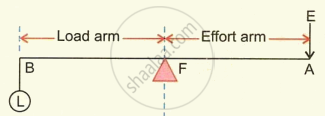
- What kind of lever is shown in diagram?
- Derive ideal mechanical advantage of this lever.
- Give two examples of this lever.
Study the diagram alongside and answer the following questions.
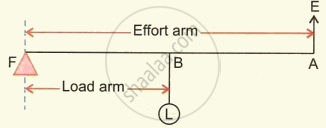
- What kind of lever is shown in diagram?
- Derive ideal mechanical advantage of this lever.
- Give two examples of this lever.
Study the diagram alongside and answer the following questions.
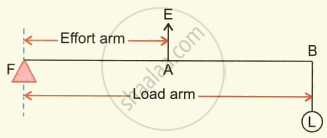
- What kind of lever is shown in diagram?
- Derive ideal mechanical advantage of this lever.
- Give two examples of this lever.
State the principle of a lever?
Explain why the mechanical advantage of the class III type of lever is always less than 1.
Name a class of lever which multiplies effort. Give one example.
Name a class of lever which multiplies speed. Give one example.
Why is it easier to open a lid with spoon, rather than with finger?
Describe three orders of levers giving an example of each. Draw neat diagrams showing the positions of fulcrum, load, and effort in each kind of lever.
A crowbar of length 120 cm has its fulcrum situated at a distance of 20 cm from the load. Calculate the mechanical advantage of the crowbar.
Diagram alongside shows a nut cracker.
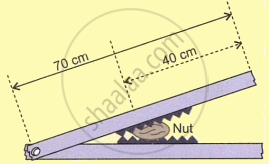
- What kind of lever is nutcracker?
- Copy the diagram on it show the line of action of force for (i) effort, (ii) load.
- What is the mechanical advantage of this lever?
- Calculate the resistance offered by the nut, if an effort of 300 N is sufficient to crack it.
A spade of length 1 m is held by a person at a distance of 20 cm from the fulcrum. Calculate.
- Velocity ratio of the spade.
- Force required to lift a load of 40 N.
A machine can lift a useful load of 80 kgf and effort E. If the efficiency of machine is 80% and velocity ratio 5, calculate:
- Actual mechanical advantage.
- The value of effort E.
A cook uses a fire tong of length 28 cm to lift a piece of burning coal of mass 250 g. If he applies effort at a distance of 7 cm from the burning coal, what is the effort applied?
What is the relationship between the mechanical advantage and the velocity ratio for:
- An ideal machine,
- A practical machine.
Scissors and shears are levers of first order. However, the cutting edge of scissors used for cutting cloth is much longer than the cutting edges of shears used for cutting metals. Explain the difference.
Which class of lever has mechanical advantage always greater than one?
What change can be brought about in this lever to increase its mechanical advantage?
With reference to the terms mechanical advantage, velocity ratio and efficiency of a machine, name and define the term that will not change for the machine of a given design.
Match the movement of the body part in column A to the class of lever in column B.
| Movement of the body part Column A |
Class of lever Column B |
| (a) Nodding head | Class III |
| (b) Lifting body weight on your toes | Class II |
| Class I |
Goyal Brothers Prakashan solutions for A New Approach to ICSE Physics [English] Class 10 3 Machines NUMERICAL PROBLEMS ON LEVERS [Pages 51 - 54]
The uniform plank of a seesaw is 8 m long and is supported at the centre. A boy weighing 50 kgf sits at a distance of 2.5 m from the fulcrum. Where must another boy weighing 40 kgf sit, so as to balance the plank?
Practice Problems 1:
In operating a water pump, a resistance of 480 N is overcome by an effort of 72 N. If the distance of the fulcrum from the point where the resistance acts is 0.2 m, find the distance from the fulcrum, where the effort is applied.
A uniform plank of a seesaw is 5 m long and supported at its centre. A boy weighing 40 kgf sits at a distance 1.5 m from one end of the seesaw. Where must a girl weighing 25 kgf sit on the other end of the see-saw, so as to balance the boy?
In the diagram shown calculate the resistance (R) offered by the walnut when an effort of 30 N is applied.
Practice Problems 2:
The handle of a nutcracker is 16 cm long and a nut is placed 2 cm from its hinge. If a force of 4 kgf is applied at the end of the handle to crack it, what weight, if simply, placed on the nut will crack it?
An effort of 50 kgf is applied at the end of a lever of the second order, which supports a load of 750 kgf, such that the load is at a distance of 0.1 m from the hinge. Find the length of the lever. [Assume that the lever is weightless.]
An effort of 8 kgf is applied on a machine through a distance of 50 cm, when a load of 100 kgf moves through a distance of 3 cm. Calculate
- velocity ratio
- mechanical advantage
- % age efficiency of the machine.
Practice Problems 3:
A machine displaces a load of 125 kgf through a distance 0.30 m, when an effort of 12.5 kgf acts through a distance of 4.0 m. Calculate the
- velocity ratio
- mechanical advantage
- % age efficiency of the machine.
Calculate the (a) velocity ratio (b) mechanical advantage (c) % age efficiency of a machine which overcomes a resistance of 800 N through a distance of 0.12 m, when an effort of 160 N acts through a distance of 0.72 m.
A resistance of 500 N is overcome by a machine of V.R. 5 and efficiency 80%. Find (a) mechanical advantage (b) effort required to overcome resistance.
Practice Problems 4:
An effort of 500 N is applied through a distance of 0.50 m on a machine, whose efficiency is 90%, such that resistance is overcome through a distance of 0.04 m. Calculate the (a) V.R. (b) M.A. (c) resistance overcome by the machine.
A crowbar of length 2.0 m is used as a machine, to lift a box of 100 kgf by placing a fulcrum at a distance of 0.1 m from the box. Calculate the (a) V.R. (b) effort required. What assumption has been made by you in solving the problem?
A crowbar of length 3 m is pivoted at a point 15 cm from its tip. Calculate (a) mechanical advantage of the crowbar (b) least effort required at its other end to displace a load of 150 kgf.
Practice Problems 5:
The handle of a water pump is 90 cm long from its piston rod. If the pivot of handle is at a distance of 15 cm from the piston rod, calculate : (a) mechanical advantage of handle (b) least effort required at its other end to overcome a resistance of 60 kgf.
A crowbar of length 2.5 m is pivoted at a point 25 cm from its tip. Calculate (a) mechanical advantage of crowbar (b) the maximum load displaced by it by applying an effort of 100 kgf on its extreme end.
An almond nut can be broken by applying a force of 2 kgf on the extreme end of the handle of a nutcracker which is 25 cm long. If the nut is placed at a distance of 5 cm from its hinge, calculate the maximum resistance offered by the nut.
Practice Problems 6:
A walnut can be broken by applying a direct force of 50 kgf. If the walnut is placed in a nut cracker, the length of whose handle is 18 cm and nut is placed 2 cm from the pivot, calculate the minimum force required to crack the nut.
A key is 5 cm long and turns the levers of a lock at a distance of 1 cm. If the lock is opened by an effort of 10 N, calculate the resistance offered by the levers of the lock.
A man can open a nut by applying a force of 75 kgf by using a lever of handle 0.5 m. What should belength of the lever of another handle, if the force required to open the nut is 45 kgf?
Practice Problems 7:
A door is 1 m wide. It can be closed by an effort of 25 N, when effort is applied at a distance of 0.4 m from the hinge. What effort is needed, if it is applied at its extreme end?
A nut can be opened by a lever of length 0.25 cm by applying a force of 80 N. What should be the length of lever, if a force of 32 N is enough to open the nut?
Goyal Brothers Prakashan solutions for A New Approach to ICSE Physics [English] Class 10 3 Machines EXERCISE-2 [Pages 57 - 59]
Give two reasons as to why the efficiency of a single movable pulley system is always less than 100%.
Why is a single fixed pulley used as its mechanical advantage always less than 1?
The alongside figure shows the combination of a movable pulley P1 with a fixed pulley P2 used for lifting up a load W.

(i) State the function of the fixed pulley P2.
(ii) If the free end of the string moves through a distance x, find the distance by which the load W is raised.
(iii) Calculate the force to be applied at C to just raise the load W = 20 kgf, neglecting the weight of the pulley P1 and friction.
Name the type of single pulley that can act as a force multiplier. Draw a labelled diagram of the pulley mentioned by you.
A block and tackle system of pulleys has a velocity ratio of 4.
- Draw a labelled diagram of the system indicating clearly the direction of the load and effort.
- Calculate the potential energy of the load 100 kgf lifted by this pulley to a height 5 m. (g = 10 ms−2)
A pulley system comprises of two pulleys, one fixed and other movable.
- Draw a labelled diagram of the arrangement and show clearly all the forces acting on it.
- What change can be made in movable pulley of this system to increase the mechanical advantage of system?
In what way does an ‘Ideal machine’ differ from a ‘Practical machine’?
Can a simple machine act as a force multiplier and a speed multiplier at the same time?
A pulley system with velocity ratio 5 can lift a load ‘L’ by an effort of 150 kgf. If the efficiency of system is 75%, calculate the value of L.
A pulley system has three pulleys. A load of 120 N is overcome by applying an effort of 50 N. Calculate the Mechanical Advantage and Efficiency of this system.
MULTIPLE CHOICE QUESTIONS Choose the most appropriate option.
Which of the statement is not true for a machine?
It can multiply force.
It can increase speed.
It can change the direction of applied force.
Output is more than the input.
Anita used a single movable pulley to lift a bucket of water from a well. She lubricates the pulley. Which of the following statements is true regarding the performance of the pulley used?
Mechanical Advantage decreases and efficiency increases.
Velocity Ratio increases and efficiency decreases.
Mechanical Advantage remains unchanged and efficiency increases.
Velocity Ratio remains unchanged and efficiency increases.
A single fixed pulley is used because ______.
its efficiency is 100%.
it multiplies effort.
it multiplies speed.
it changes the direction of applied effort.
The actual mechanical advantage of a single movable pulley is ______.
one
two
less than 2, but more than 1
none of these
A sheaf pulley system has ______.
efficiency more than 100%
multiplies speed
multiplies effort
both (a) and (b)
A pulley system has 5 pulleys in all. Its velocity ratio is ______.
5
less than 5
more than 5
none of these
A single movable pulley has ______.
velocity ratio 2, and actual mechanical advantage 2
velocity ratio 2, and actual mechanical advantage less than 2
velocity ratio 2, and actual mechanical advantage more than 2
none of the above
An actual pulley system always has mechanical advantage less than velocity ratio because:
A part of effort is wasted in overcoming friction.
A part of effort is wasted in overcoming the load of the movable block.
A part of the effort is wasted in overcoming friction, and another part of the effort is wasted in overcoming the load of the movable block.
None of these
A machine can:
multiply force
increase the speed
change the direction of applied effort
all of these
For practical machine :
input = output
input > output
input < output
none of these
In order to have maximum mechanical advantage :
The moving parts of machine should be as light as possible
The friction between the movable parts should be as small as possible
The moving parts of the machine should be as light as possible and the friction between the movable parts should be as small as possible.
none of these
Which of the following statements is correct?
A machine has always output more than input.
The mechanical advantage of a machine can never be more than one.
If a machine gives a convenience of direction, its mechanical advantage is greater than one.
For a given design of a machine, its velocity ratio is always a constant quantity
A block and tackle system with convenient direction has four pulleys in movable block. The velocity ratio of the system is:
either 8 or 9
8
9
7
A movable pulley system has velocity ratio 4 and efficiency 90%. If an effort of 100 kgf acts at its free end, answer the following question.
The mechanical advantage of the pulley system is:
3.4
3.8
3.6
3.9
A movable pulley system has velocity ratio 4 and efficiency 90%. If an effort of 100 kgf acts at its free end, answer the following question.
The maximum load lifted by the system is:
350 kgf
360 kgf
370 kgf
355 kgf
A simple machine displaces a load of 125 kgf through a distance of 0.30 m, when an effort of 12.5 kgf acts through a distance of 4.0 m. Answer the following question.
The velocity ratio of the machine is:
13.33
12.67
12.33
12.83
A simple machine displaces a load of 125 kgf through a distance of 0.30 m, when an effort of 12.5 kgf acts through a distance of 4.0 m. Answer the following question.
The mechanical advantage of the machine is:
9
10
12
8
A simple machine displaces a load of 125 kgf through a distance of 0.30 m, when an effort of 12.5 kgf acts through a distance of 4.0 m. Answer the following question.
The percentage efficiency of the machine is:
60%
65%
75%
70%
A simple machine overcomes a resistance of ‘L’ through a distance of 0.04 m, when a effort of 500 N is applied through a distance of 0.50 m. If the efficiency of machine is 90%, answer the following question.
The velocity ratio of the machine is:
12.00
12.50
12.25
11.75
A simple machine overcomes a resistance of ‘L’ through a distance of 0.04 m, when a effort of 500 N is applied through a distance of 0.50 m. If the efficiency of machine is 90%, answer the following question.
The mechanical advantage of the machine is:
11.25
11.20
11.30
11.15
A simple machine overcomes a resistance of ‘L’ through a distance of 0.04 m, when a effort of 500 N is applied through a distance of 0.50 m. If the efficiency of machine is 90%, answer the following question.
The resistance ‘L’ overcome by the machine is:
5630 N
5620 N
5610 N
5625 N
A pulley system has five pulleys in all and is 90% efficient such that it lifts a load of 1000 N. Answer the following question:
The mechanical advantage of the pulley system is:
4.50
4.45
4.40
4.55
A pulley system has five pulleys in all and is 90% efficient such that it lifts a load of 1000 N. Answer the following question:
The effort required to lift the load is:
218.8 N
220.0 N
222.2 N
224.4 N
A pulley system has five pulleys in all and is 90% efficient such that it lifts a load of 1000 N. Answer the following question:
The resistance of movable parts of pulley system is:
112.2 N
111.1 N
110.0 N
113.3 N
Direction for Q. Numbers 18 to 22: The questions given below are Assertion (A) and Reason (R) type questions. Choose the correct answer from options given below:
Assertion (A): A machine having mechanical advantage greater than 1, gives gain in speed.
Reason (R): A machine having mechanical advantage less than 1, acts as a force multiplier.
Both Assertion (A) and Reason (R) are true and Reason (R) is the correct explanation of Assertion.
Both Assertion (A) and Reason (R) are true but Reason (R) is not the correction explanation of Assertion.
Assertion (A) is false, but Reason (R) is true.
Assertion (A) is true, but Reason (R) is false.
Both Assertion (A) and Reason (R) are false.
Assertion (A): If the displacement of load is equal to the displacement of effort, then velocity ratio of such machine is 1.
Reason (R): Such a machine generally changes the direction of effort.
Both Assertion (A) and Reason (R) are true and Reason (R) is the correct explanation of Assertion.
Both Assertion (A) and Reason (R) are true but Reason (R) is not the correction explanation of Assertion.
Assertion (A) is false, but Reason (R) is true.
Assertion (A) is true, but Reason (R) is false.
Assertion (A): In case of pair of scissors, their blades are longer than their handles, are used to cut a piece of cloth (or, paper).
Reason (R): A pair of shears have much longer handles as compared to its blades, are used to cut a thin metal sheet.
Both Assertion (A) and Reason (R) are true and Reason (R) is the correct explanation of Assertion.
Both Assertion (A) and Reason (R) are true but Reason (R) is not the correction explanation of Assertion.
Assertion (A) is false, but Reason (R) is true.
Assertion (A) is true, but Reason (R) is false.
Assertion (A): A machine can have mechanical advantage greater than its velocity ratio.
Reason (R): A machine always has efficiency less than 100%.
Both Assertion (A) and Reason (R) are true and Reason (R) is the correct explanation of Assertion.
Both Assertion (A) and Reason (R) are true but Reason (R) is not the correction explanation of Assertion.
Assertion (A) is false, but Reason (R) is true.
Assertion (A) is true, but Reason (R) is false.
Assertion (A): The velocity ratio of a combination of n movable pulleys with a fixed pulley is always 2n.
Reason (R): The velocity ratio of a single fixed pulley is always more than 1.
Both Assertion (A) and Reason (R) are true and Reason (R) is the correct explanation of Assertion.
Both Assertion (A) and Reason (R) are true but Reason (R) is not the correction explanation of Assertion.
Assertion (A) is false, but Reason (R) is true.
Assertion (A) is true, but Reason (R) is false.
Complete the following by choosing the correct answers from brackets.
The ratio between total load moved (or resistance overcome) to the effort applied is called ______.
actual mechanical advantage
ideal mechanical advantage
A ______ lever will always have M.A. > 1.
Class I
Class II
Class III
For an _______ machine output is not equal to input.
Ideal
Actual
Mechanical advantage of lever of third order is always _______ one.
less than
more than
A single fixed pulley changes the direction _______ applied.
effort
load
Match the statements in Column A with those in Column B.
| Column A | Column B |
|---|---|
| (a) Lever of 1st class | 1. Load is in between the fulcrum and effort. |
| (b) Lever of 2nd class | 2. Ratio between output and input of machine. |
| (c) Lever of 3rd class | 3. A pulley system having two sets of pulleys, each set containing two or more pulleys. |
| (d) Efficiency | 4. Fulcrum is in between the load and effort. |
| (e) Block and Tackle | 5. Effort is in between the load and fulcrum. |
Goyal Brothers Prakashan solutions for A New Approach to ICSE Physics [English] Class 10 3 Machines NUMERICAL PROBLEMS ON PULLEYS [Pages 59 - 62]
A pulley system has four pulleys in all and is 60% efficient. Calculate (a) the mechanical advantage (b) the effort required to lift a load of 1200 N, (c) the resistance due to the movable parts and friction of the pulley system.
Practice Problems 1:
A pulley system has five pulleys in all and is 90% efficient. Calculate (a) the mechanical advantage (b) the effort required to lift a load of 1000 N (c) the resistance due to the movable parts of the machine and friction.
Diagram shows a single movable pulley system.
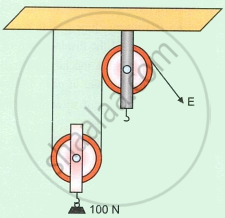
- Mark the direction of force due to tension.
- What is the purpose of the fixed pulley?
- If T is the tension in newtons, what is the relation between T and E?
- Calculate VR of the system.
- Assuming efficiency is 100%, what is the mechanical advantage?
- Calculate the effort E.
The diagram alongside shows a single pulley system when a load of 20 kgf is attached to it.
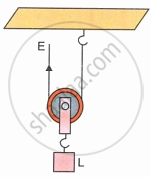
- What is the velocity ratio of the pulley system?
- What is the mechanical advantage of the pulley system?
- What is the magnitude of effort applied?
- If the pulley is not ideal and is 80% efficient, calculate the effort applied.
Practice Problems 2:
Diagram alongside shows a pulley system when a load of 30 kgf is attached to a movable block.
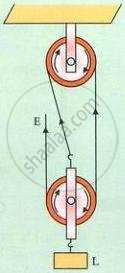
- What is the velocity ratio of pulley system?
- What is the mechanical advantage of pulley system assuming it is ideal?
- What is the magnitude of effort applied?
- If the pulley system is not ideal and is 60% efficient, what is the effort required?
A pulley system has five pulleys in all, 2 in the movable block and three in fixed block, such that effort is applied in the upward direction and a load of 60 kgf is attached to the movable block.
- What is the velocity ratio of pulley system?
- Assuming pulley system an ideal one, what is the mechanical advantage?
- What is the magnitude of effort applied?
- If the pulley system is not ideal but is 75% efficient, what is the effort required?
A pulley system with velocity ratio 6 is used to lift a load 180 kgf through a vertical height of 30 m. The effort required to do so is 50 kgf which is applied in downward direction. Calculate:
- Distance through which effort is applied
- Work done by the effort
- Mechanical advantage of pulley system
- Efficiency of the pulley system
- Total number of pulleys in movable and fixed block.
(Take g = 10 Nkg−1)
Practice Problems 3:
A pulley system with velocity ratio 4 is used to lift a load of 100 kgf through a vertical height of 15 m. The effort required to do so is 40 kgf which is applied in the downward direction. Calculate:
- Distance through which effort is applied
- Work done by the effort
- Mechanical advantage of pulley system
- Efficiency of pulley system
- Number of pulleys in the upper and lower block.
(Take g = 10 Nkg−1)
A pulley system with velocity ratio 3 is used to lift a load of 60 kgf through a height of 20 m. The force is applied in upward direction and its magnitude is 25 kgf. Calculate:
- Distance through which effort is applied
- Work done by the effort
- Mechanical advantage of pulley system
- Efficiency of pulley system
- Total number of pulleys in the fixed and movable block.
(Take g = 10 Nkg−1)
Goyal Brothers Prakashan solutions for A New Approach to ICSE Physics [English] Class 10 3 Machines COMPETENCY-FOCUSED PRACTICE QUESTIONS RELEASED BY CISCE [Pages 62 - 63]
During his experiments with a single movable pulley, Jas determined the effort, mechanical advantage and efficiency as X, Y and Z, respectively. Subsequently, after lubricating the pulley thoroughly, he recalculated the effort, MA and efficiency. X', Y' and Z' respectively. Which of the following relationships accurately represents the scenario?
X' > X
Y' < Y
Z' > Z
Z' = Z
The diagrams show four pulley systems. State which of the statements following the diagrams is true.
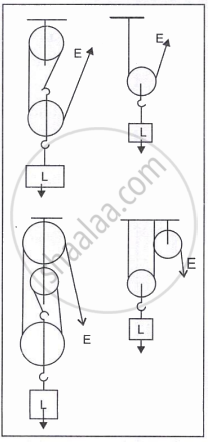
There are three pulley systems with V.R. = 2 and one pulley system with V.R. = 1.
There are two pulley systems with V.R. = 2, one pulley system with V.R. = 3 and one pulley system with V.R. = 1.
There are two pulley systems with V.R. = 2, one pulley system with V.R.= 3 and one pulley system with V.R. = 4.
There are two pulley systems with V.R. = 2 and two pulley system with V.R. = 3.
The graph shows load against effort for a lever with load and effort on the same side of the fulcrum.
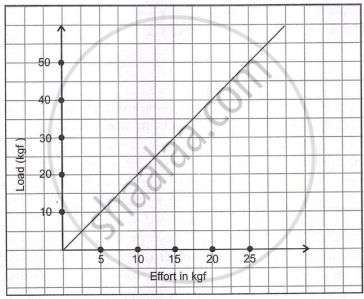
- Which feature of the load and effort graph must be calculated to determine mechanical advantage?
- Which class does this lever belong to?
Match the columns by choosing the body part and corresponding mechanical lever of the same class.
| Human body part | Mechanical lever |
|---|---|
| i. Nodding head | (a) Bottle Opener |
| ii. Lifting body weight on your toes. | (b) Tongs |
| (c) See-Saw |
The diagram shows a pulley used to lift an iron beam of length 3 m and weight 100 kgf, lying on the ground.
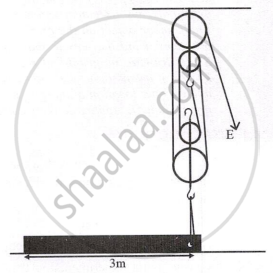
- Calculate the minimum effort needed to just lift the beam off the ground. [Assume no loss of energy]
- When the beam is being lifted from the ground, with the other end touching the ground, state with a reason whether the effort needed keeps on increasing, decreasing or remains constant.
Solutions for 3: Machines
Goyal Brothers Prakashan solutions for A New Approach to ICSE Physics [English] Class 10 chapter 3 - Machines
Shaalaa.com has the CISCE Mathematics A New Approach to ICSE Physics [English] Class 10 CISCE solutions in a manner that help students grasp basic concepts better and faster. The detailed, step-by-step solutions will help you understand the concepts better and clarify any confusion. Goyal Brothers Prakashan solutions for Mathematics A New Approach to ICSE Physics [English] Class 10 CISCE 3 (Machines) include all questions with answers and detailed explanations. This will clear students' doubts about questions and improve their application skills while preparing for board exams.
Further, we at Shaalaa.com provide such solutions so students can prepare for written exams. Goyal Brothers Prakashan textbook solutions can be a core help for self-study and provide excellent self-help guidance for students.
Concepts covered in A New Approach to ICSE Physics [English] Class 10 chapter 3 Machines are Concept of Machines, Levers, Technical Terms Related to a Machine, Principle of a Machine, Types of Levers, Single Fixed Pulley, Combination of Pulleys, A Single Movable Pulley, Using one fixed pulley and other movable pulleys, Using several pulleys in two blocks (block and tackle system), Pulley, Efficiency, Mechanical Advantage, and Velocity Ratio, Single Pulley vs Single Movable Pulley.
Using Goyal Brothers Prakashan A New Approach to ICSE Physics [English] Class 10 solutions Machines exercise by students is an easy way to prepare for the exams, as they involve solutions arranged chapter-wise and also page-wise. The questions involved in Goyal Brothers Prakashan Solutions are essential questions that can be asked in the final exam. Maximum CISCE A New Approach to ICSE Physics [English] Class 10 students prefer Goyal Brothers Prakashan Textbook Solutions to score more in exams.
Get the free view of Chapter 3, Machines A New Approach to ICSE Physics [English] Class 10 additional questions for Mathematics A New Approach to ICSE Physics [English] Class 10 CISCE, and you can use Shaalaa.com to keep it handy for your exam preparation.
