Advertisements
Advertisements
Question
Explain why the mechanical advantage of the class III type of lever is always less than 1.
Advertisements
Solution
In these types of levers, the effort is in between the fulcrum F and the load L and so the effort arm is always smaller than the load arm. Therefore M.A. < 1.
APPEARS IN
RELATED QUESTIONS
Which class of lever has the mechanical advantage always more than 1? Give an example.
Give one example of a class I lever in a case where the mechanical advantage is equal to 1?
Name the class to which the following lever belong:
A pair of scissors
The diagram given below shows the three kinds of levers. Name the class of lever and give one example of the class.
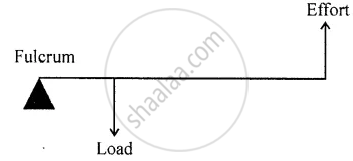
A lever of length 100 cm has the effort of 15 kgf at a distance of 40 cm from the fulcrum at one end. What load can be applied at its other end?
Answer the following in a word or two or in a sentence.
Which type of machine is used to squeeze a lemon?
What is the use of the lever if its mechanical advantage is
- more than 1,
- equal to 1, and
- less than 1?
Which type of lever has a mechanical advantage always more than one? Give one example. What change can be made in this lever to increase its mechanical advantage?
Classify the following into levers:
A fishing rod
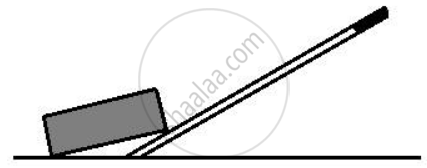
The diagram below shows a rod lifting a stone.
- Mark position of fulcrum F and draw arrows to show the directions of load L and effort E.
- What class of lever is the rod?
- Give one more example of the same class of lever stated in part (b).