Advertisements
Advertisements
Question
A lever of length 100 cm has the effort of 15 kgf at a distance of 40 cm from the fulcrum at one end. What load can be applied at its other end?
Advertisements
Solution
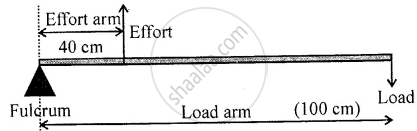
Given,
Effort = 15 kgf
Load arm = 100 cm
Effort arm = 40 cm
Mechanical advantage = `"Effort arm "/"Load arm" = 40 /100 = 0.4`
By definition,
Mechanical advantage =`"Load"/"Effort"`
∴ 0.4 = `"Load"/"15 kgf"`
⇒ Load = 15 kgf × 0.4
∴ Load = 6 kgf
APPEARS IN
RELATED QUESTIONS
What do you mean by the mechanical advantage of a lever?
Name the class to which the following lever belong:
a lemon squeezer
Name the class to which the following lever belong:
a nutcracker
Name the class to which the following levers belong:
a pair of pliers
Draw diagram to illustrate the position of fulcrum, load, and effort, of the following:
a nutcracker
Tick the most appropriate answer.
Which of the following is a Class II lever?
Give one example of a class I lever where mechanical advantage is less than 1.
What is the use of the lever if its mechanical advantage is
- more than 1,
- equal to 1, and
- less than 1?
Both a pair of scissors and a pair of pliers belong to the same class of levers. Name the class of lever. Which one has the mechanical advantage less than 1?
Classify the following into levers:
A fishing rod
