Advertisements
Advertisements
प्रश्न
A lever of length 100 cm has the effort of 15 kgf at a distance of 40 cm from the fulcrum at one end. What load can be applied at its other end?
Advertisements
उत्तर
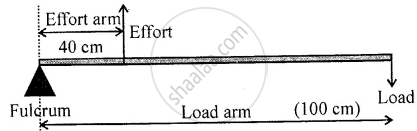
Given,
Effort = 15 kgf
Load arm = 100 cm
Effort arm = 40 cm
Mechanical advantage = `"Effort arm "/"Load arm" = 40 /100 = 0.4`
By definition,
Mechanical advantage =`"Load"/"Effort"`
∴ 0.4 = `"Load"/"15 kgf"`
⇒ Load = 15 kgf × 0.4
∴ Load = 6 kgf
APPEARS IN
संबंधित प्रश्न
Name the class to which the following lever belong:
A pair of scissors
Name the class to which the following lever belong:
a beam balance
Name the class to which the following lever belong:
a see-saw
Draw diagram to illustrate the position of fulcrum, load, and effort, of the following:
a pair of forceps
How does the friction at the fulcrum affect the mechanical advantage of the lever?
Answer the following.
Name the simplest of all types of machines.
Explain why scissors for cutting cloth may have blades longer than the handles, but shears for cutting metals have short blades and long handles.
Explain why the mechanical advantage of the class III type of lever is always less than 1.
Lemon juicer belongs to which type of lever? Why?
second-order lever ______.
