Advertisements
Advertisements
प्रश्न
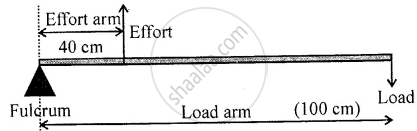
A lever of length 100 cm has the effort of 15 kgf at a distance of 40 cm from the fulcrum at one end. What load can be applied at its other end?
Advertisements
उत्तर
Given,
Effort = 15 kgf
Load arm = 100 cm
Effort arm = 40 cm
Mechanical advantage = `"Effort arm "/"Load arm" = 40 /100 = 0.4`
By definition,
Mechanical advantage =`"Load"/"Effort"`
∴ 0.4 = `"Load"/"15 kgf"`
⇒ Load = 15 kgf × 0.4
∴ Load = 6 kgf
APPEARS IN
संबंधित प्रश्न
Describe three orders of levers giving an example of each. Draw neat diagrams showing the positions of fulcrum, load, and effort in each kind of lever.
Name the class to which the following lever belong:
a wheelbarrow
State three differences between the three classes of levers.
Name the machine to which the following belong:
Beam balance
Tick the most appropriate answer.
Which of the following is a Class II lever?
Answer the following in a word or two or in a sentence.
Given an example of a Class I lever.
Answer the following in short.
What is the basis of the classification of levers?
Answer the following in short.
Using a suitable example, describe how a machine acts as a force multiplier.
Classify the following into levers:
A catapult
Classify the following into levers:
Sugar tongs
