Advertisements
Advertisements
Question
What is the use of the lever if its mechanical advantage is
- more than 1,
- equal to 1, and
- less than 1?
Advertisements
Solution
- When the mechanical advantage is greater than 1, the lever serves as a force multiplier, enabling us to overcome a sizeable resistive force with a small effort.
- When the mechanical advantage is equal to 1, the lever is applied in a physical balance with equal lengths of both arms.
- When the mechanical advantage is less than 1, the levers are used to obtain the gain in speed. This implies that the load-displacement is greater than the displacement of effort.
APPEARS IN
RELATED QUESTIONS
State whether the following statement is True or False.
All levers are force multipliers.
Which class of lever has the mechanical advantage always less than 1? Give an example.
Give one example of a class I lever in a case where the mechanical advantage is less than 1?
Name the class to which the following lever belong:
A pair of scissors
Draw diagram to illustrate the position of fulcrum, load, and effort, of the following:
a pair of forceps
Name the three classes of levers and state how are they distinguished. Give two examples of each class.
Both a pair of scissors and a pair of pliers belong to the same class of levers. Name the class of lever. Which one has the mechanical advantage less than 1?
Which type of lever has a mechanical advantage always more than one? Give one example. What change can be made in this lever to increase its mechanical advantage?
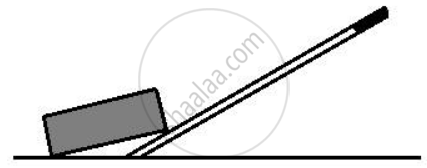
The diagram below shows a rod lifting a stone.
- Mark position of fulcrum F and draw arrows to show the directions of load L and effort E.
- What class of lever is the rod?
- Give one more example of the same class of lever stated in part (b).
Classify the things below.
| Sl. No | Examples | Class of Lever |
| 1. | Spade | |
| 2. | Seesaw | |
| 3. | Wheel barrow | |
| 4. | Plier | |
| 5. | Nail cutter |
