Advertisements
Advertisements
Question
Answer the following.
What is a Class I lever?
Advertisements
Solution
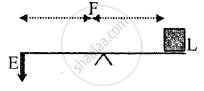
In Class I levers (also called levers of first order), the fulcrum lies between the load and the effort, i.e., the load and the effort are on the opposite sides of the fulcrum.
Examples: See-saw, pairs of scissors, pliers, beam balance, etc.
The mechanical advantage of a Class I lever is always greater than one. These levers act as force multipliers.
APPEARS IN
RELATED QUESTIONS
What is a lever?
Give one example of a class I lever where the mechanical advantage is more than 1.
Name the class to which the following lever belong:
a nutcracker
Draw diagram to illustrate the position of fulcrum, load, and effort, of the following:
a see-saw.
Tick the most appropriate answer.
A pair of scissors is an example of a/an
Explain why the mechanical advantage of a class II of lever is always more than 1.
Draw a labelled diagram of a class II lever. Give one example of such a lever.
Class III levers have mechanical advantage less than one. Why are they then used?
second-order lever ______.
Classify the following into levers:
Sugar tongs
