Advertisements
Advertisements
Question
The graph shows load against effort for a lever with load and effort on the same side of the fulcrum.
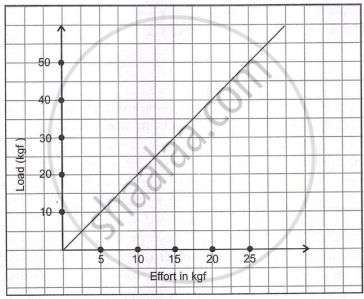
- Which feature of the load and effort graph must be calculated to determine mechanical advantage?
- Which class does this lever belong to?
Short Answer
Advertisements
Solution
(a) The gradient (slope) of the load–effort graph must be calculated to determine the mechanical advantage.
Mechanical Advantage \[=\frac{\text{Load}}{\text{Effort}}\]
From the graph:
M.A. = \[\frac{20}{10}\] = 2
So, mechanical advantage is 2.
(b) Since the load and effort act on the same side of the fulcrum, and the mechanical advantage is greater than 1, the lever is a second-class lever. In a second-class lever, the load lies between the fulcrum and the effort, which allows a smaller effort to overcome a larger load.
shaalaa.com
Is there an error in this question or solution?
