Advertisements
Advertisements
Question
Study the diagram alongside and answer the following questions.
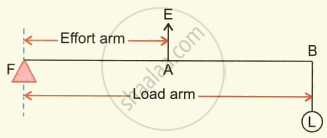
- What kind of lever is shown in diagram?
- Derive ideal mechanical advantage of this lever.
- Give two examples of this lever.
Very Long Answer
Advertisements
Solution
a. It is a Class III lever (or third-order lever).
The effort (E) is located in the middle, between the fulcrum (F) and the load (L).
b. According to the Principle of Levers:
Load (L) × Load Arm (FB) = Effort (E) × Effort Arm (FA)
\[ \frac{L}{E} = \frac{FA}{FB} \]
Since Mechanical Advantage (M.A.) is defined as \[ \frac{\text{Load}}{\text{Effort}} \]:
\[ \text{Ideal M.A.} = \frac{\text{Effort Arm } ({FA})}{\text{Load Arm } ({FB})} \]
Here, the Effort Arm is always shorter than the Load Arm, so its M.A. is always less than 1.
c. Two examples are forceps and a fishing rod.
shaalaa.com
Is there an error in this question or solution?
