Advertisements
Advertisements
Question
The alongside figure shows the combination of a movable pulley P1 with a fixed pulley P2 used for lifting up a load W.

(i) State the function of the fixed pulley P2.
(ii) If the free end of the string moves through a distance x, find the distance by which the load W is raised.
(iii) Calculate the force to be applied at C to just raise the load W = 20 kgf, neglecting the weight of the pulley P1 and friction.
Advertisements
Solution
(i) It is quite difficult to apply effort in the upward direction if no fixed pulley P2 is used. The fixed pulley changes the direction of effort from upwards to downwards, making the application of the effort more convenient and easier.
(ii) As the movable pulley doubles the effort,
∴ Force, L = 2T
i.e., W = 2T
Mechanical advantage M.A. =`(2"T")/"T"=2`
and V.R. =`("Distance travelled by effort")/("Distance travelled by load")=(2"x")/"x"=2`
The distance travelled by load is half the distance moved by effort = x / 2.
(iii) Since W = 2T or 20 kgf = 2T Here, T = effort
∴ Effort applied =`20/2` = 10 kgf.
APPEARS IN
RELATED QUESTIONS
A boy uses a single fixed pulley to lift a load of 50 kgf to some height. Another boy uses a single movable pulley to lift the same load to the same height. Compare the effort applied by them. Give a reason to support your answer.
The pulley system has drawn lifts a load of 150 N when an effort of 60 N is applied. Find its mechanical advantage.
What is the justification for using the pulley then ?
State if the following statement is true or false. Correct the statement if it is false.
A single movable pulley is a pulley that has its axis of rotation fixed.
Explain the working of a gear system.
(a) Fig represents an incomplete diagram of a simple string pulley system. Copy this diagram on a new page and complete it and mark where the effort must be applied to lift the load.
(b) What is the velocity ratio of this system?
(c) If the pulley system is 80% efficient and the load is 720 N, then
(i) What effort must be applied to lift the load?
(ii) What work must be done must be done in lifting the load through a distance of 2 m using this machine?
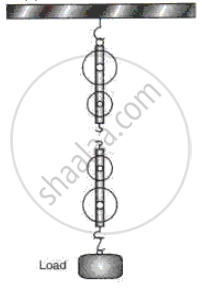
In the case of a block and tackle arrangement, the mechanical advantage increases with the number of pulleys. Explain.
What is the relation between the mechanical advantage and the number of strands of string used to support the load, in a ‘block and tackle’ set-up?
The pulley system shown in the figure is to be used to lift a load W. If the man applying the effort cannot apply a force exceeding 1000 N, what is the maximum load that can be lifted?
The actual load that the man is finally able to lift turns out to be 2700 N. What are the values of the actual M.A., obtained, and the efficiency of the actual set-up?
A pulley is a machine made up of a ______.
