Advertisements
Advertisements
Question
Answer the following in short.
Explain the various functions that a machine can perform.
Advertisements
Solution
Various functions that a machine can perform are :
- Changing the direction of applied force − Example: When a flag is hoisted with the help of a pulley.
- Changing the magnitude of applied force − Example: Bottle opener multiplies the applied force and much less effort is required to open the cap.
- Applying force at a convenient point − Example: hi a pair of scissors, the input force is applied at the handle of the scissors which cuts the paper at the other end of the blade.
- Changing the speed of an object − Example: While riding a bicycle, force is applied on pedals which multiplies the speed.
APPEARS IN
RELATED QUESTIONS
A pulley system has three pulleys. A load of 120 N is overcome by applying an effort of 50 N. Calculate the Mechanical Advantage and Efficiency of this system.
Explain how a gear system can be used to obtain Change in direction of rotation. Given one example.
Define the following term in reference to a gear system for Gain in torque ?
The diagram below shows a pulley arrangement.
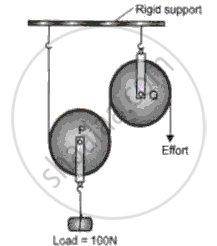
(i) In the diagram, mark the direction of the forces due to tension, acting on the pulley P.
(ii) What is the purpose of the pulley Q?
(iii) If the tension is T newton, deduce the relation between T and E.
(iv) Calculate the velocity ratio of the arrangement.
(v) Assuming that the efficiency of the system is 100%, what is the mechanical advantage?
(vi) Calculate the value of E
Give reason for the following:
The efficiency of a pulley is always less than 100%
A type of single pulley is very often used as a machine even though it does not give any gain in mechanical advantage. Name the type of pulley used.
What is a block and tackle system of pulleys? What precautions would you observe while rounding the string so that the effort is applied in the downward direction?
Draw a diagram showing a block and tackle system of 4 pulleys.

(i) State, how many strands of tackle support the load?
(ii) Draw arrows to represent tension in each strand.
(iii) Find the mechanical advantage of the system, stating the assumptions made.
(iv) If the load is pulled up by a distance 1m, how much does the effort end move?
A block and tackle system of pulleys has a velocity ratio of 4.
- Draw a labelled diagram of the system indicating clearly the points of application and directions of load and effort.
- What is the value of the mechanical advantage of the given pulley system if it is an ideal pulley system?
Diagram given below shows an arrangement of four pulleys. A load L is attached to the movable lower block and effort E is applied at the free end of the string.
Copy the diagram; and

(i) Draw arrows to indicate tension in each part of the string; and
(ii) Calculate the mechanical advantage of the system.
