Advertisements
Advertisements
Question
The diagram below shows a pulley arrangement.
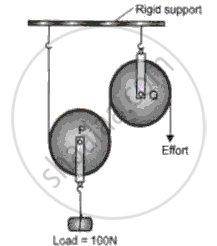
(i) In the diagram, mark the direction of the forces due to tension, acting on the pulley P.
(ii) What is the purpose of the pulley Q?
(iii) If the tension is T newton, deduce the relation between T and E.
(iv) Calculate the velocity ratio of the arrangement.
(v) Assuming that the efficiency of the system is 100%, what is the mechanical advantage?
(vi) Calculate the value of E
Advertisements
Solution
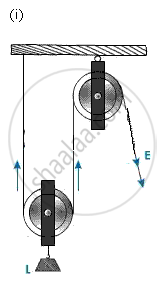
(ii) The purpose of the pulley Q is to change the direction of application of effort to a convenient direction.
(iii) In the diagram, T = E
(iv) If the free end of the string moves, through the distance x, the load will rise by a distance x/2.
Threfore, V.R = distance moved y the effort arm / distance moved by the load = `"x"/("x"//2) = 2`
(v) In equilibrium,L = 2T and E = T
efficiency = M.A / V. R
or, 1 = `("M ""A")/2`
⇒ M.A = 2
(vi) M.A = `"L"/"E"`
⇒ E = `"L"/("M"."A") = 100/2` = 50 N
APPEARS IN
RELATED QUESTIONS
A block and tackle system has V.R. = 5.
Draw a neat labeled diagram of a system indicating the direction of its load and effort.
The pulley system has drawn lifts a load of 150 N when an effort of 60 N is applied. Find its mechanical advantage.
Explain how a gear system can be used to obtain gain in torque? Given one example.
Explain how a gear system can be used to obtain Change in direction of rotation. Given one example.
Define the following term in reference to a gear system of Driving gear ?
The diagram below shows a pulley arrangement :
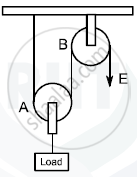
(i) Copy the diagram and mark the direction of tension on each strand of the string.
(ii) What is the velocity ratio of the arrangement ?
(iii) If the tension acting on the string is T, then what is the relationship between T and effort E ?
(iv) If the free end of the string moves through distance x, find the distance by which the load is raised.
What is a block and tackle system of pulleys?
In the alongside the figure of two pulleys shown a system in which one pulley is fixed and the other is movable. What is the velocity ratio of the system?
An effort of 600 N is needed to lift a weight of 1000 N. What are the mechanical advantage and efficiency of the pulley system?
Diagram given below shows an arrangement of four pulleys. A load L is attached to the movable lower block and effort E is applied at the free end of the string.
Copy the diagram; and

(i) Draw arrows to indicate tension in each part of the string; and
(ii) Calculate the mechanical advantage of the system.
If the weight of the movable pulley is W, obtain the expression for MA, VR, and efficiency.
