Advertisements
Advertisements
Question
Differentiate between a single fixed pulley and a single movable pulley.
Advertisements
Solution
| Single fixed pulley | Single movable pulley |
| 1. It is fixed to a rigid support. | 1. It is not fixed to a rigid support |
| 2. Its mechanical advantage is one . | 2. Its mechanical advantage is two. |
| 3. Its velocity ratio is one. | 3. Its velocity ratio is two. |
| 4. The weight of pulley itself does not affect its mechanical advantage. | 4. The weight of pulley itself reduces its mechanical advantage. |
| 5. It is used to change the direction of effort | 5. It is used as force multiplie |
RELATED QUESTIONS
From the diagram given below. answer the question that follows:
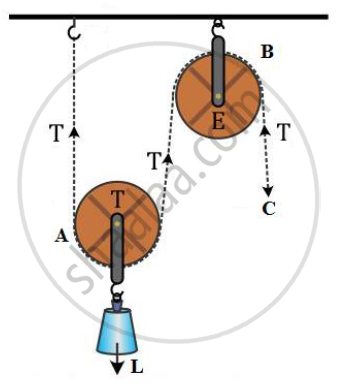
- What kind of pulleys are A and B?
- State the purpose of pulley B.
- What effort has to be applied at C just raise the load L = 20 kgf?
(Neglect the weight of pulley A and friction)
Fill in the blank:
A pulley is used to change ........................
What is the mechanical advantage of an ideal pulley?
The mechanical advantage of an actual pulley is less than one. Give a reason. What is the justification for using the pulley then?
Explain how a gear system can be used to obtain Change in direction of rotation. Given one example.
Write two uses of pulleys. Is pulley a force multiplier?
What is a pulley?
The pulley system shown in the figure is to be used to lift a load W. If the man applying the effort cannot apply a force exceeding 1000 N, what is the maximum load that can be lifted?
The actual load that the man is finally able to lift turns out to be 2700 N. What are the values of the actual M.A., obtained, and the efficiency of the actual set-up?
Diagram given below shows an arrangement of four pulleys. A load L is attached to the movable lower block and effort E is applied at the free end of the string.
Copy the diagram; and

(i) Draw arrows to indicate tension in each part of the string; and
(ii) Calculate the mechanical advantage of the system.
Complete the table.
| S. No | Types of Simple Machine | Example |
| 1. | Pulley | |
| 2. | Wheel and axle | |
| 3. | Wedge | |
| 4. | Inclined plan | |
| 5. | Lever | |
| 6. | Screw |
