Advertisements
Advertisements
प्रश्न
The alongside figure shows the combination of a movable pulley P1 with a fixed pulley P2 used for lifting up a load W.

(i) State the function of the fixed pulley P2.
(ii) If the free end of the string moves through a distance x, find the distance by which the load W is raised.
(iii) Calculate the force to be applied at C to just raise the load W = 20 kgf, neglecting the weight of the pulley P1 and friction.
Advertisements
उत्तर
(i) It is quite difficult to apply effort in the upward direction if no fixed pulley P2 is used. The fixed pulley changes the direction of effort from upwards to downwards, making the application of the effort more convenient and easier.
(ii) As the movable pulley doubles the effort,
∴ Force, L = 2T
i.e., W = 2T
Mechanical advantage M.A. =`(2"T")/"T"=2`
and V.R. =`("Distance travelled by effort")/("Distance travelled by load")=(2"x")/"x"=2`
The distance travelled by load is half the distance moved by effort = x / 2.
(iii) Since W = 2T or 20 kgf = 2T Here, T = effort
∴ Effort applied =`20/2` = 10 kgf.
APPEARS IN
संबंधित प्रश्न
The mechanical advantage of an actual pulley is less than one. Give a reason. What is the justification for using the pulley then?
In which direction does the force need to applied, when a single pulley is used with a mechanical advantage greater than one? How can you change the direction of force applied without altering its mechanical advantage? Draw a labelled diagram of the system.
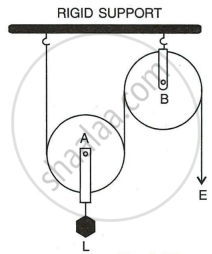
The diagram below shows a pulley arrangement.
- Name the pulleys A and B.
- In the diagram, mark the direction of tension on each strand of string.
- What is the purpose of the pulley B?
- If the tension is T, deduce the relation between
- T and E, and
- E and L.
- What is the velocity ratio of the arrangement?
- Assuming that the efficiency of the system is 100%, what is the mechanical advantage?
The diagram below shows an arrangement of three pulleys A, B, and C. The load is marked as L and the effort as E.
- Name the Pulleys A, B, and C.
- Mark in the diagram the directions of load (L), effort (E) and tension T1 and T2 in the two strings.
- How are the magnitudes of L and E related to the tension T1?
- Calculate the mechanical advantage and velocity ratio of the arrangement.
- What assumptions have you made in parts (c) and (d)?

A block and tackle pulley system has a velocity ratio 5. Draw a labelled diagram of this system. In your diagram, indicate clearly the points of application and the directions of the load and effort.
There is no gain in mechanical advantage in the case of a single fixed pulley. Explain, why the pulley is then used?
In the case of a block and tackle arrangement, the mechanical advantage increases with the number of pulleys. Explain.
State two reasons, why the efficiency of a pulley system is not 100 percent?
A pulley is a machine made up of a ______.
