Advertisements
Advertisements
प्रश्न
The diagram below shows an arrangement of three pulleys A, B, and C. The load is marked as L and the effort as E.
- Name the Pulleys A, B, and C.
- Mark in the diagram the directions of load (L), effort (E) and tension T1 and T2 in the two strings.
- How are the magnitudes of L and E related to the tension T1?
- Calculate the mechanical advantage and velocity ratio of the arrangement.
- What assumptions have you made in parts (c) and (d)?

Advertisements
उत्तर
(a) Pulleys A and B are movable pulleys. Pulley C is a fixed pulley.
(b)
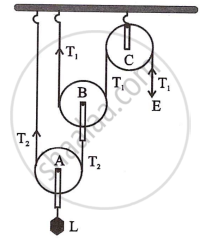
(c) L = 4T1; E = T1
(d) M.A. = `L/E`
M.A. = `(4T_1)/T_1`
M.A. = 4
V.R. = `(4d)/d = 4`
(e)
- There is less weight on pulleys A and B.
- There's no friction at all between the axle and the pulleys.
APPEARS IN
संबंधित प्रश्न
Select the correct alternative:
A pulley is used because of it
What is the mechanical advantage of an ideal pulley?
Draw a neat labelled diagram showing a pulley being used to lift a load. How are load and effort related in an ideal situation?
Define the following term in reference to a gear system of Driving gear ?
Define the following term in reference to a gear system for Driven gear ?
What should be the gear ration of a car : equal to 1, less than 1 or greater than 1, while ascending a hill ?
Give reason for the following:
In case of a block and tackle arrangement, the mechanical advantage increases with the increase in the number of pulleys.
In the case of a block and tackle arrangement, the mechanical advantage increases with the number of pulleys. Explain.
A man raises a load of 360 kgf using a block and tackle system of 3 pulleys. If the efficiency of the pulley system is 60%, what effort is applied by the man?
A pulley is a machine made up of a ______.
