Advertisements
Advertisements
Question
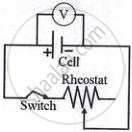
Observe the electric circuit and answer the questions that follow.
- If we increase the current in the above circuit using a rheostat, will the reading of the voltmeter decrease or increase?
- Give a reason for your answer in 'a'.
- The present reading of the voltmeter is 2V, and the current in the circuit is 0.8A.
Calculate the potential drop when the current in the circuit becomes 1 A. Given E = 3V.
Advertisements
Solution
(a) The reading of the voltmeter will decrease.
(b) The voltmeter measures the terminal voltage (\(V\)) across the cell, which is given by the formula:
\(V=E-Ir\)
Where \(E\) is the electromotive force (e.m.f.) and \(Ir\) is the internal potential drop across the cell's internal resistance (\(r\)). When the rheostat's resistance is reduced, the circuit current (\(I\)) increases. As \(I\) increases, the internal potential drop (\(Ir\)) also increases, which causes the terminal voltage (\(V\)) to decrease.
(c) Given:
Initial terminal voltage (\(V_{1}\)) = \(2\text{ V}\)
Initial current (\(I_{1}\)) = \(0.8\text{ A}\)
Cell e.m.f. (\(E\)) = \(3\text{ V}\)
1. Find the internal resistance (r) of the cell
\(V_{1}=E-I_{1}r\)
\(2=3-0.8r\)
\(0.8r=3-2\)
\(0.8r=1\)
r = `1/0.8`
r = 1.25 Ω
2. Calculate the potential drop when the current (\I2) becomes 1 A
Potential Drop = I2 × r
= 1 A × 1.25 Ω
= 1.25 V
